
CME impact causes minor increase in geomagnetic activity
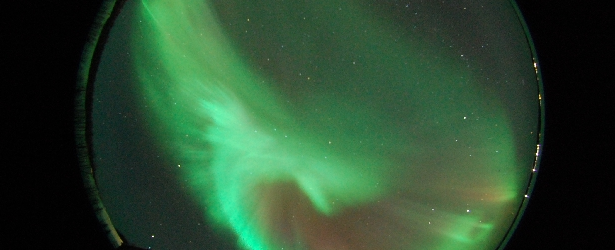
Image credit: Yann Hollander at Porjus, Swedish Lapland (via SpaceWeather)
A geomagnetic sudden impulse, indicating the arrival of the March 23 CME, was observed at the Hartland magnetometer (23 nT) at 20:09 UTC on March 25.
The geomagnetic field is expected to be at unsettled to active levels (below G1-Minor) early on March 26 as CME effects continue. A return to mostly quiet conditions is expected on March 27 and 28 as CME effects wane.
Geomagnetic K-index of 4 threshold was reached at 01:42 UTC on March 26:
Space Weather Message Code: ALTK04
Serial Number: 1699
Issue Time: 2014 Mar 26 0149 UTCALERT: Geomagnetic K-index of 4
Threshold Reached: 2014 Mar 26 0142 UTC
Synoptic Period: 0000-0300 UTCActive Warning: Yes
NOAA Space Weather Scale descriptions can be found at www.swpc.noaa.gov/NOAAscales
Potential Impacts: Area of impact primarily poleward of 65 degrees Geomagnetic Latitude.
Induced Currents – Weak power grid fluctuations can occur.
Aurora – Aurora may be visible at high latitudes such as Canada and Alaska.
The impact, although weak, sparked nice aurora show. The following image was taken by Yann Hollander at Porjus, Swedish Lapland:
We had to wait 3 hours after the impact of the CME and finally at 00:00 the sky exploded above Porjus in Swedish Lapland. Best I have seen since 15 January due to clouds at crucial moments.

Image credit: Yann Hollander at Porjus, Swedish Lapland (via SpaceWeather)
Solar wind conditions are expected to continue under the influence of the CME today before returning to nominal conditions on March 27 – 28.
NOAA SWPC forecasters estimate 35% chance of M-class, and 1% chance of X-class solar flares in next three days.

Teo Blašković founded The Watchers in 2011 and edited it until 2026, covering seismic and volcanic activity, extreme weather, space weather and near-Earth objects. Articles on this page are his archive.
Earlier reporting
Nothing on Watchers was published in the last 24 hours. These are older articles.
- G1 geomagnetic storm watch remains in effect as NOAA forecasts Kp 4.67 late on November 17 and early on November 18
- On October 22, 2017, a single flash of lightning stretched 515 miles from eastern Texas to near Kansas City, a distance that takes eight hours to drive, and nobody realized how far it had gone until scientists went back through the satellite data years later Epicenter
- CPC posts a slight risk of heavy rain from the Gulf Coast to the Northeast urban corridor November 25-29, and a moderate risk of West Coast wind and Sierra snow on November 25
- Florida's east coast faces a moderate flash flood risk Wednesday through Friday, with 4 to 8 inches of rain forecast and the St. Johns River near Cocoa already in major flood at 17.13 feet
