
Geomagnetic storm still in progress (June 2, 2013)
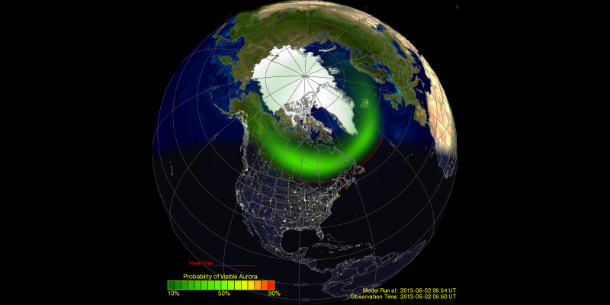
Featured image: North Pole aurora forecast map on June 2, 2013 (Credit: NOAA/SWPC/OVATION)
The arrival of an interplanetary shock wave on May 31, 2013 caused geomagnetic storming that reached G2 (Moderate) geomagnetic storm levels on NOAA/SWPC storm scale during June 1, 2013. The solar wind speed remains elevated above 650 km/s. Currently, geomagnetic conditions are at G1 (Minor) geomagnetic storm level on NOAA/SWPC storm scale. Solar winds blow above 700 km/s and IMF is tipping south.

Estimated planetary K index levels from May 31 to June 2, 2013 (Credit: NOAA/SWPC)
At G2 (Moderate) geomagnetic storming levels high-latitude power systems may experience voltage alarms and long-duration storms may cause transformer damage. Spacecraft operations may required corrective actions to orientation by ground control and some changes are possible in drag affect orbit predictions. HF radio propagation can fade at higher latitudes, and aurora has been seen as low as New York and Idaho.
At G1 (Minor) geomagnetic storm level weak power grid fluctuations can occur and minor impact on satellite operations is possible. Migratory animals are affected at this and higher levels. Aurora is commonly visible at high latitudes (northern Michigan and Maine)
The source of the shock is probably due a disappearing filament or it was caused by corotating interaction region (CIR) or a shock-like transition zone between high- and low-speed solar wind streams. The impact sparked beautiful auroras around polar circles.

Northern lights seen from Nebraska on June 1, 2013 (Credit; Mark Watson via SpaceWeather.com Gallery)
Purple and green auroras were reported as far south as Colorado and Nebraska, US. Wonderful auroras were also sighted around polar regions in southern hemisphere.

Aurora australis seen from Tasmania (above) and from New Zealand (bellow) on June 1, 2013 (Credit: John Oxley, Koen Broekema/via SpaceWeather.com Gallery)
High-latitude sky watchers should remain alert for auroras as Earth's magnetic field continues to reverberate from the impact. NOAA/SWPC forecasters estimate 35% chance of active geomagnetic storm levels in the next 24 hours.

Aurora forecast maps (Credit: NOAA/OVATION)
CURRENT CONDITIONS (05:15 UTC – June 2, 2013)
Solar wind
speed: 722.2 km/sec
density: 1.7 protons/cm3
The Radio Sun
10.7 cm flux: 104 sfu
Planetary K-index
Now: Kp= 5 storm
24-hr max: Kp= 6 storm
Interplanetary Mag. Field
Btotal: 4.6 nT
Bz: 3.8 nT south

Earlier reporting
Nothing on Watchers was published in the last 24 hours. These are older articles.
- G1 geomagnetic storm watch remains in effect as NOAA forecasts Kp 4.67 late on November 17 and early on November 18
- On October 22, 2017, a single flash of lightning stretched 515 miles from eastern Texas to near Kansas City, a distance that takes eight hours to drive, and nobody realized how far it had gone until scientists went back through the satellite data years later Epicenter
- CPC posts a slight risk of heavy rain from the Gulf Coast to the Northeast urban corridor November 25-29, and a moderate risk of West Coast wind and Sierra snow on November 25
- Florida's east coast faces a moderate flash flood risk Wednesday through Friday, with 4 to 8 inches of rain forecast and the St. Johns River near Cocoa already in major flood at 17.13 feet
