
Asteroid 2003 QQ47 to safely fly by Earth on March 26, 2014
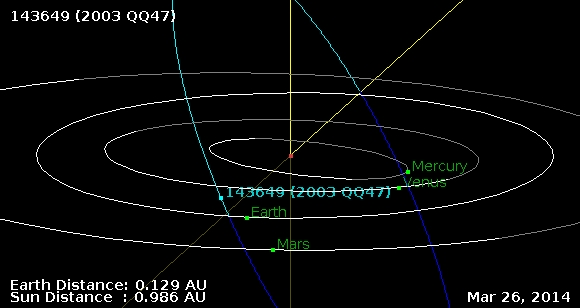
Image credit: NASA JPL
Asteroid 2003 QQ47 received quite a bit of media attention back in 2003 when it was discovered because it was said that it had a small chance of colliding with our planet in the year 2014.
It was rated a "1" on the Torino impact hazard scale of 1 – 10. The odds of collision in 2014, as estimated by JPL's Sentry impact monitoring system, peaked at 1 chance in 250 000, a result which was posted on JPL's Impact Risk Page on Saturday, August 30, 2003. On September 2, new measurements of QQ47's position allowed scientists to narrow their prediction of its path in 2014, and thus the Earth impact was ruled out. (JPL)
There are still people who think this asteroid will hit our planet on March 21, 2014 but we are actually 19 million kilometers away from the impact. Much of this latest public attention and panic was caused by misleading Daily Mail article… Phil Plait aka Bad Astronomer did a good job explaining it here.

[ Ephemeris | Orbit Diagram | Orbital Elements | Physical Parameters | Discovery Circumstances | Close-Approach Data ]
According to JPLs close-approach data for asteroid 2003 QQ47, at 12:36 UTC on March 26, 2014 it will safely fly by Earth at a minimum distance of roughly 19 million kilometers (~12 million miles / 0.128 AU) with a relative velocity of 32.41 km/s.
According to Phil Plait, its size isn’t well known, but it’s something like 800 to 2 000 meters (0.5 – 1.2 miles) in diameter. Its orbit around the Sun is roughly the same size as Earth’s but tipped by more than 60°, which is fairly unusual.
The Virtual Telescope Project will offer a live, online event sharing real-time images of 2003 QQ47 with live commentary by their scientific staff.
The online, free session is scheduled for March 26, 2014, starting at 19:30 UTC.

Teo Blašković founded The Watchers in 2011 and edited it until 2026, covering seismic and volcanic activity, extreme weather, space weather and near-Earth objects. Articles on this page are his archive.
Published in the last 24 hours
- Asteroid 2026 WJ to pass Earth at 1.7 lunar distances at 04:20 UTC on November 22, with 2026 WD following at 4.4 lunar distances on November 23
- High Risk of excessive rainfall covers Florida’s Space Coast as St. Johns River near Cocoa reaches 5.67 m
- Cyclone Akvan crossed the north Andhra Pradesh and south Odisha coasts close to Gopalpur on November 20 with 70-80 km/h winds gusting to 90, and has weakened into a deep depression
- A broad low over southeastern Florida and the northwestern Bahamas has a 30 percent chance of subtropical or tropical development within 48 hours and a 50 percent chance within 7 days, the National Hurricane Center says

Commenting rules and guidelines
We value the thoughts and opinions of our readers and welcome healthy discussions on our website. In order to maintain a respectful and positive community, we ask that all commenters follow these rules.