
Typhoon Lekima aims northern Mariana Islands
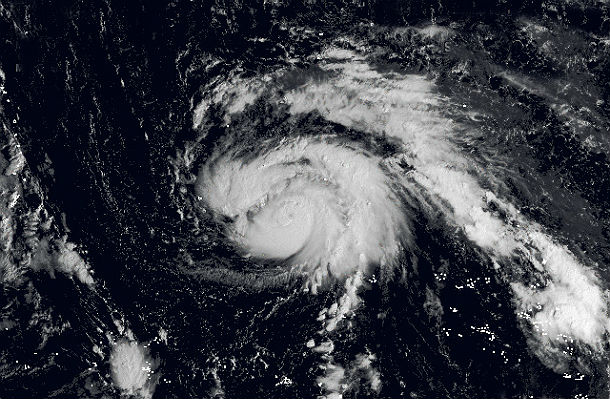
Image credit: NASA/Blue Marble base map
Typhoon Lekima is developing east of Guam and west of Wake Island as the 28th tropical disturbance and the easternmost named tropical system in the 2013 Western Pacific season. Lekima is expected to stay away from major landmasses as it tracks west and then north west. This system will bring heavy rainfall to the northern Mariana islands and the outlying islands of Japan, including Iwo To.
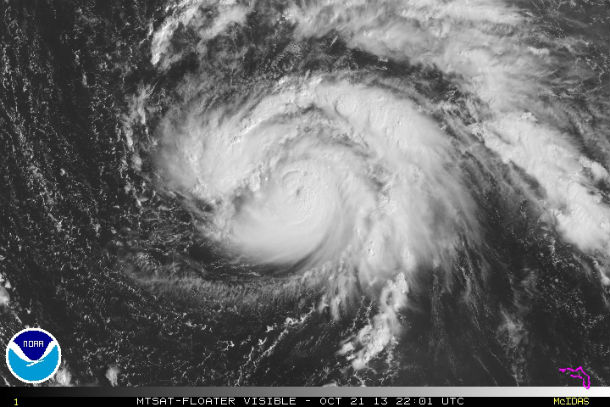
MTSAT visible satellite image of Typhoon Lekima taken at 22:01 UTC on October 21, 2013 (Credit: NOAA/MTSAT)
According to latest report by Joint Typhoon Warning Center (JTWC), the center of Typhoon Lekima is located approximately 827 nm east of Andersen AFB, Guam. The system is moving northwestward at speed of 11 knots (20 km/h, 12,5 mph). Maximum sustained winds are 80 knots (148 km/h, 92 mph) with gusts up to 100 knots (185 km/h, 115 mph).

Typhoon Lekima forecast track (Credit: JTWC)
Relatively low vertical wind shear and good equatorward outflow, in addition to the perennially warm sea surface temperatures in the area will ensure gradual intensification. Lekima's maximum sustained winds are expected to peak near 115 knots (213 km/h,132.3 mph) by October 24 as it continues to move over open waters of the Northwestern Pacific. Lekima is forecast to approach Iwo To on October 24, and then turn to the northeast away from the island.
There is a chance that Lekima meets Typhoon Francisco north of Japan and two systems could merge into one large extra-tropical system.
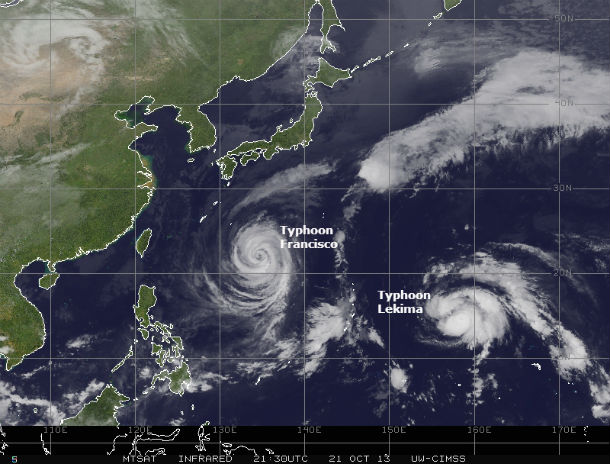
Francisco and Lekima on MTSAT Infrared satellite image taken at 21:30 UTC on October 21, 2013 (Credit: NOAA/UW-CIMSS)
Satellite Animations
- Storm-Centered Infrared (MTSAT2; NOAA/SSD)
- Storm-Centered Infrared (Aviation Color Enhancement) (MTSAT2; NOAA/SSD)
- Storm-Centered Water Vapor (MTSAT2; NOAA/SSD)
- Storm-Centered Visible (MTSAT2; NOAA/SSD)
- Storm-Centered Visible (Colorized) (MTSAT2; NOAA/SSD)
- Tropical West Pacific Infrared (MTSAT2; NOAA)
- Tropical West Pacific Enhanced Infrared (MTSAT2; NOAA)
- Tropical West Pacific Water Vapor (MTSAT2; NOAA)
- Tropical West Pacific Visible (MTSAT2; NOAA)

Published in the last 24 hours
- Cyclone Akvan weakens after landfall near Gopalpur; more than 300 000 evacuated in Odisha, India
- Male toads abandoned a pond in Italy five days before a deadly 2009 earthquake, while a scientist was counting them Epicenter
- An asteroid was spotted 19 hours before it exploded over Sudan in 2008, and students picked its pieces off the desert Epicenter
- A wave up to 3 m (10 feet) high rose out of Lake Michigan on a sunny June morning in 1954 and swept fishermen off Chicago’s piers, and when a second came 10 days later, warnings had cleared the shore Epicenter
