
Major, Earth directed and long duration X1.4 solar flare erupted from Sunspot 1520
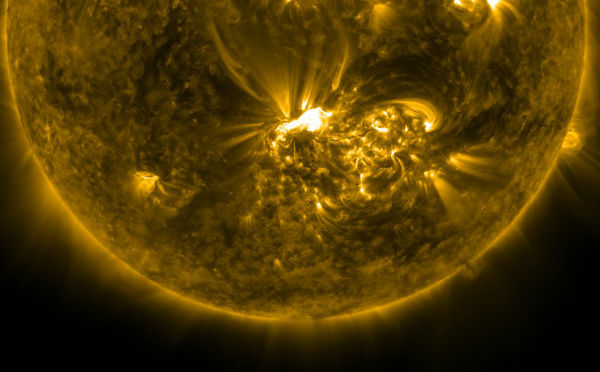
Image credit: TW
A major and long duration solar flare peaked at 16:52 UTC on July 12, 2012. The source of this solar flare is Region 1520. A Type II and IV Sweep frequency events were recorded. Strong R3 radio blackout on the sunlit side of the Earth was recorded. This solar flare produced Earth directed bright Coronal Mass Ejection (CME)!
SUMMARY: 10cm Radio Burst
Begin Time: 2012 Jul 12 1614 UTC
Maximum Time: 2012 Jul 12 1653 UTC
End Time: 2012 Jul 12 1705 UTC
Duration: 51 minutes
Peak Flux: 800 sfu
Description: A 10cm radio burst indicates that the electromagnetic burst associated with a solar flare at the 10cm wavelength was double or greater than the initial 10cm radio background. This can be indicative of significant radio noise in association with a solar flare. This noise is generally short-lived but can cause interference for sensitive receivers including radar, GPS, and satellite communications.
ALERT: Type IV Radio Emission
Begin Time: 2012 Jul 12 1615 UTC
Description: Type IV emissions occur in association with major eruptions on the sun and are typically associated with strong coronal mass ejections and solar radiation storms.
ALERT: Type II Radio Emission
Begin Time: 2012 Jul 12 1625 UTC
Estimated Velocity: 1268 km/s
Description: Type II emissions occur in association with eruptions on the sun and typically indicate a coronal mass ejection is associated with a flare event.


Follow Sun’s activity in real time – SWS!

Teo Blašković founded The Watchers in 2011 and edited it until 2026, covering seismic and volcanic activity, extreme weather, space weather and near-Earth objects. Articles on this page are his archive.
Earlier reporting
Nothing on Watchers was published in the last 24 hours. These are older articles.
- On October 22, 2017, a single flash of lightning stretched 515 miles from eastern Texas to near Kansas City, a distance that takes eight hours to drive, and nobody realized how far it had gone until scientists went back through the satellite data years later Epicenter
- CPC posts a slight risk of heavy rain from the Gulf Coast to the Northeast urban corridor November 25-29, and a moderate risk of West Coast wind and Sierra snow on November 25
- Florida's east coast faces a moderate flash flood risk Wednesday through Friday, with 4 to 8 inches of rain forecast and the St. Johns River near Cocoa already in major flood at 17.13 feet
- Cyclone Akvan to make landfall between Nellore and Visakhapatnam around noon on November 20, IMD forecasts 120-130 km/h winds gusting to 145

[…] https://watchers.news/2012/07/12/major-earth-directed-and-long-duration-x1-4-solar-flare-… Share this:EmailFacebookTwitterLinkedInLike this:LikeBe the first to like this. « NASA – There is a fifth moon orbiting Pluto […]