
Guatemalan stratovolcano Fuego erupted again
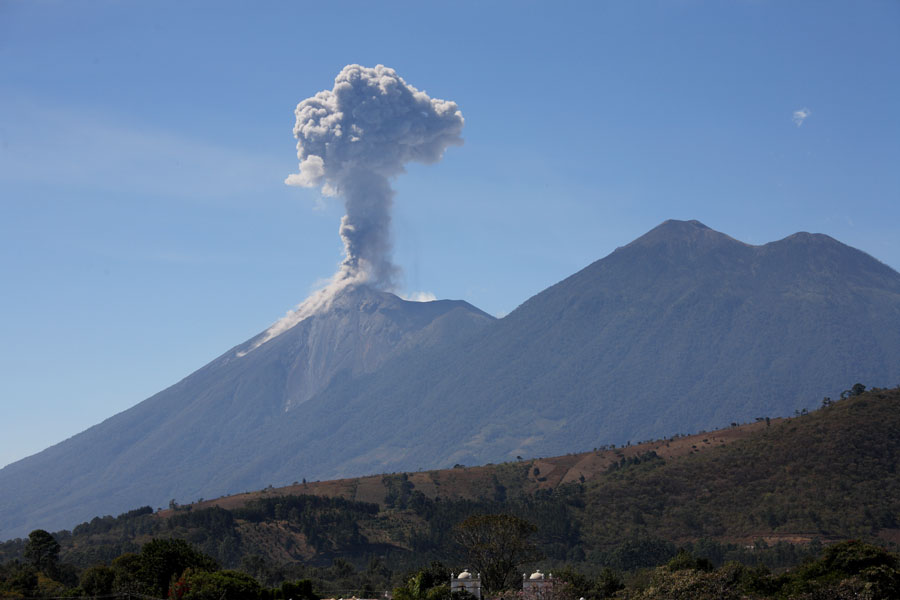
Featured image: Fuego eruption December, 2007 - Credit: www.photovolcanica.com
Guatemalan stratovolcano Fuego erupted again on Sunday, June 10, 2012 and spewed a column of ash up to a kilometer (about 3,300 feet) high.
The National Vulcanology Institute said in a communique that the volcano, which rises 3,763 meters (12,230 feet) above sea level, on Sunday erupted effusively, according to seismic recordings and the images received from a camera at the observatory at Panimache.

The vulcanology institute warned that although the eruption presently consists of an effusion of lava, the possibility exists that in the coming hours the volcano’s activity will increase to a pyroclastic flow of the kind experienced on May 19 and May 25.
A pyroclastic flow is a fast-moving current of superheated gas, which can reach temperatures of about 1,000 C (1,830 F), and rock, which reaches speeds moving away from a volcano of up to 700 km/h (450 mph). The flow normally hugs the ground and travels downhill, or spreads laterally under gravity, and is quite devastating to virtually anything in its path.
Civilian air traffic is being warned to take precautions because the ash cloud extends up to 10 kilometers (6.2 miles) from the volcano.
Fuego is one of Central America’s most active volcanoes, and is one of three large stratovolcanoes overlooking Guatemala’s former capital, Antigua.
Sources: latino.foxnews.com, volcano.si.edu

Teo Blašković founded The Watchers in 2011 and edited it until 2026, covering seismic and volcanic activity, extreme weather, space weather and near-Earth objects. Articles on this page are his archive.
Published in the last 24 hours
- High Risk of excessive rainfall covers Florida’s Space Coast as St. Johns River near Cocoa reaches 5.67 m
- Four small asteroids will pass close to Earth from November 21 to 23
- Cyclone Akvan weakens after landfall near Gopalpur; more than 300 000 evacuated in Odisha, India
- A broad low over southeastern Florida and the northwestern Bahamas has a 30 percent chance of subtropical or tropical development within 48 hours and a 50 percent chance within 7 days, the National Hurricane Center says
