
Geomagnetic storm subsiding, expecting more CMEs
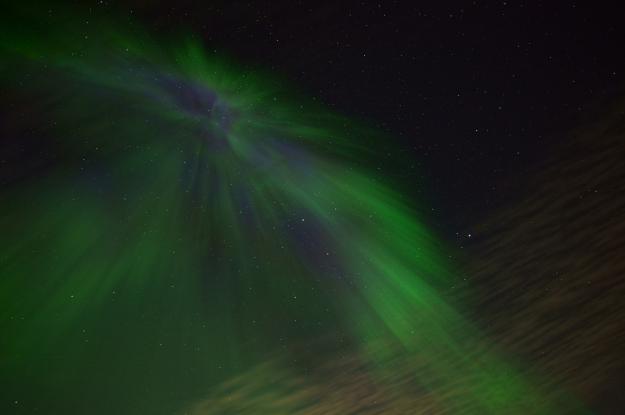
Image credit: TW
The first of several CMEs en route to Earth struck our planet’s magnetic field on Sept. 9th around 1130UT. The impact sparked a strong (Kp=7) geomagnetic storm, which is now subsiding. Last night Northern Lights were spotted in the United States as far south as Washington, Wisconsin, Michigan,Vermont, Montana, Maine and North Dakota. More geomagnetic activity could be in the offing as one or two more CMEs approach. (SpaceWeather)
Solar wind
speed: 555.8 km/sec
density: 0.7 protons/cm3
The Radio Sun
10.7 cm flux: 112 sfu
Planetary K-index
Now: Kp= 3 quiet
24-hr max: Kp= 5 storm
 A short lived moderate geomagnetic storm took place on Friday due to a incoming CME shock just after 11:00 UTC. Minor storm levels did persist overnight and Aurora was spotted in northern parts of Canada.
Just before 14:00 UTC Saturday, the solar wind jumped from 460 km/s to 520 km/s. Keep an eye on the ACE Spacecraft data for any further increases that may contribute to minor geomagnetic activity. (SolarHam)
NOAA Scales Activity |
||
|
Range 1 (minor) to 5 (extreme)
|
||
|
NOAA Scale
|
||
| Geomagnetic Storms * |
 |
 |
| Solar Radiation Storms |
 |
 |
| Radio Blackouts |
 |
 |
Alerts / Bulletins
Latest Alert: Sep 10 2242 UTC ALERT: Geomagnetic K-index of 5
Last Advisory Bulletin: Sep 06 2344 UTC: Strong Radio Blackout Event

The Farside of the Sun has been very active and late Thursday night a large Solar Flare triggered a bright Coronal Mass Ejection. I created a movie below showing the Flare and CME. This was most likely an X-Class event.

Published in the last 24 hours
- High Risk of excessive rainfall covers Florida’s Space Coast as St. Johns River near Cocoa reaches 5.67 m
- Asteroid 2026 WJ to pass Earth at 1.7 lunar distances at 04:20 UTC on November 22, with 2026 WD following at 4.4 lunar distances on November 23
- Cyclone Akvan crossed the north Andhra Pradesh and south Odisha coasts close to Gopalpur on November 20 with 70-80 km/h winds gusting to 90, and has weakened into a deep depression
- A broad low over southeastern Florida and the northwestern Bahamas has a 30 percent chance of subtropical or tropical development within 48 hours and a 50 percent chance within 7 days, the National Hurricane Center says



