• Rare weather alert issued for Seattle, Portland, Vancouver and Salem

    The Storm Prediction Center (SPC) has issued a rare level 2 out of 5, or Slight Risk, for severe thunderstorms across parts of the Pacific Northwest from March 26 to 27, potentially impacting over 7.2 million people in major cities such as Seattle, Portland, and Vancouver. The threats include hail in excess of 2.5 cm (1 inch), wind gusts over 93 km/h (58 mph), and possible isolated tornadoes.

  • Ice storm warnings and winter weather advisories issued across Oregon

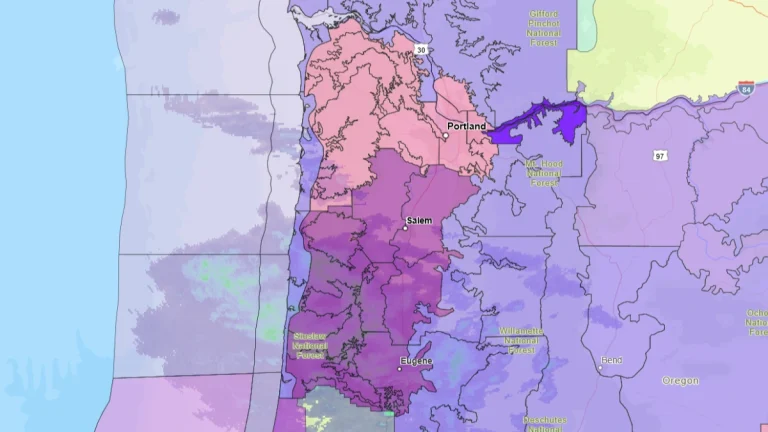
    An Ice Storm Warning has been issued for the Central and Southern Willamette Valley, the Central Oregon Coast Range Lowlands, and the Central Oregon Coast Range as winter storms bring hazardous conditions to the region. The warning will be in effect from 01:00 local time (LT) on February 13 to 04:00 LT on February 14, with significant ice and snow accumulation expected.

  • Massive underground aquifer discovered beneath Oregon’s Cascade Range

    Scientists from the University of Oregon have discovered a vast underground aquifer beneath Oregon’s Cascade Range, storing at least 81 km3 (19.4 mi3) of water — almost three times the maximum capacity of Lake Mead. The research detailing the findings was published on January 13, 2025, reshaping the understanding of the region’s water resources and volcanic hazards.

  • Family of atmospheric rivers to bring heavy rain, flood, and snow to the U.S. West Coast

    A series of atmospheric rivers (ARs) is forecast to bring heavy precipitation, flooding risks, and winter storm impacts to the U.S. West Coast this week, with the first AR making landfall on Tuesday, December 17, 2024.  The fourth and fifth ARs are forecast to make landfall on December 21 and 22. Up to 500 mm (20 inches) of rain expected in some areas and significant streamflow rises in western Washington and Oregon.

  • Four dead across U.S. West Coast as atmospheric river brings record rains and 20 landslides in California

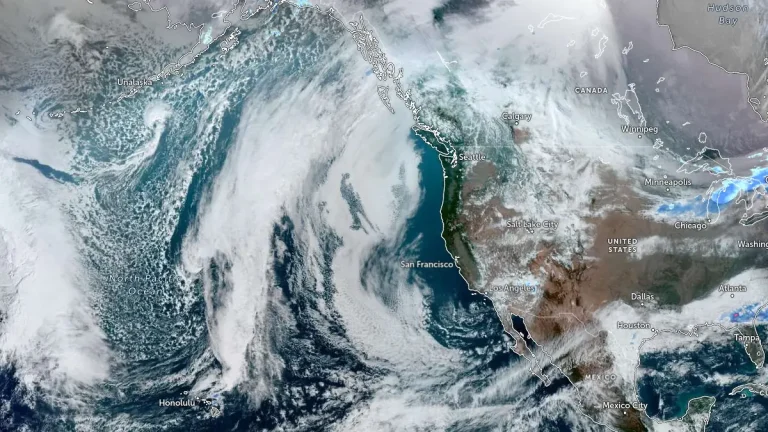
    The strongest atmospheric river of the season, driven by a bomb cyclone with a central pressure of 945 hPa, ravaged the U.S. West Coast on Wednesday, November 20, 2024, bringing unprecedented rainfall, flooding, and wind damage. Northern California bore the brunt of the storm, with 543.4 mm (21.39 inches) of rain recorded in Sonoma County and widespread flooding that stranded hundreds. Meanwhile, fierce winds of up to 206 km/h (128 mph) toppled trees and left communities without power.