
Wandering black hole with jets confirmed in a nearby dwarf galaxy, reshaping ideas of black hole growth
A wandering intermediate-mass black hole with jets was confirmed in the dwarf galaxy MaNGA 12772-12704, about 230 million light-years away, according to a study published in Science Bulletin on September 5, 2025.

This artist’s impression illustrates the mechanism that could be at the origin of the powerful bursts of X-ray light seen from a newly awakened black hole named Ansky. Credit: ESA
The traditional picture of galaxies places black holes in their centers, where abundant gas and stars fuel their growth. But this view is increasingly challenged.
Astronomers now know that some black holes wander away from the nucleus, either because of gravitational recoil after mergers or interactions with other massive objects. These “off-nuclear” or “wandering” black holes are difficult to confirm, especially in dwarf galaxies, which have shallow gravitational wells that make ejections more likely.
Numerical simulations predict that up to half of massive black holes in dwarf galaxies may be displaced by more than 1 kiloparsec (3 000 light-years) from their centers. Until recently, however, convincing observational examples were rare.
The case of MaNGA 12772-12704
An international team led by Tao An of the Shanghai Astronomical Observatory investigated the dwarf galaxy MaNGA 12772-12704, located about 230 million light-years away (redshift z = 0.017).
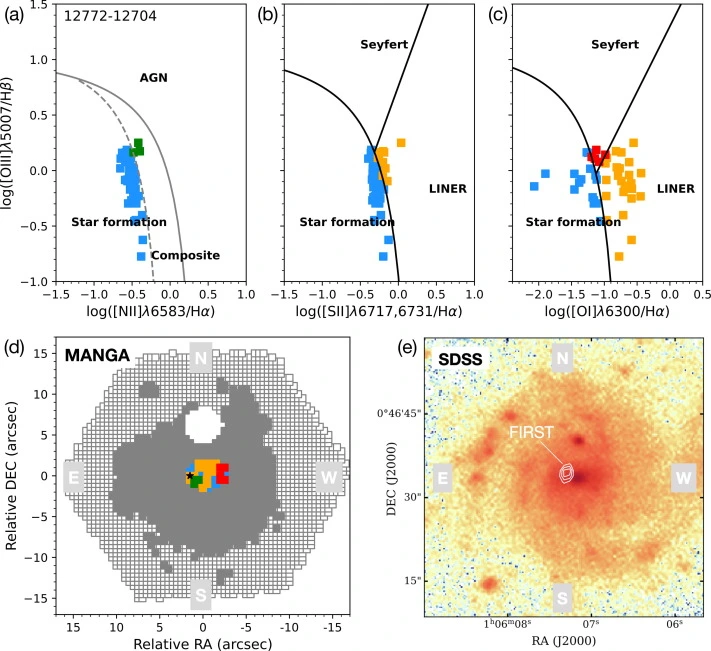
The galaxy’s optical morphology appears regular, with no signs of recent mergers or a double nucleus. Yet integral-field spectroscopy from the Mapping Nearby Galaxies at Apache Point Observatory (MaNGA) survey revealed weak active galactic nucleus (AGN) signatures not located at the geometric center.
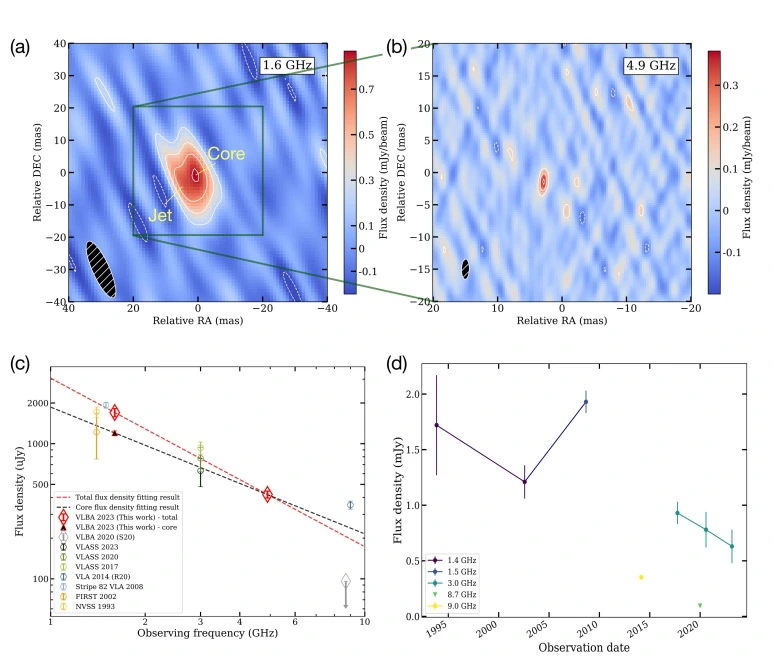
Radio observations were the key. Data from the Very Long Baseline Array (VLBA) at 1.6 and 4.9 GHz showed a compact radio core offset 2.68 arcseconds from the galaxy’s center, corresponding to 0.94 kiloparsec (3 000 light-years). The core’s brightness temperature exceeds one billion Kelvin, a clear indicator of AGN activity. At 1.6 GHz, the team also resolved a jet extending about 2.2 parsec (7.2 light-years) to the southeast.
A black hole proven by variability
To distinguish between a true black hole and possible impostors such as a supernova remnant, the researchers examined archival Very Large Array (VLA) data covering 1993–2023.
The source brightened and dimmed irregularly over decades, inconsistent with the monotonic fading expected of a supernova. Instead, the pattern fits ongoing accretion onto a black hole.
Based on the stellar mass of the host galaxy and established scaling relations, the black hole’s mass is estimated at about 300 000 times that of the Sun. This places it in the intermediate-mass black hole (IMBH) category — a population thought to bridge the gap between stellar-mass and supermassive black holes.
Why this case is unique
Among more than 3 000 dwarf galaxies surveyed by MaNGA, astronomers identified 628 AGN candidates. About 62% showed evidence of positional offsets between emission-line regions and optical centers.
However, candidates are not confirmations. From over 600 possible cases, Tao An’s team narrowed the list to 11 strong targets for VLBA observations. Only MaNGA 12772-12704 satisfied three independent criteria: a compact high-brightness core, a parsec-scale jet, and long-term variability.
That makes it the nearest and most convincing case of an accreting, off-nuclear black hole with jets in a dwarf galaxy.
Implications for black hole growth
The discovery shows that black hole growth is not restricted to galactic centers. An IMBH nearly a kiloparsec away from the nucleus can still sustain accretion and produce jets.
This supports the idea of “distributed feeding,” where black holes grow in multiple locations rather than only in the central reservoir. Such a pathway could help explain how supermassive black holes, with masses of billions of Suns, formed so quickly in the early universe by redshift 7.
The study also highlights feedback: even displaced black holes inject energy into surrounding gas through outflows, potentially regulating star formation and galactic evolution.
Looking ahead
The confirmed wandering black hole in MaNGA 12772-12704 may be only the beginning.
Next-generation facilities such as the Square Kilometre Array (SKA), the next-generation Very Large Array (ngVLA), and China’s FAST core array will have the sensitivity and resolution to detect fainter accreting IMBHs and resolve sub-parsec jets.
With systematic surveys, astronomers may find that wandering black holes are not rare outliers, but a hidden population shaping the dynamics of dwarf galaxies and contributing to the rapid growth of early-universe supermassive black holes.
References:
1 A jetted wandering massive black hole candidate in a dwarf galaxy – Yuanqi Liu, Tao An et al. – Science Direct – September 4, 2025 – https://doi.org/10.1016/j.scib.2025.09.001 – OPEN ACCESS
2 Wandering Black Hole in a Dwarf Galaxy – Shanghai Astronomical Observatory: Chinese Academy of Sciences – September 6, 2025

I’m a science journalist and researcher at The Watchers, contributing to the Epicenter edition, where I cover peer-reviewed scientific research and emerging discoveries across Earth and space sciences. With a background in astronomy and a passion for environmental science, I’ve worked in shark and coral conservation in Fiji, conducting reef and shark-behavior research, contributing to mangrove restoration, and earning PADI Open Water and Coral Reef Certifications. I bring a blend of scientific rigor and storytelling to illuminate the discoveries shaping our planet and beyond.

Commenting rules and guidelines
We value the thoughts and opinions of our readers and welcome healthy discussions on our website. In order to maintain a respectful and positive community, we ask that all commenters follow these rules.