
Venus’ clouds hold surprising amount of water
A reanalysis of NASA’s 1978 Pioneer Venus mission data, published on September 26, 2025, reveals that the planet’s clouds contain about 60% water bound in hydrated minerals, challenging decades of assumptions that they are made mostly of sulfuric acid.
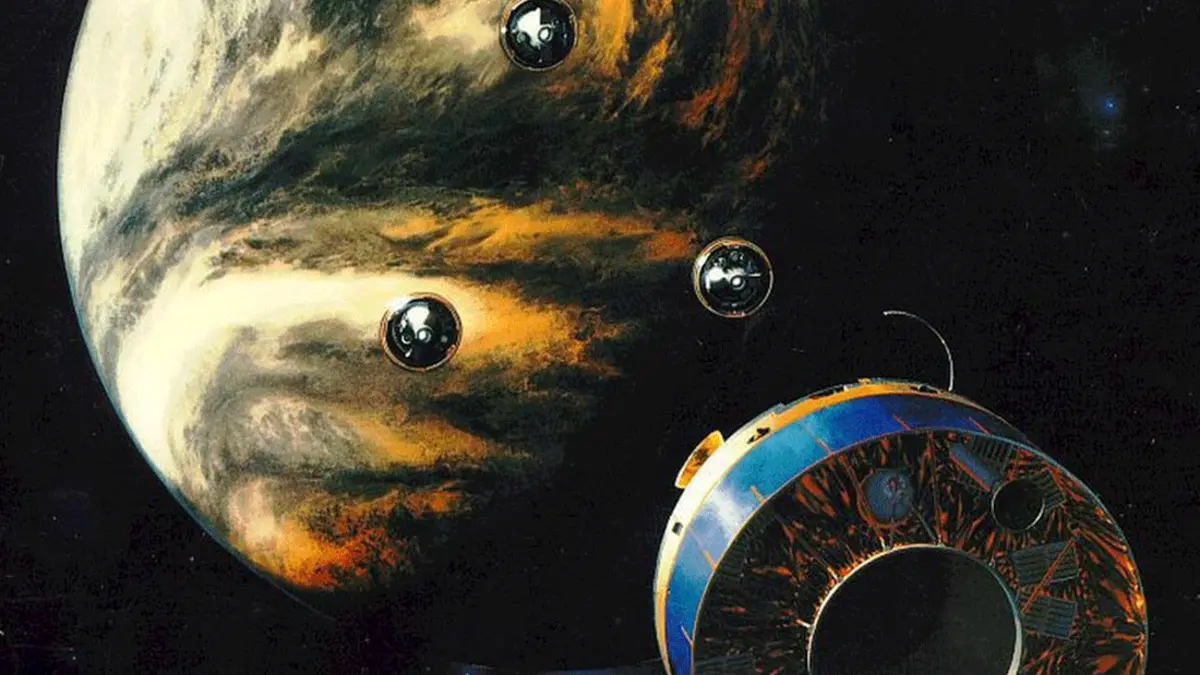
Depiction of the Pioneer probes descending to Venus' atmosphere. Credit: NASA
Venus has long been viewed as Earth’s fiery twin, cloaked in dense, acidic clouds. But a new study of NASA’s 1978 Pioneer Venus mission data paints a different picture. Scientists have found that up to 60% of Venus’ cloud material is water, most of it locked inside hydrated minerals instead of existing as liquid droplets.
The discovery challenges one of the longest-standing assumptions in planetary science. For decades, models of Venus’ atmosphere described its clouds as nearly pure sulfuric acid. The new results suggest that the composition is far richer and that water plays a key role in the planet’s chemical balance.
Researchers from California State Polytechnic University Pomona, the University of Wisconsin, Arizona State University, and NASA collaborated on the work. Their analysis reveals a Venusian atmosphere far more dynamic and varied than previous theories allowed.
Digging ancient data out of NASA’s archives
For nearly half a century, the Pioneer Venus Large Probe data sat on microfilm inside NASA’s Space Science Data Coordinated Archive. Before any analysis could begin, the scientists had to retrieve and digitize those fragile records from 1978.
The probe carried two key instruments, the Large Probe Neutral Mass Spectrometer and the Large Probe Gas Chromatograph, which were designed to sample gases during descent. As the spacecraft dropped through the thick cloud layers, roughly 55 to 48 km (34 to 30 miles) above the surface, its inlets clogged with aerosol particles.
What might once have been labeled a failure became a unique opportunity. The clogging effectively allowed the probe to trap real cloud material. As the descent continued, heat caused the aerosols to decompose, releasing gases that the instruments recorded.
By analyzing which gases emerged at what temperatures, researchers could reconstruct the composition of the particles. That unexpected turn transformed decades-old raw readings into a window on the chemistry of Venus’ sky.
The surprising mix inside Venus’ clouds
The reanalysis revealed strong water signals at about 185°C (365°F) and 414°C (777°F), matching the decomposition of hydrated minerals such as ferric sulfate and magnesium sulfate. Calculations indicate that water makes up roughly 62% of the cloud material, nearly triple previous estimates.
Sulfuric acid, long thought to dominate, represents only about 22% of the mixture. Around 215°C (419°F), sulfur dioxide appeared as the acid decomposed. Another release of sulfur dioxide near 397°C (747°F), accompanied by an iron spike, points to ferric sulfate breaking apart. That compound may account for about 16% of the aerosols.
The findings indicate that the clouds are not simple acid fogs, but rather complex mineral suspensions. Hydrated sulfates can trap large amounts of water, changing how the atmosphere stores and circulates hydrogen and oxygen.
Cosmic dust and Venus’ hidden water cycle
The study suggests that the iron detected likely comes from cosmic dust continuously falling into Venus’ atmosphere. When this dust reacts with sulfuric acid, it forms iron sulfate minerals that bind water molecules within their crystal structures.
Such reactions could explain how the clouds maintain significant water content despite the planet’s extreme heat of about 460°C (860°F) at the surface. The minerals effectively store water where vapor alone could not survive, creating a stable but chemically active cloud layer.
This mechanism also helps solve a long-standing puzzle. Remote spectrometers on orbiting spacecraft detect less water than probes that actually pass through the clouds. The reason is that orbiters sense only vapor, not water bound in solids, so they were seeing just part of the picture.
Rethinking habitability and planetary chemistry
For years, astrobiologists have speculated that the cooler upper atmosphere of Venus might harbor microbial life. Conditions there are milder, with pressures similar to those at sea level on Earth. The scarcity of water seemed to rule it out, but this new evidence suggests otherwise.
Even with abundant hydrates, the environment remains extremely acidic. Only certain microbes on Earth survive in similar conditions, such as those living near volcanic vents rich in sulfur compounds. Still, the presence of water in any form widens the window of chemical possibilities.
Beyond life, the discovery reshapes the understanding of Venus’ evolution. Hydrated minerals in the atmosphere point to ongoing exchange between the surface, the clouds, and incoming cosmic material. They reveal a planet still chemically active, not the static world many once imagined.
Old missions, new insights
The reanalysis shows the power of looking back with fresh tools. Pioneer Venus ended its work decades ago, yet its data continues to change planetary science. With modern computing and improved chemistry models, scientists can extract entirely new discoveries from vintage measurements.
NASA’s archives hold similar opportunities in data from missions such as Voyager, Galileo, and Cassini. Each could hide details that new analysis methods are now able to uncover. The challenge is to preserve and revisit these records before they fade from usability.
Venus’ newly revealed water-rich clouds prove that discovery does not always depend on new spacecraft. Sometimes it begins in forgotten reels of data waiting for scientists to ask different questions.
References:
1 Venus’ Clouds Are 60% Water, According To Reanalyzed Pioneer Data – Universe Today – October 1, 2025
2 Re-Analysis of Pioneer Venus Data: Water, Iron Sulfate, and Sulfuric Acid are Major Components in Venus’ Aerosols – R. Mogul et al. – September 26, 2025 – https://doi.org/10.1029/2024JE008582 – OPEN ACCESS

I’m a science journalist and researcher at The Watchers, contributing to the Epicenter edition, where I cover peer-reviewed scientific research and emerging discoveries across Earth and space sciences. With a background in astronomy and a passion for environmental science, I’ve worked in shark and coral conservation in Fiji, conducting reef and shark-behavior research, contributing to mangrove restoration, and earning PADI Open Water and Coral Reef Certifications. I bring a blend of scientific rigor and storytelling to illuminate the discoveries shaping our planet and beyond.

???? WHY are you promoting this guy’s (THREE) videos; this NOBODY guy??
There are researchers who have spent DECADES on most, if not ALL of ‘Our Planets’, that are 1,000,000 times MORE WORTHY that this NOBODY. Richard C. Hoagland, and all of his Associates, blow that NOBODY (and all like him) OUT of the Universe! The Body of Research that ‘Hoagland and Company’ has done, over the MANY DECADES, very few can hold a candle to!
Some NOBODY on YT with an ‘obsession’ with Venus. Really? REALLY?? LOLOLOLOL