
Universe’s expansion may already be slowing, new study suggests
A new analysis of more than 300 Type Ia supernovae by astronomers at Yonsei University, published on November 6, 2025, in Monthly Notices of the Royal Astronomical Society, finds evidence that the Universe’s expansion has already begun to slow — challenging the long-standing idea of an accelerating cosmos driven by dark energy.
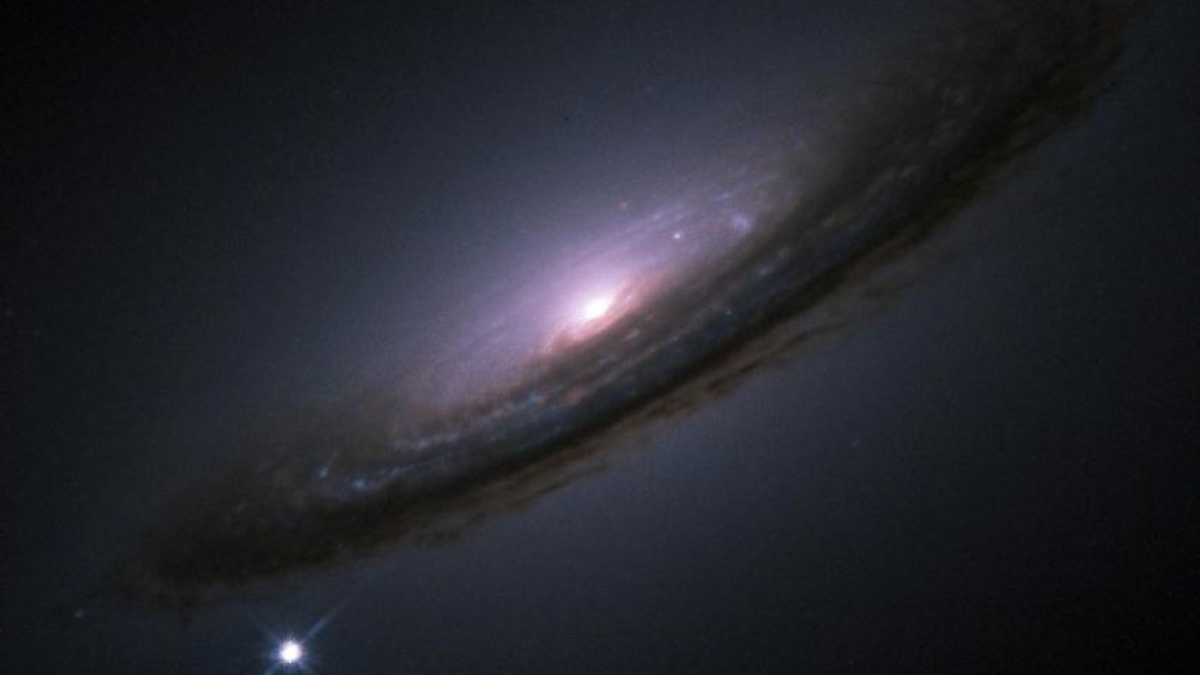
Researchers used type Ia supernovae, similar to SN1994d pictured in its host galaxy NGC4526, to help establish that the Universe’s expansion may actually have started to slow. Credit: NASA/ESA
The Universe, long thought to be racing apart faster and faster, might actually be easing off the throttle. A study published in Monthly Notices of the Royal Astronomical Society on November 6 reports that the cosmic expansion rate has already begun to slow. The results come from a team led by Professor Young-Wook Lee at Yonsei University in South Korea, who reexamined the very supernovae that formed the basis for the 2011 Nobel Prize in Physics.
Their conclusion is both striking and simple: when astronomers correct for the age of the stars that explode as Type Ia supernovae, the Universe no longer appears to be accelerating. Instead, it is gently decelerating today.
If confirmed, this finding would mark a major turning point in modern cosmology, rewriting the role of dark energy and potentially resolving the long-standing Hubble tension that divides early- and late-Universe measurements of expansion.
Lee and his colleagues describe the discovery as “remarkable.” It challenges the cosmological constant itself, the Λ in the ΛCDM model that has dominated for nearly three decades. The team suggests that dark energy is not constant but evolves, weakening over time. This conclusion touches the very core of modern physics: how the Universe changes on the largest scales and how the laws of nature may shift as cosmic time unfolds.
The research also reopens a question once thought settled—what if the acceleration discovered in 1998 was only temporary? If so, the Universe’s history may be more cyclical than linear, with alternating periods of acceleration and slowdown governed by evolving energy fields.
The Universe’s great deceleration moment
For a generation, the idea of an accelerating Universe has been nearly sacred. The Nobel-winning work of 1998 showed that distant Type Ia supernovae appeared dimmer than expected, leading astronomers to infer that the cosmos was expanding faster and faster. The Yonsei team, however, found a critical oversight in that reasoning. The brightness of a Type Ia supernova depends not only on its distance but also on the age of the stars that gave rise to it. Younger progenitor systems produce slightly dimmer explosions, while older systems shine more brightly.
This “progenitor age bias” was confirmed using a large sample of about 300 supernova host galaxies, each with measured stellar ages. When the researchers accounted for this effect, they discovered that much of the apparent dimming of distant supernovae could be attributed to stellar evolution rather than cosmic acceleration. The result changes how astronomers interpret redshift–luminosity data that have been used to map the history of expansion.
At higher redshifts, where the average stellar populations are younger by roughly five billion years, the effect produces an artificial dimming equivalent to about 0.15 magnitudes. That difference alone can flip the sign of the cosmic deceleration parameter, turning an accelerating Universe into a slowing one. The corrected Hubble diagram, which plots supernova brightness against redshift, no longer matches the classic ΛCDM curve. Instead, it aligns with a time-varying dark-energy model favored by results from the Dark Energy Spectroscopic Instrument (DESI) and cosmic microwave background (CMB) observations.
How Yonsei’s supernova rethink shakes cosmology
The correction arises from straightforward astrophysics. As the Universe ages, galaxies host progressively older stellar populations. Younger galaxies at higher redshift produce Type Ia supernovae from less-evolved binary systems, typically yielding fainter explosions even after luminosity standardization. Traditional calibration techniques remove brightness variations related to color and light-curve shape but assume those relationships are constant with time. The new study shows they are not.
When the team applied an age correction of 0.03 magnitudes per gigayear across the redshift range up to 0.45, the combined supernova data moved into perfect alignment with DESI’s BAO + CMB model. In this version of cosmic history, dark energy weakens and transitions toward a phase of decelerated expansion at the current epoch. The authors call this a “new cosmological concordance,” since the corrected supernovae, the sound-wave remnants of the Big Bang (BAO), and the oldest light in the Universe (CMB) all now agree.
DESI’s own results had hinted that dark energy’s influence might already be waning. The Yonsei correction pushes that idea further, suggesting the acceleration phase ended recently and that the cosmos is now slowing, even if imperceptibly to us. In this framework, the once-unified ΛCDM model might need to be replaced with a time-dependent w₀wₐCDM model where the equation-of-state parameter evolves.
This adjustment in perspective also forces scientists to reconsider the interplay between cosmic and stellar evolution. It demonstrates that local astrophysical details—like the age of exploding stars—can influence measurements that describe the entire Universe. The finding bridges galactic astrophysics and cosmology, showing that precision at small scales matters profoundly on the largest ones.
Dark energy reinterpreted: a fading cosmic force
If the findings hold, the very nature of dark energy must be reconsidered. Under the ΛCDM model, dark energy is represented by the cosmological constant Λ, an unchanging property of spacetime that exerts uniform repulsion everywhere. But the new analysis points to a variable equation-of-state parameter, w, which changes over time. After the correction, w rises from −1 toward −0.56, implying that dark energy’s strength is fading.
This would mean that cosmic acceleration is not permanent. Instead, the Universe could be entering a long, gentle slowdown as gravity gradually reasserts itself. At present, the deceleration parameter q₀ derived from the corrected data is slightly positive, indicating that expansion has already passed its peak rate.
Such a scenario could resolve multiple cosmological tensions at once. It would bring supernova distances, BAO measurements, and CMB data into harmony without invoking unknown physics or new particles. It could also explain why the Hubble constant, measured from local supernovae differs from that inferred from early-Universe observations.
The conceptual shift is subtle but profound: dark energy might not be a mysterious constant force at all, but a transient property of cosmic evolution that is losing influence as the Universe ages. This interpretation still fits general relativity but implies that the Universe’s fate could be far calmer than endless acceleration once predicted.
The Hubble tension and the case for cosmic slowdown
The Hubble tension remains one of astrophysics’ most stubborn problems. Local measurements based on Cepheid-calibrated Type Ia supernovae yield values of about 73 km/s/megaparsec (45 mi/s/per million light-years), while early-Universe estimates from the CMB are closer to 67 km/s/megaparsec (42 mi/s/per million light-years). The Yonsei team notes that this gap could arise partly from population mismatch. Local calibrators are mostly in young, star-forming galaxies, whereas the supernovae used for distant measurements occur in a mix of older systems.
If younger galaxies host slightly dimmer supernovae, then using them to calibrate the cosmic distance ladder introduces a small overestimate in the Hubble constant. Correcting for a two to three gigayear age difference between calibration and Hubble-flow samples could lower the value by roughly 3–4.5%. That adjustment alone could ease the discrepancy between early- and late-Universe results, suggesting that stellar evolution, not new physics, might explain much of the tension.
If so, the progenitor age bias could become one of the most significant hidden systematics ever uncovered in cosmology. It would also mean that future refinements to the Hubble constant will depend less on instrument precision and more on understanding stellar populations. Such insight links cosmic-scale measurement directly to the life cycles of stars.
The correction also reinforces the need to reexamine other distance indicators that assume constant stellar behavior over cosmic time. In the coming decade, astronomers may need to recalibrate not only supernova-based distances but also those derived from standard sirens and surface brightness fluctuations.
The next great test: Rubin Observatory and the decade ahead
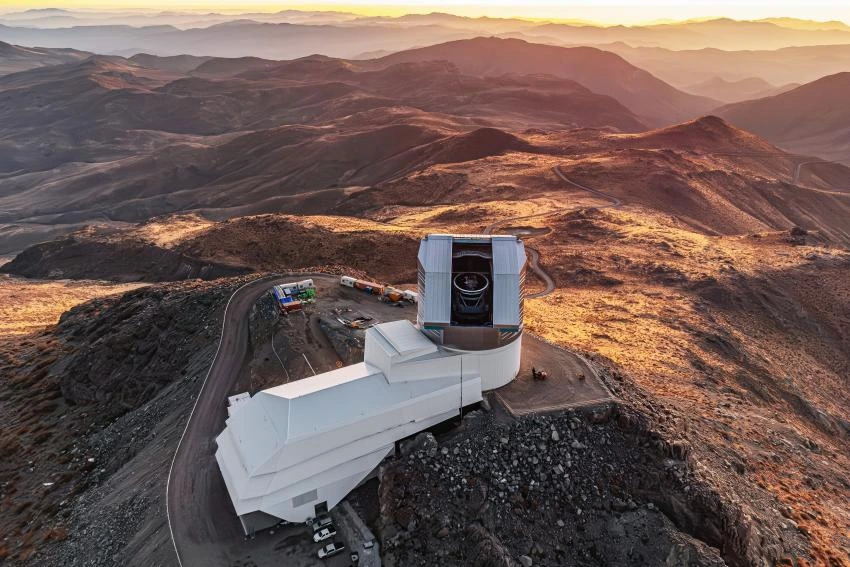
The Vera C. Rubin Observatory in Chile is poised to transform this debate. Located 2 665 m (8 740 ft) above sea level in the Andes, its eight-meter-wide digital camera began scientific operations this year. Over the next five years, Rubin’s Legacy Survey of Space and Time (LSST) will detect more than 20 000 new Type Ia supernova host galaxies. Each will have measurable stellar ages, allowing precise testing of the progenitor age-bias hypothesis.
The Yonsei group is already preparing what they call an “evolution-free test.” This approach uses only supernovae from coeval young hosts, avoiding the need for redshift-based correction entirely. Early results again favor a decelerating Universe, reinforcing the main conclusion. As those datasets grow, cosmologists will be able to map how dark energy’s strength changes over time rather than assuming it is constant.
Rubin’s data will also help refine galaxy evolution models, providing better age estimates and spectral calibration standards. Within a decade, astronomers expect to know whether cosmic acceleration was ever as strong or as sustained as once believed. The observatory’s vast dataset will either confirm a slowing cosmos or restore confidence in the acceleration paradigm.
What if the Universe really is slowing down?
If the Universe has already begun to slow, then we may be living at the tipping point between two great eras: one of acceleration and one of gradual deceleration. In such a Universe, expansion continues indefinitely but at a decreasing rate, avoiding both runaway acceleration and eventual collapse. The cosmic horizon would stabilize, and the influence of dark energy would fade into the background.
Theoretically, this could occur if dark energy arises from a dynamic field that loses energy over time, similar to quintessence models. Alternatively, it might indicate that the cosmological constant is not fundamental but emerges from evolving large-scale curvature. Either interpretation would demand a rewrite of the ΛCDM model, replacing its central assumption of constancy with one of cosmic evolution.
“If our results are confirmed, it would mark a major paradigm shift in cosmology since the discovery of dark energy 27 years ago,” Professor Lee said. The Universe, it seems, may be slowing down not because its engines are failing but because we have finally learned to measure its motion correctly.
References:
1 Strong progenitor age bias in supernova cosmology – II. Alignment with DESI BAO and signs of a non-accelerating universe – Junhyuk Son et al. – November 6, 2025 – https://doi.org/10.1093/mnras/staf1685 – OPEN ACCESS
2 Universe’s expansion ‘is now slowing, not speeding up’ – Royal Astronomical Society – November 5, 2025

I’m a science journalist and researcher at The Watchers, contributing to the Epicenter edition, where I cover peer-reviewed scientific research and emerging discoveries across Earth and space sciences. With a background in astronomy and a passion for environmental science, I’ve worked in shark and coral conservation in Fiji, conducting reef and shark-behavior research, contributing to mangrove restoration, and earning PADI Open Water and Coral Reef Certifications. I bring a blend of scientific rigor and storytelling to illuminate the discoveries shaping our planet and beyond.

Commenting rules and guidelines
We value the thoughts and opinions of our readers and welcome healthy discussions on our website. In order to maintain a respectful and positive community, we ask that all commenters follow these rules.