
The May 2024 geomagnetic superstorm reshaped the ionosphere across hemispheres
A new study reveals how the May 2024 super geomagnetic storm dramatically reshaped the ionosphere across the Asia-Pacific, producing intense hemispheric asymmetries that challenge existing space weather models.
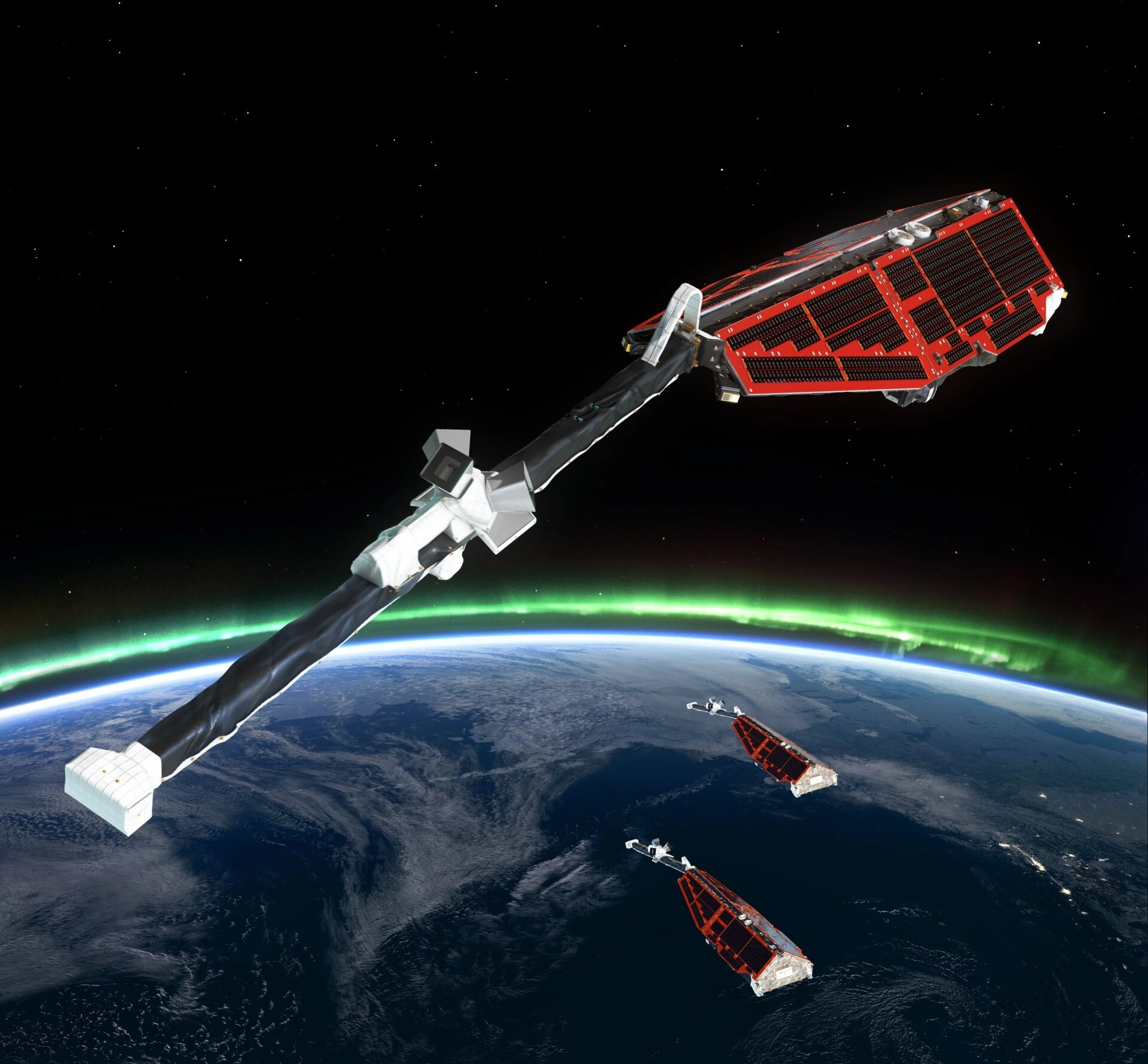
Swarm is ESA’s first constellation of Earth observation satellites designed to measure the magnetic signals from Earth’s core, mantle, crust, oceans, ionosphere and magnetosphere, providing data that will allow scientists to study the complexities of our protective magnetic field. Credit: ESA/AOES Medialab
The May 2024 geomagnetic superstorm began when a powerful coronal mass ejection left the Sun in early May and reached Earth’s magnetic field at about 18:30 UTC on May 10. The collision produced a global geomagnetic index of Kp 9 — G5 – Extreme geomagnetic storm, the maximum possible intensity.
The storm caused auroras to spread far beyond their usual range, visible from the northern United States to southern Japan and across parts of Australia. This was the strongest storm since the Halloween events of 2003. The storm lasted through May 12, triggering widespread disturbances in the ionosphere, particularly across the Asia-Pacific region.
Solar wind parameters measured by satellites showed sustained speeds above 800 km/s (500 mps) and dense plasma conditions, both of which contributed to severe magnetospheric compression. These conditions led to a major energy input into the upper atmosphere, initiating intense electric fields and rapid ionospheric restructuring.
Regional effects began within hours. Navigation and communication signals degraded over East Asia and Oceania, and several satellite operators reported temporary anomalies due to fluctuating plasma densities and surface charging in orbit.
Observing the ionosphere in real time
To capture the storm’s evolution, researchers used multiple data sources that complemented one another. Ground-based GNSS networks tracked changes in total electron content (TEC), while ionosondes provided vertical electron density profiles from stations across Asia and the Pacific Islands.
From orbit, the COSMIC-2 constellation offered radio occultation measurements, giving detailed information on plasma gradients, while the Swarm satellites operated by the European Space Agency recorded in-situ electron densities and magnetic field variations at altitudes between 400 and 500 km (250 to 310 miles).
By combining these observations, the study reconstructed the storm’s full spatiotemporal behavior. It allowed researchers to see how the ionosphere responded at different heights and latitudes during both the main and recovery phases.
This multi-instrument approach was essential because no single dataset can describe the ionosphere’s rapid, three-dimensional changes. Cross-validation between Swarm and ground-based receivers confirmed that local features observed during the storm were real and not artifacts of specific instruments.
Hemispheric asymmetry intensified during recovery
During the main phase from May 10 to May 11, total electron content decreased sharply across the Northern Hemisphere, most notably over China, Japan, and Southeast Asia. In contrast, the Southern Hemisphere experienced smaller reductions, especially over northern Australia and the western Pacific.
When the storm began to subside on May 11 and entered recovery, these hemispheric differences became even stronger. The north continued to show negative storm effects, characterized by persistent electron density depletion, while the south developed positive effects, with large increases in electron density and total electron content at low latitudes.
This intensification was driven by complex thermospheric circulation. Seasonal and geomagnetic conditions at the time of the event, occurring during boreal spring and austral autumn, enhanced energy transport asymmetries between hemispheres. Neutral wind systems and conductivity gradients caused plasma redistribution that amplified these differences.
Researchers concluded that the hemispheric asymmetry during the recovery phase was mainly influenced by the lower ionosphere and thermosphere, where heating and wind dynamics played a greater role than direct solar wind forcing.
Regional complexity across the Asia-Pacific
Local variability was one of the most striking features of this event. Over Japan, the ionosphere briefly increased in strength on May 11, showing a short-lived positive phase before transitioning into a long-lasting depletion that persisted for more than 24 hours.
Inland China recorded milder disturbances than its eastern coastal regions, suggesting that geomagnetic field geometry and local thermospheric winds strongly modulated ionospheric responses. Over northeastern Australia, however, intense disturbances appeared during the same period and shifted westward by May 12.
The westward movement in the Southern Hemisphere was linked to storm-enhanced density (SED) plumes, which form when strong electric fields redistribute ionospheric plasma toward nighttime sectors. These plumes can stretch thousands of kilometers (over 620 miles) and heavily impact satellite-based navigation.
Such local and hemispheric contrasts demonstrate that the ionosphere does not respond uniformly during geomagnetic storms. Even within a single region like the Asia-Pacific, space weather conditions can vary greatly from one day to the next and between nearby locations.
Plasma irregularities and equatorial dynamics
The study also analyzed small-scale fluctuations in the ionosphere known as scintillation, which cause radio signals to fade and fluctuate rapidly. Researchers used two key indices: ROTI, which measures the rate of TEC change, and S4, which quantifies signal amplitude variation.
During the storm’s peak, low-latitude scintillation was suppressed near the magnetic equator, while mid-latitude activity increased. This pattern was likely the result of the expansion of the equatorial ionization anomaly and a temporary equatorward shift of the auroral oval.
In the later recovery phase, equatorial irregularities reappeared as the two EIA crests merged, enhancing east-west plasma gradients. At the same time, storm-enhanced density plumes and thermospheric winds produced new irregularities at middle latitudes, creating complex patterns of signal distortion.
These observations confirmed that strong storms can temporarily reorganize the entire electrodynamic system of the ionosphere, altering not just density but also the morphology and movement of irregularities.
Why this matters for prediction and infrastructure
The May 2024 storm exposed weaknesses in how current space weather models handle hemispheric and regional differences. Many global prediction systems use geomagnetic indices such as Kp or Dst as proxies for ionospheric disturbance, but these fail to capture asymmetrical or localized effects.
According to the study, recovery-phase dynamics were mainly controlled by processes in the lower ionosphere and thermosphere, such as wind-driven plasma transport and composition changes. This means that accurate modeling requires multi-layer coupling, not just magnetospheric inputs.
For regions like the Asia-Pacific, where magnetic declination and field geometry vary sharply, region-specific models will be essential. Local GNSS receiver networks and low-Earth orbit constellations can provide higher resolution data to improve storm-time predictions.
These findings are critical for protecting systems dependent on ionospheric stability, including aviation navigation, maritime positioning, satellite communications, and power grid operations sensitive to geomagnetically induced currents.
Building a global view of ionospheric recovery
The May 2024 geomagnetic storm has become one of the most important case studies of Solar Cycle 25. It offered a rare opportunity to compare hemispheric responses using coordinated ground and satellite observations.
By integrating Swarm, COSMIC-2, and GNSS data, scientists could visualize how the ionosphere evolved over time and across hemispheres. This combined approach provided valuable validation for numerical models used by space weather agencies.
The event also emphasized the need for continuous, multi-instrument monitoring networks capable of capturing short-term dynamics. Expanding these systems globally would make it possible to detect early signs of hemispheric divergence before major impacts occur.
As solar activity continues to rise toward the peak of Cycle 25, similar superstorms are likely to occur again. Lessons from the May 2024 storm will therefore be vital for developing reliable forecasting and mitigation strategies worldwide.
1 Characterizing Ionospheric Disturbances and Hemispheric Differences Over the Asia-Pacific During the May 2024 Geomagnetic Storm Leveraging Multi-Instrumental Observations – Hongyang Su et al. – JGR Space Physics – October 30, 2025 – https://doi.org/10.1029/2025JA034432 – OPEN ACCESS

I’m a science journalist and researcher at The Watchers, contributing to the Epicenter edition, where I cover peer-reviewed scientific research and emerging discoveries across Earth and space sciences. With a background in astronomy and a passion for environmental science, I’ve worked in shark and coral conservation in Fiji, conducting reef and shark-behavior research, contributing to mangrove restoration, and earning PADI Open Water and Coral Reef Certifications. I bring a blend of scientific rigor and storytelling to illuminate the discoveries shaping our planet and beyond.

Commenting rules and guidelines
We value the thoughts and opinions of our readers and welcome healthy discussions on our website. In order to maintain a respectful and positive community, we ask that all commenters follow these rules.