
Swirling dust devils expose hidden power of Martian winds
ESA’s Mars Express and ExoMars Trace Gas Orbiter have tracked 1 039 dust devils across the Red Planet, revealing near-surface wind speeds up to 158 km/h (98 miles/h). Published on October 8, 2025 in Science Advances, the research provides the most detailed map ever made of how dust is lifted and transported across Mars.


ExoMars TGO catches a dust devil on Mars. Credit: Dust devil migration patterns reveal strong near-surface winds across Mars, Valentin T. Bickel et al.
For decades, spacecraft have photographed small spiraling columns of dust drifting across Mars. These dust devils form when sunlight heats the surface, causing warm air to rise through cooler layers and spin into tall, narrow vortices that can stretch hundreds of meters into the sky.
The new study, led by Valentin Bickel from the University of Bern, used artificial intelligence to search 20 years of data from ESA’s Mars Express and the ExoMars Trace Gas Orbiter. The system identified 1 039 dust devils, tracking their paths, diameters, and travel speeds across the Martian surface.
These spinning plumes act as natural tracers of invisible winds. By measuring their displacement over seconds, researchers produced a direct map of near-surface wind directions and strengths—something previously impossible to observe at a global scale.
The fastest devils moved at 158 km/h (98 miles/h), more than double the highest values recorded by surface stations. Typical speeds ranged from 40 km/h (25 miles/h) to 65 km/h (40 miles/h), fast enough to lift sand and dust grains into the atmosphere despite Mars’ thin air.
These winds fill a long-standing gap in understanding how Martian dust remains airborne for months without constant large-scale storms. They show that localized gusts are far more effective at stirring the atmosphere than once thought.

A global map from billions of pixels
To detect the elusive features, the team trained a neural network to recognize the faint patterns left by moving dust devils in orbital images. It scanned 44 000 pictures from the CaSSIS camera aboard the Trace Gas Orbiter and 5 390 from the High-Resolution Stereo Camera on Mars Express.
Each instrument captured different scales of motion. HRSC images broad regions at 12 m (39 feet) per pixel, while CaSSIS provides finer details down to 4 m (13 feet). Comparing frames taken seconds apart allowed scientists to measure how far a vortex moved between exposures.
Dust devils appeared across nearly every type of Martian terrain, from the low plains of Amazonis Planitia to the slopes of Olympus Mons, rising 21 000 m (69 000 feet) high. Most concentrated in dusty regions coated with fine material that can easily become airborne.
Measured diameters ranged from 18 m (60 feet) to 578 m (1 900 feet), with an average of 82 m (270 feet). Larger vortices tended to appear near noon, when solar heating is strongest. Globally, activity peaked between 11:00 and 14:00 local solar time, mirroring similar behavior seen in Earth’s deserts.
The resulting dataset provides the most complete record yet of how Mars’ winds behave, forming the basis for major updates to climate models that predict temperature, dust, and energy flows across the planet.

Stronger winds than models predicted
When compared to the Mars Climate Database, the measured velocities exceeded model predictions in roughly four out of five cases. Observed winds were typically 3 to 10 m/s (11 to 36 km/h or 7 to 22 mph) faster than expected, showing that Mars’ lower atmosphere is far more dynamic than theory suggests.
Many of the recorded winds were strong enough to exceed the stress needed to lift dust particles about 0.02 Pascal, equivalent to an airspeed of 83 km/h (52 miles/h) measured 10 m (33 feet) above the surface. Between 11 and 39% of the dust devils surpassed this threshold.
In some locations, the team observed stresses as high as 0.1 Pascal, sufficient to move grains between 30 and 800 micrometres in size. These levels confirm that local gusts can drive the movement of sand dunes and bright streaks visible from orbit.
The data also help solve the long-standing “sand transport puzzle.” For years, models suggested winds were too weak to explain shifting dunes, yet the surface clearly changed. These measurements show that brief but powerful bursts of wind occur frequently enough to maintain active sand transport.
Such findings will allow scientists to refine global models and better simulate how local turbulence links with large-scale dust storms that periodically envelop the planet.

The rhythm of Martian seasons
Dust devil activity follows Mars’ changing seasons. It peaks during spring and summer in both hemispheres when surface heating drives stronger convection. During late northern autumn, activity nearly disappears, leaving the atmosphere unusually clear.
Two-thirds of all dust devils were found in the northern hemisphere, particularly across Amazonis Planitia. The southern hemisphere, by contrast, showed a band of activity between 40° and 65° south, most intense during southern summer.
The patterns reflect the planet’s topography and solar input. At mid-latitudes, most dust devils drifted eastward, driven by prevailing winds. Near the equator, migration reversed seasonally toward the pole in one half of the year, toward the equator in the other—matching the planet’s large-scale circulation cells.
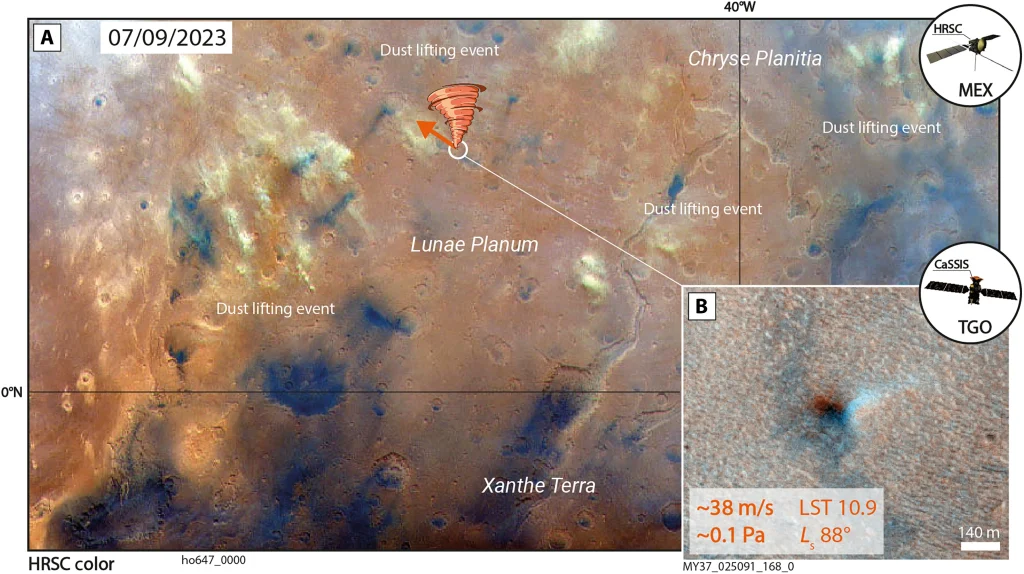
The team found that strong winds often appeared in areas where regional dust storms later formed. A particularly striking case occurred on July 9, 2023 in Lunae Planum, where a 137 km/h (85 miles/h) dust devil coincided with a regional dust event recorded by orbiters.
This overlap hints that small whirlwinds and straight-line gusts could act as early indicators or triggers of larger storms, offering valuable clues for future forecasting.
Turning image noise into atmospheric data
Neither Mars Express nor the Trace Gas Orbiter was built to measure wind. Both cameras, however, take multiple images in sequence, either in color channels or stereo pairs, with delays of 1 to 48 seconds. Moving dust devils appear slightly misaligned between frames, producing color fringes or shadows that shift position.
The researchers used these tiny offsets as motion markers. By tracking how far each vortex moved, they derived precise speeds and directions. The method achieved accuracy within ± 0.7 km/h (± 0.4 miles/h) for stereo data and ± 14 km/h (± 9 miles/h) for color data.
Cross-checks between the two techniques confirmed strong agreement, proving that small imaging artifacts can be repurposed into physical measurements. The result is a novel tool for mapping atmospheric dynamics from visual data alone.
This creative reuse of archival imagery shows that even missions not designed for meteorology can reveal fine-scale weather processes. It opens possibilities for studying other worlds, including Titan or Venus, using similar methods.
In practical terms, scientists have turned optical noise into climate data, extracting wind information from imagery that would once have been discarded.
Why Martian dust matters
Dust plays a major role in Mars’ climate and geology. Airborne particles scatter and absorb sunlight, modifying surface and atmospheric temperatures. They also act as nuclei for cloud formation and affect how water vapor escapes into space, influencing the planet’s long-term evolution.
Because Mars has no rain, dust can stay suspended for months and circle the planet multiple times. Understanding how it becomes airborne clarifies how energy, temperature, and chemistry interact on a global scale.
The dust devil catalogue helps pinpoint the main regions where atmospheric dust originates. These include Amazonis, Chryse, Syrtis, Hellas, and Aonia Planitia areas long suspected as global dust sources. The study confirms that these regions experience frequent high-velocity surface winds capable of injecting material upward.
Dust’s behavior has direct implications for exploration. Layers of fine particles can block solar panels and degrade optical systems. Knowing when and where cleaning winds occur will help engineers plan longer-lasting missions.
By capturing the dynamics of these storms, scientists can better model Mars’ evolving atmosphere and forecast periods of clear skies or dusty weather for future robotic and human explorers.
Preparing for future explorers
The findings already influence mission planning for ESA’s ExoMars Rosalind Franklin rover, expected to land in 2030 at Oxia Planum. Understanding local wind cycles allows engineers to predict dust accumulation rates and determine when the rover might benefit from natural cleaning events.
Nearby observations indicate that winds at noon reach 54–83 km/h (34–52 mph) during southern summer, while afternoon breezes slow to 18–32 km/h (11–20 mph) in northern summer. These patterns will guide rover operations and power management.
Past missions such as Spirit, Opportunity, and Phoenix experienced dust clearing caused by passing vortices. Similar conditions may help ExoMars maintain its energy output for extended periods.
The same data improve safety forecasts for landers and potential human bases. Predicting wind load, dust transport, and visibility conditions will be essential for surface operations and hardware design.
With these insights, mission planners now possess a map of Martian wind behavior that spans two decades, providing the clearest picture yet of atmospheric conditions at ground level.
Broader meaning for planetary science
The results deepen understanding of how small-scale atmospheric motions sculpt planetary surfaces. Dust devils erode and redistribute material, contributing to surface renewal and influencing the appearance of recurring slope lineae dark streaks that fade and reappear each Martian year.
By confirming that near-surface winds are stronger and more variable than expected, the study strengthens the link between air movement and visible surface change. It reveals that Mars, though quiet from afar, remains a geologically active world shaped daily by air and dust.
References:
1 Dust devil migration patterns reveal strong near-surface winds across Mars – Valentin T. Bickel et al. – October 8, 2025 – DOI: 10.1126/sciadv.adw5170 – OPEN ACCESS
2 Dancing dust devils trace raging winds on Mars – ESA – October 8, 2025

I’m a science journalist and researcher at The Watchers, contributing to the Epicenter edition, where I cover peer-reviewed scientific research and emerging discoveries across Earth and space sciences. With a background in astronomy and a passion for environmental science, I’ve worked in shark and coral conservation in Fiji, conducting reef and shark-behavior research, contributing to mangrove restoration, and earning PADI Open Water and Coral Reef Certifications. I bring a blend of scientific rigor and storytelling to illuminate the discoveries shaping our planet and beyond.

Commenting rules and guidelines
We value the thoughts and opinions of our readers and welcome healthy discussions on our website. In order to maintain a respectful and positive community, we ask that all commenters follow these rules.