
Study adds Little Ice Age climate variability to explanations for vitamin D deficiency in industrial-era England
A study of an 18th- and 19th-century Quaker cemetery in North East England found repeated dental evidence of disrupted mineral metabolism in a population whose historical chronology overlapped periods of intense volcanic activity and reduced solar output. The researchers argue that climate variability should be considered alongside industrial pollution, latitude, diet and social conditions when reconstructing historical vitamin D deficiency.

Hunters in the Snow (Winter). Credit: Pieter Bruegel the Elder
Researchers studying the Coach Lane cemetery in North Shields found that the conventional emphasis on industrialization and latitude does not fully account for patterns of disrupted mineral metabolism seen there and at other postmedieval sites. Their comparative data did not show a clear increase in prevalence with industrialization, latitude, urbanization or socioeconomic status alone, adding the climatic conditions of the Little Ice Age to the factors that need to be considered.
Kendall et al. (2026) examined 30 teeth from 21 individuals at Coach Lane. Sixteen of the 21 individuals, or 76.2%, had interglobular dentin (IGD), areas in which dentin failed to mineralize normally. Among those affected, 68.8% had more than one episode, and some teeth recorded defects at roughly annual intervals from childhood into adolescence or early adulthood.
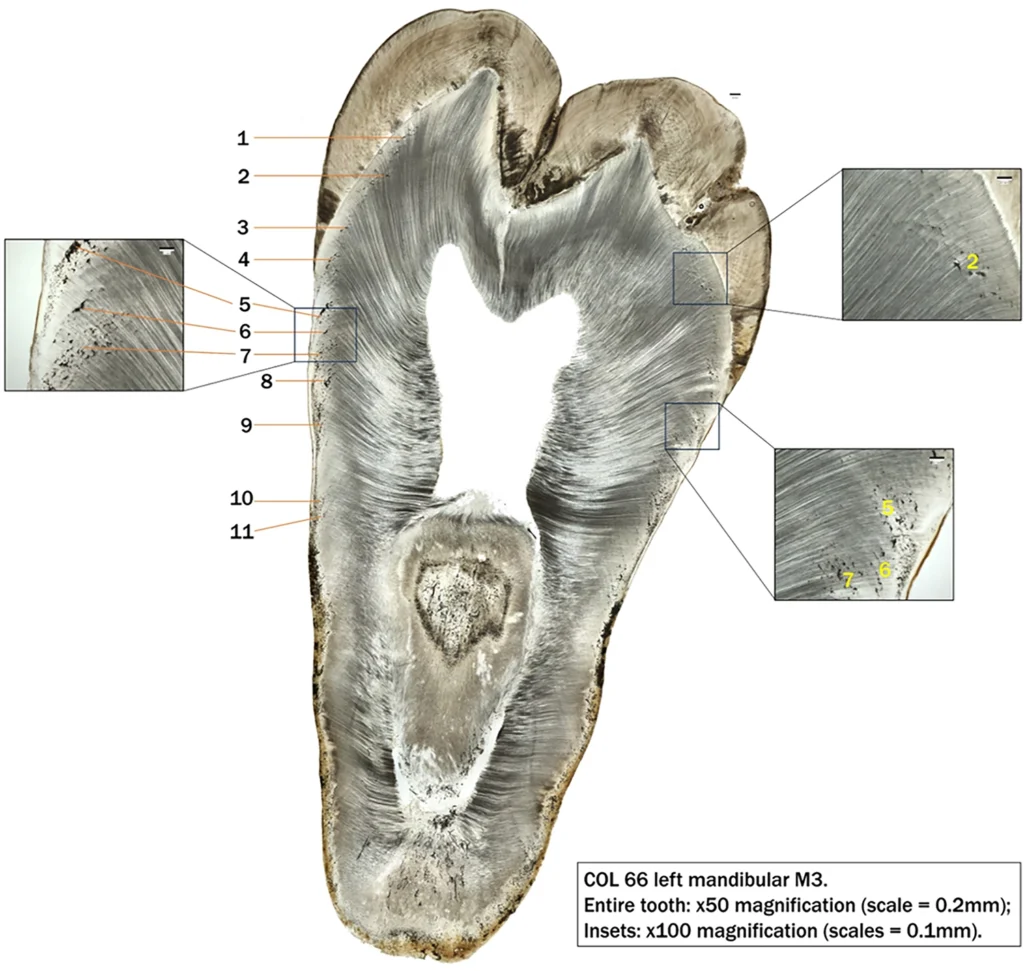
IGD does not by itself diagnose vitamin D deficiency. The researchers therefore use the broader term disordered mineral metabolism for the dental lesions and interpret recurrent seasonal patterns alongside other skeletal and environmental evidence. In archaeological remains, vitamin D deficiency cannot be established from a single lesion because several disturbances can affect mineralization.
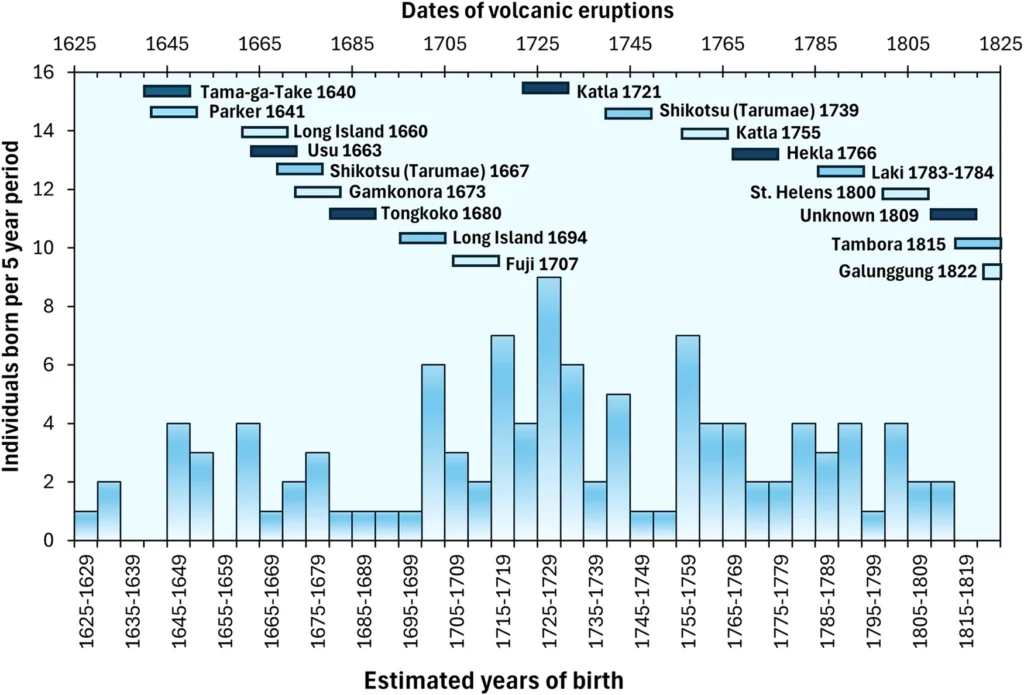
A separate analysis used the Coach Lane burial register to reconstruct the population’s chronology. Of 197 people recorded in the register, 109 had sufficiently precise age-at-death and death-year information for the researchers to estimate their birth years. Those estimated births ranged from the 1620s into the early 19th century.
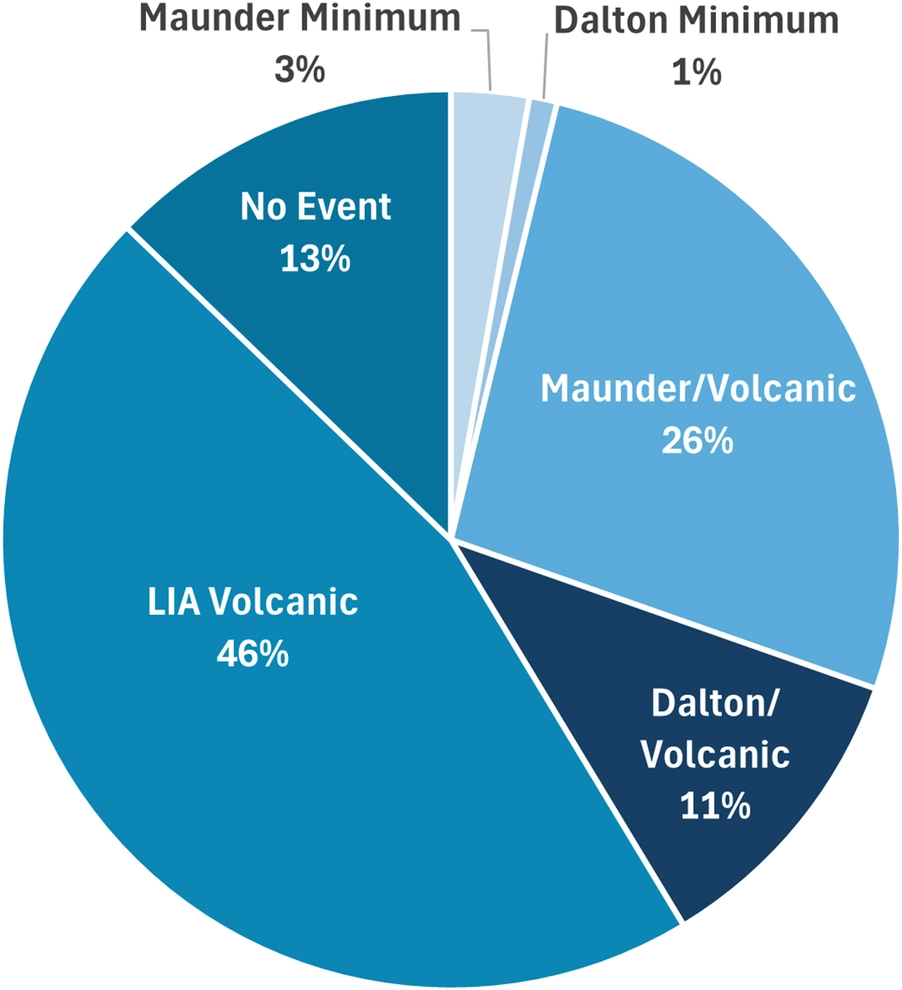
The chronology placed much of the population within periods of strong natural climate forcing. Ninety-one of the 109 birth-estimable individuals, or 84%, were born during or within 10 years after one of the high-VEI eruptions included in the study. Forty-five people, or 41%, were born during the Maunder or Dalton solar minima, while 41 people, or 38%, were born during periods when volcanic activity and a solar minimum overlapped. Only 14 of the 109 fell outside the study’s defined volcanic and solar-event periods.
The volcanic connection is physical rather than simply chronological. Large explosive eruptions can carry sulfur dioxide into the stratosphere, where it forms sulfate aerosols capable of reducing the amount of solar radiation reaching Earth’s surface. The paper identifies repeated high-VEI eruptions between the 17th and early 19th centuries, including the VEI 7 eruption of Tambora in 1815. Repeated eruptions during the late Little Ice Age created the potential for overlapping periods of climate forcing rather than isolated short-lived disturbances.
Reduced ultraviolet-B (UVB) radiation matters because most vitamin D is produced when UVB reaches the skin. Latitude already restricts seasonal UVB availability in northern populations, while indoor work, high-coverage clothing and atmospheric pollution can further reduce exposure. Dietary sources can partly compensate, but the amount available depends on diet and access to foods containing vitamin D.
The Little Ice Age adds another environmental layer to that problem. The study describes the period as one of strong climatic variability produced by interacting volcanic, solar and ocean-atmosphere processes. Large eruptions reduced incoming radiation, while sea-ice and ocean feedbacks could extend cooling, especially in the North Atlantic. Cold and wet conditions could also change behavior by reducing time outdoors or increasing clothing coverage, further limiting UVB exposure.
Comparisons with other historical populations complicate a simple industrial-pollution explanation. Coach Lane’s IGD prevalence of 76.2% was similar to the 74% measured at the non-industrial urban St. Antoine cemetery in Montreal, while industrial sites at Wolverhampton recorded still higher rates in smaller dental samples. The authors found no straightforward pattern in which industrialization or increasing latitude alone predicted the prevalence of mineralization defects.
That comparison does not remove pollution, industrial working conditions, diet, socioeconomic status or latitude from the explanation. The researchers describe vitamin D status as the product of multiple conditions whose relative importance can vary across time and place. Their contribution is to place climatological evidence alongside those established anthropogenic and geographic factors rather than treating climate and industrialization as competing causes.
The strongest limitation is chronological. Coach Lane lacked a detailed burial plan, grave markers and legible coffin plates, so the researchers could not match nearly all excavated skeletons with named individuals in the burial register. The dental defects therefore cannot be assigned to individual volcanic eruptions or solar minima. The register provides population-level environmental context, not a direct person-by-person causal test.
Sample size also limits how far the result can be extended. Twenty-one people formed the dental histology sample, while comparative datasets from other cemeteries remain small and methodologically uneven. The findings therefore do not establish that volcanic eruptions caused vitamin D deficiency across Victorian Britain, or that climate was more important than pollution, diet, latitude or social conditions.
A stronger test would require human remains with tightly controlled chronology and individual life histories that can be compared directly with reconstructed ultraviolet exposure and volcanic forcing. The Coach Lane results instead establish a narrower point: bioarchaeological interpretations of metabolic health during industrialization can lose relevant environmental context when the climatic conditions in which those populations lived are excluded.
References:
1 Kendall, E. J., Sohler-Snoddy, A. M. E., Kendall, R., Koon, H., Gowland, R., Weale, M. C., Chaplin, I., & Edwards, S. (2026). ‘The bright sun was extinguish’d’: metabolic health and vitamin D status in a Little Ice Age population (18th–19th c.) in North East England. Frontiers in Environmental Archaeology, 5, 1909791. DOI: 10.3389/fearc.2026.1909791

I’m a science journalist and researcher at The Watchers, contributing to the Epicenter edition, where I cover peer-reviewed scientific research and emerging discoveries across Earth and space sciences. With a background in astronomy and a passion for environmental science, I’ve worked in shark and coral conservation in Fiji, conducting reef and shark-behavior research, contributing to mangrove restoration, and earning PADI Open Water and Coral Reef Certifications. I bring a blend of scientific rigor and storytelling to illuminate the discoveries shaping our planet and beyond.
