
Stellar jet discovery shows massive star formation in outer Milky Way
Webb has captured a rare stellar jet stretching 8 light-years (2.5 parsecs) from a massive protostar in Sh2-284. The finding strengthens evidence for “core accretion” in massive star formation and offers a window into low-metallicity conditions similar to the early universe.
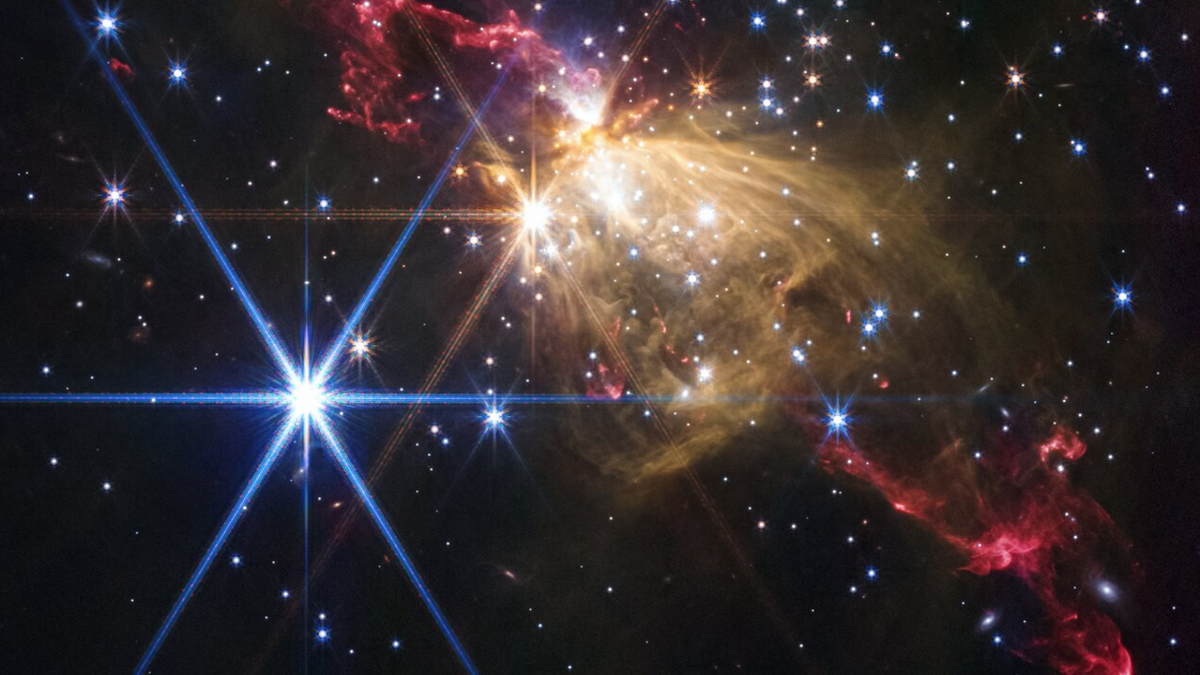
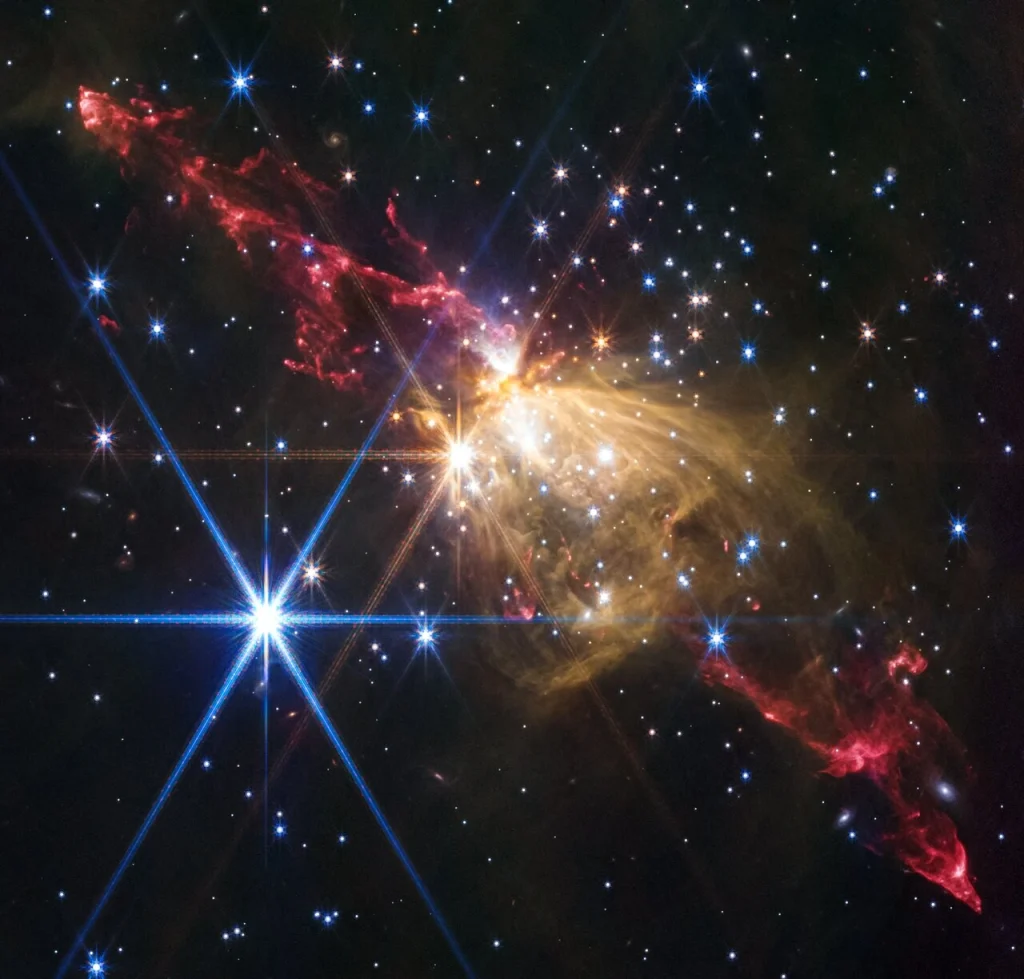
Stellar jet in Sh2-284 (NIRCam image). Credit: NASA, ESA, CSA, STScI, Y. Cheng (NAOJ), J. DePasquale (STScI)
The James Webb Space Telescope (JWST) has captured a rare Herbig-Haro jet stretching across 8 light-years (2.5 parsecs) in the Sharpless 2-284 (Sh2-284) star-forming region. The outflow is powered by a protostar with a mass of about 10 suns, located 15 000 light-years away in the outer Milky Way.
Such immense jets are formed when material falling onto a forming star is expelled along its rotation axis, channeled into narrow beams by magnetic fields. Webb’s near-infrared images revealed intricate filamentary structures, knots, bow shocks, and linear chains, created as the jet plows into surrounding gas and dust.
Rare class of stellar fireworks
Jets of this kind are called Herbig-Haro (HH) objects — highly collimated plasma outflows from young stars. More than 300 HH objects have been documented, but almost all are associated with low-mass stars. The Sh2-284 jet demonstrates that the phenomenon scales with stellar mass.
“Such a spectacular outflow of molecular hydrogen from a massive star is rare in our galaxy,” said Yu Cheng of the National Astronomical Observatory of Japan, lead author of the study. Co-author Jonathan Tan noted the symmetry and order of the jet, suggesting a stable accretion disc has persisted for at least 100 000 years.
Implications for massive star formation theories
For decades, astronomers have debated whether massive stars form through chaotic “competitive accretion” or through stable “core accretion.” The Webb observations strongly support the latter. The near-180° symmetry of the jet suggests a steady disc orientation, ruling out twisting expected from chaotic inflows.
“This central disc is held steady and validates a prediction of the core accretion theory,” said Tan. Radiative transfer models fitted to the Webb data imply the protostar has already accumulated about 10 solar masses and is still growing.
Low-metallicity environment — a window into the past
The host cluster in Sh2-284 lies nearly twice as far from the Galactic center as the Sun and contains hundreds of forming stars. Its metallicity — the fraction of elements heavier than hydrogen and helium — is only 0.3–0.5 times solar. This makes it a rare analog of early-universe star-forming regions, where heavy elements were scarce.
“Webb’s exquisite data have shown us that relatively more stars seem to form at lower masses in Sh2-284 than in closer, more metal-rich clusters,” said co-author Morten Andersen of the European Southern Observatory.
Wider context and future prospects
Massive stars play a crucial role in galaxy evolution by enriching the interstellar medium through winds and supernovae. Observations like these provide essential constraints for star formation models in both the present Milky Way and the early cosmos.
ALMA follow-up observations also revealed another dense stellar core in Sh2-284, suggesting more massive stars may be in earlier stages of development. The findings are part of the Low-metallicity Star Formation (LZ-STAR) survey, a multifacility campaign combining JWST, ALMA, Hubble, Chandra, and Gemini.
References:
1 LZ-STAR Survey: Low-metallicity Star Formation Survey of Sh2-284. I. Ordered Massive Star Formation in the Outer Galaxy – Yu Cheng, Jonathan C. Tan – September 10, 2025 – https://doi.org/10.3847/1538-4357/addf4b – OPEN ACCESS
2 Webb observes immense stellar jet on outskirts of our Milky Way – ESA WEBB – September 10, 2025

I’m a science journalist and researcher at The Watchers, contributing to the Epicenter edition, where I cover peer-reviewed scientific research and emerging discoveries across Earth and space sciences. With a background in astronomy and a passion for environmental science, I’ve worked in shark and coral conservation in Fiji, conducting reef and shark-behavior research, contributing to mangrove restoration, and earning PADI Open Water and Coral Reef Certifications. I bring a blend of scientific rigor and storytelling to illuminate the discoveries shaping our planet and beyond.

Commenting rules and guidelines
We value the thoughts and opinions of our readers and welcome healthy discussions on our website. In order to maintain a respectful and positive community, we ask that all commenters follow these rules.