
South Atlantic Anomaly, weak spot in Earth’s magnetic field, expanding steadily since 2014
New data from the European Space Agency’s Swarm mission show that the South Atlantic Anomaly, a weak region in Earth’s magnetic field over the South Atlantic Ocean, has expanded steadily since 2014, now covering nearly 1% of the planet’s surface. The 11-year record marks the most detailed satellite observation of the field’s uneven weakening to date.
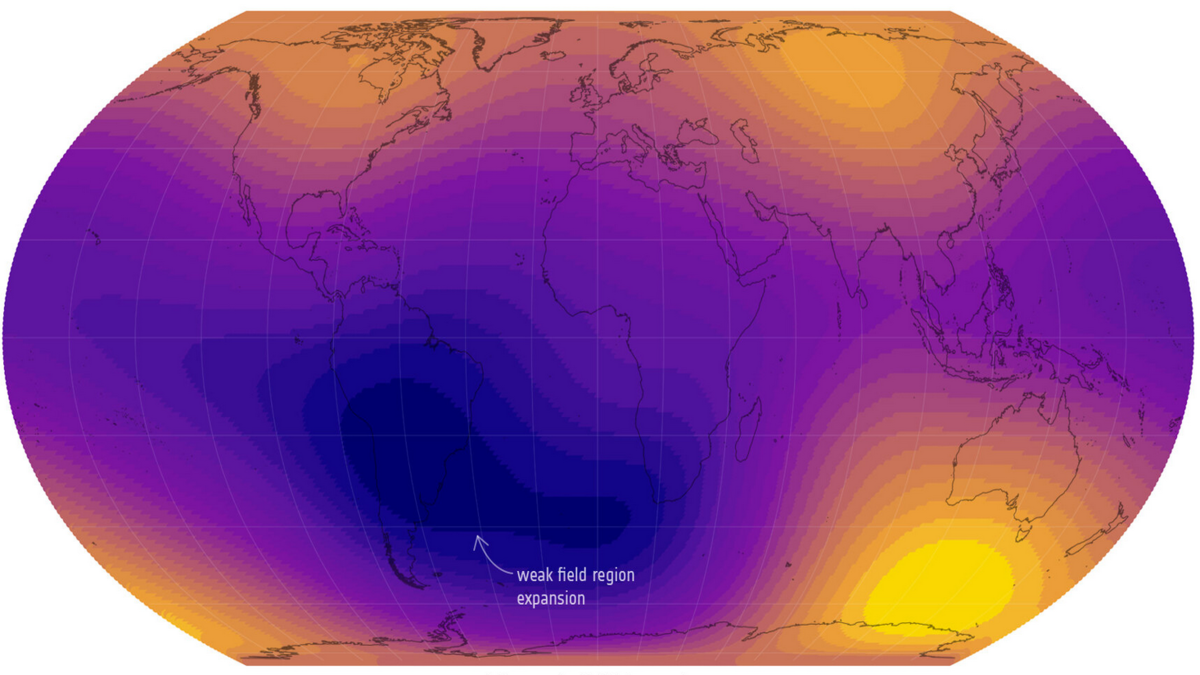
South Atlantic Anomaly 2025. Credit: ESA (Data source: Finlay, C.C. et al., 2025)
Earth’s magnetic field forms a global defense that shields the surface from cosmic radiation and charged solar particles. Without it, life would be exposed to far higher doses of space radiation.
The latest model based on Swarm satellite measurements shows that this shield is weakening unevenly, most notably over the South Atlantic Ocean. This region, known as the South Atlantic Anomaly, now covers about 0.9% of Earth’s surface, expanding steadily since 2014. The minimum field strength in this area fell from 22 430 nT to 22 094 nT between 2014 and 2025, a drop of 336 nT.
For spacecraft in low-Earth orbit, the anomaly is a high-risk radiation zone. When satellites pass through it, they encounter greater exposure to energetic particles, which can disrupt onboard systems, corrupt memory, or trigger temporary blackouts. Mission operators often plan for these encounters to reduce damage to hardware and sensors.
The expansion of the South Atlantic Anomaly is also significant for navigation and communication technologies that depend on magnetic-field stability. Its evolution helps scientists refine models used for forecasting geomagnetic activity and radiation hazards in space operations.
Professor Chris Finlay of the Technical University of Denmark explained that the anomaly is not a single weakening region but a complex system. The field is changing faster southwest of Africa than near South America, suggesting that multiple internal processes are at work below the surface.

What Swarm uncovered about Earth’s hidden engine
The European Space Agency’s Swarm mission consists of three identical satellites named Alpha, Bravo, and Charlie. Launched on November 22, 2013, the trio orbits in slightly different planes to measure magnetic signals from Earth’s core, mantle, crust, oceans, ionosphere, and magnetosphere.
Each spacecraft carries fluxgate vector magnetometers and absolute scalar magnetometers mounted on a rigid optical bench with star trackers. This setup allows scientists to measure the magnetic field with exceptional precision and absolute accuracy.
The 11-year dataset collected by Swarm now represents the longest continuous magnetic field record ever acquired from space. It captures not only surface changes but also variations originating roughly 3 000 km (1 860 miles) below our feet, where molten iron in the outer core drives the geodynamo that produces Earth’s magnetic field.
Using these measurements, Finlay and colleagues constructed a new geomagnetic field model that isolates signals from the liquid outer core. Their results reveal that the South Atlantic Anomaly is expanding due to shifting “reversed flux patches” at the core–mantle boundary.
These reversed patches are regions where magnetic field lines plunge back into the core instead of rising outward. One such patch beneath southern Africa is drifting westward, intensifying the weakening of the field above it.
Beneath the anomaly: the restless motion of liquid iron
Roughly 2 890 km (1 800 miles) beneath the surface, Earth’s liquid outer core flows slowly like a vast ocean of molten iron, generating electric currents that sustain the global magnetic field.
Even slight changes in the direction or speed of this flow can alter magnetic strength at the surface. Beneath southern Africa, Swarm data show a reversed flux patch moving westward, while another under the mid-Atlantic drifts eastward. Where their influences overlap, magnetic intensity decreases, weakening the field in the South Atlantic region.
Similar dynamics occur elsewhere on the planet. A strong magnetic feature beneath the Bering Strait is migrating westward, while those under Indonesia and the western Pacific are shifting east. These patterns suggest that the core’s motion follows slow, wave-like cycles that affect field strength over decades.
The Swarm data also indicate that field accelerations, rapid changes in strength, are most intense near the equator. This supports the view that the geodynamo fluctuates in short-term oscillations layered over long-term evolution.
Although the movements are sometimes interpreted as precursors to a global polarity reversal, some scientists emphasize that current evidence points to localized variation rather than an impending flip of the entire field.
Short-lived magnetic flips in Earth’s history
While a complete magnetic polarity reversal captures public imagination, Earth’s field more commonly experiences excursions: short-lived, incomplete flips where the poles wander far from their usual positions before returning to normal orientation. The episodes can last a few centuries to a few thousand years, weakening the magnetic field and reshaping how cosmic radiation interacts with the atmosphere.
Excursions are recorded in sediments, volcanic rocks, and even in peatlands, whose slow accumulation of magnetized particles preserves fine-scale snapshots of field direction and strength.
A 2024 study of peat layers in Russia’s Khabarovsk region traced several Holocene fluctuations, including a marked weakening about 2 500 years ago. The findings, reported by The Watchers in September 2024, linked this episode with historical sightings of auroras at unusually low latitudes and with isotopic evidence of increased cosmic radiation in contemporaneous layers from Israel.
The most famous of these short reversals is the Laschamp event, which occurred about 41 000 years ago. During that interval, Earth’s magnetic field collapsed to less than 20% of its current strength, allowing far more energetic particles from space to penetrate the upper atmosphere.
The poles may have drifted by tens of degrees, temporarily reorganizing the global field. Traces of this weakening are preserved in volcanic lavas from France’s Massif Central, in Greenland ice cores, and in elevated concentrations of the cosmogenic isotope ^10Be. Within roughly a thousand years, however, the field regained strength and its original polarity.
Other partial reversals include the Mono Lake excursion, dated to around 30 000–35 000 years ago, and several smaller anomalies detected in Black Sea and North Atlantic sediments from the past 70 000 years.
The records demonstrate that the geodynamo, the turbulent movement of molten iron some 2 890 km (1 800 miles) below the surface, regularly enters unstable phases without fully flipping. Each excursion represents a transient state of imbalance, when the dipole temporarily weakens as reversed flux patches form and drift at the core–mantle boundary.
Because excursions are far more common than complete reversals, they provide a crucial framework for interpreting the South Atlantic Anomaly today.
The localized weakening observed by ESA’s Swarm satellites bears a strong resemblance to these earlier events, especially in how reversed flux patches migrate beneath southern Africa and the South Atlantic. The pattern suggests the anomaly may be part of a normal oscillatory cycle within the outer core rather than the onset of a planet-wide polarity transition.
Yet, excursions matter. Each marks a period when Earth’s magnetic protection diminishes, exposing satellites, astronauts, and even the surface environment to higher radiation levels. By studying the short-lived flips, scientists gain rare insight into how the geodynamo recovers from disturbance, and how our planet’s magnetic shield has endured despite its restless, fluctuating nature over millions of years.
Canada’s field weakens as Siberia’s strengthens

While the southern hemisphere experiences weakening, the north tells a different story. Since 2014, the strong-field region over Canada has shrunk by about 0.65% of Earth’s surface area, losing around 801 nT in strength. At the same time, the Siberian strong-field zone has expanded by 0.42%, gaining 260 nT.
These twin regions shape the position of the magnetic north pole. As the Siberian field grows stronger and the Canadian field weakens, the pole continues to drift toward Siberia, a migration first detected in the late 1990s and now moving faster than before.
The shift affects magnetic navigation and aviation. Runway alignments, compass bearings, and geolocation systems must be recalibrated periodically to account for the moving pole. The changes also provide new information about the distribution of energy within the liquid core.
Scientists believe the difference between the Canadian and Siberian regions reflects uneven flow patterns deep within the planet. Rising currents beneath Siberia appear to strengthen its magnetic field, while slower circulation beneath Canada leads to a gradual decline.
By monitoring these changes through Swarm and other magnetic missions, researchers can better understand how the inner workings of the core influence the field we measure at the surface.
Why this matters for technology and exploration
The South Atlantic Anomaly’s continued growth poses a real concern for spacecraft that operate in low-Earth orbit. As its area widens, more satellites will encounter increased radiation levels during their passes over the South Atlantic.
Sensitive instruments such as Earth-observing cameras, GPS payloads, and particle detectors can experience performance degradation when crossing the region. The International Space Station also experiences elevated radiation exposure each time it passes through the anomaly.
From a scientific standpoint, Swarm’s decade-long record is vital for monitoring these trends. Because the core evolves on very long timescales, maintaining uninterrupted satellite observations ensures scientists can identify slow drifts and sudden accelerations with equal accuracy.
ESA plans to keep the Swarm mission operational beyond 2030, particularly the higher-orbiting Swarm Bravo satellite, which provides a stable reference for long-term magnetic mapping. Mission Manager Anja Stromme confirmed that all satellites remain healthy and that the coming solar minimum will allow even clearer observation of Earth’s internal field.
The mission’s success illustrates how steady, high-precision monitoring can transform a technology demonstrator into one of the most important Earth science datasets ever assembled.
A living planet beneath our feet
The magnetic field that shields Earth is a product of movement, heat, and chemistry deep below the crust. It is not fixed or static but dynamic, reflecting the constant flow of molten metal inside our planet.
The expansion of the South Atlantic Anomaly and the shifting balance between Canada and Siberia show that Earth’s core is continually reshaping its magnetic expression. The changes happen slowly on human timescales but reveal the extraordinary energy within our planet.
The magnetic field we rely on today is part of an ongoing process that has lasted billions of years and will continue to evolve for many more.
Every new year of Swarm data adds another layer of understanding. With continued observation, scientists can trace the pulse of Earth’s hidden dynamo and learn how the deep interior maintains the field that keeps our atmosphere, climate, and life safe from cosmic radiation.
References:
1 Core field changes from eleven years of Swarm satellite observations – C.C. Finlay et al. – September 18, 2025 – https://doi.org/10.1016/j.pepi.2025.107447 – OPEN ACCESS
2 Swarm reveals growing weak spot in Earth’s magnetic field – ESA – October 13, 2025

I’m a science journalist and researcher at The Watchers, contributing to the Epicenter edition, where I cover peer-reviewed scientific research and emerging discoveries across Earth and space sciences. With a background in astronomy and a passion for environmental science, I’ve worked in shark and coral conservation in Fiji, conducting reef and shark-behavior research, contributing to mangrove restoration, and earning PADI Open Water and Coral Reef Certifications. I bring a blend of scientific rigor and storytelling to illuminate the discoveries shaping our planet and beyond.

Jamal, I have just noticed your comment and quickly read your abstract, thank you.
I will read your paper tomorrow.
Interesting Swarm findings, I will read Finlay et al. tomorrow. That rate of change increase towards ‘Laschamps’ pole convergence on the video clip, wow. Stand by for another out-of-sequence World Magnetic Map having to be published! Looks like the Siberian field takes predominance, which is the projection able to reach down the Bay of Bengal? We are well underway. Imagine GPS down and compass readings odd, so look to the stars; US mil developed excellent star-finder navigation tech mid 20th Century, perhaps they generously shared it for the benefit of mankind? Interesting you pose the Russian finding at 2500yrs b.p., that’s not far from 3000, circa half the robust 6000 year cycle, which, incidentally, appears to be more intense every 12000 and underway in our time since Carrington, 1859. As you say, excursions matter yet life prevails, our DNA analyses showing extreme human genetic bottlenecks (including 19 human females to every 1 male on the last, the data shows) ramps ‘evolution’. Bring in our Solar System cycles and travels that you mentioned last week on a longer time-scale, so interesting. Looked into Earth’s LLVP zones, their locations too? Then brace for The Dzhanibekov effect with two Euler points logical deduction; it all fits. This linked to S.A.A. changes from core-mantle cycles as you mention, potentially driven by the Galactic Current Sheet. Also ponder data suggesting residual field likely persists strongest and longest circa India in an excursion. The Watchers can parse so much about planetary changes by looking at magnetics alone. Where do magnetics come from; charge-separation, whose origin speaks to plasma and Universe Fundamentals. Nested fields, nested cycles, as above so below and in the middle, Reet The Watcher. Thank you for another interesting article.
In my article that was published last year, I have explained that the South Atlantic Anomaly is related to the changes in the interior of the earth.
https://www.gsjournal.net/Science-Journals/Research%20Papers/View/9919