
Solid inner core detected inside Mars, InSight mission confirms
NASA’s InSight mission detected seismic waves consistent with a solid inner core in Mars, according to a study published in Nature on September 3, 2025. Researchers constrained its radius to 613 ± 67 km (380 ± 41 miles).

The study, published open access in Nature under the title Seismic detection of a 600-km solid inner core in Mars, was led by Huixing Bi, Daoyuan Sun, Ningyu Sun, Zhu Mao, Mingwei Dai, and Douglas Hemingway. The findings provide the first direct proof that Mars has a solid inner core, offering new insights into its thermal and magnetic history.
Until now, geophysical and cosmochemical evidence confirmed that Mars’s core was at least partially liquid. Theoretical studies suggested a solid component might exist, but no confirmation was available. On Earth, the inner core is well established, and a solid inner core has also been identified on the Moon; however, such evidence was lacking for Mars.
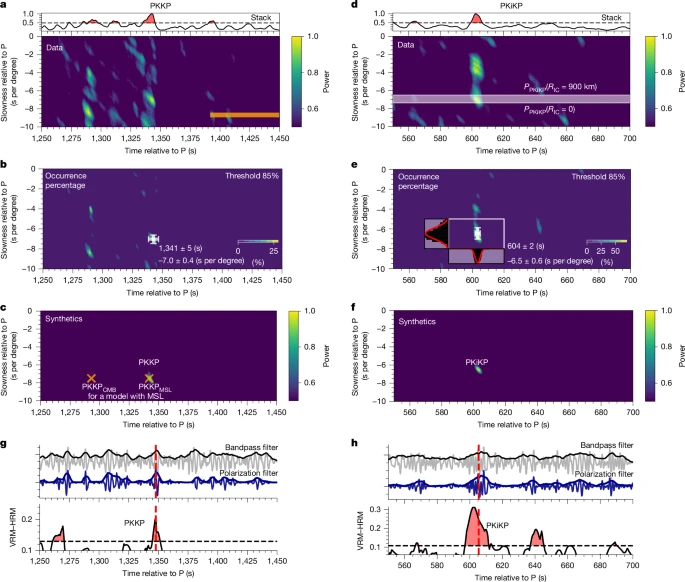
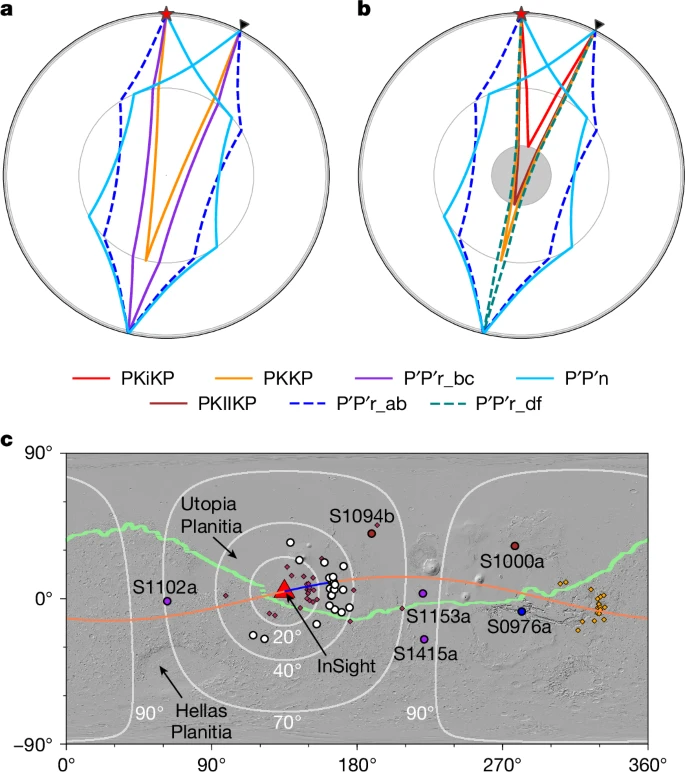
Using seismic data from InSight, which operated on the Martian surface from 2018 to 2022, the researchers identified two key seismic phases: PKKP, which passes through the deep core, and PKiKP, which reflects off the boundary of a solid core. The PKKP waves arrived 50–200 seconds earlier than expected for a fully liquid core, indicating the presence of solid material.
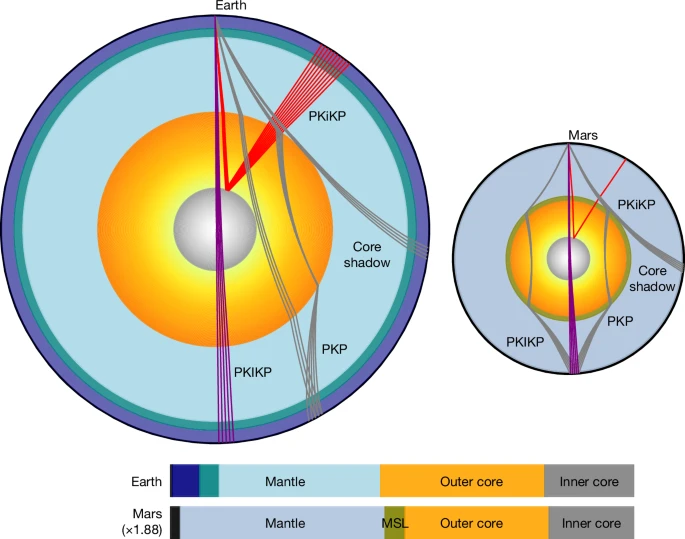
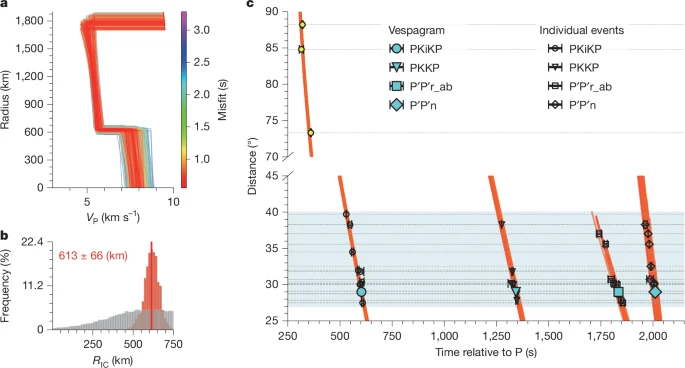
From these measurements, the radius of Mars’s inner core was determined to be 613 ± 67 km (380 ± 41 miles). A ~30% jump in compressional wave velocity across the inner core boundary suggests that light elements are distributed differently in the solid and liquid portions of the core, likely as a result of crystallization.
This crystallization process has major implications for Mars’s magnetic history. Although the planet’s crust preserves traces of an ancient magnetic field, Mars no longer generates a global dynamo. The formation of a solid inner core and segregation of light elements may have played a role in shutting down this process billions of years ago.
The findings represent the first confirmed detection of a solid inner core in a planet other than Earth.
References:
1 Seismic detection of a 600-km solid inner core in Mars – Huixing Bi, Daoyuan Sun – Nature – September 3. 2025 – https://doi.org/10.1038/s41586-025-09361-9 – OPEN ACCESS

I’m a science journalist and researcher at The Watchers, contributing to the Epicenter edition, where I cover peer-reviewed scientific research and emerging discoveries across Earth and space sciences. With a background in astronomy and a passion for environmental science, I’ve worked in shark and coral conservation in Fiji, conducting reef and shark-behavior research, contributing to mangrove restoration, and earning PADI Open Water and Coral Reef Certifications. I bring a blend of scientific rigor and storytelling to illuminate the discoveries shaping our planet and beyond.

Commenting rules and guidelines
We value the thoughts and opinions of our readers and welcome healthy discussions on our website. In order to maintain a respectful and positive community, we ask that all commenters follow these rules.