
Sharpest view yet of a solar flare reveals hidden details
Researchers using the Daniel K. Inouye Solar Telescope have measured the Sun’s thinnest coronal loops, recorded during an X1.3-class solar flare on August 8, 2024.
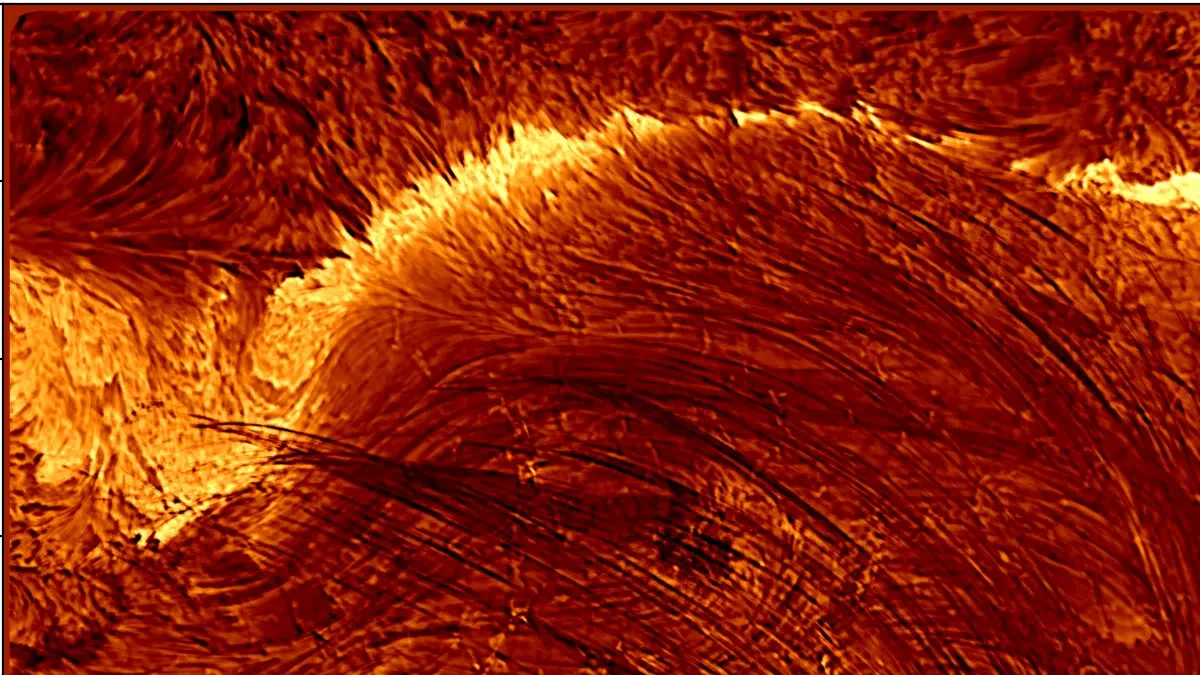
A high-resolution image of the flare from the Inouye Solar Telescope, taken at 20:12 UTC on August 8, 2024. The image is about 4 Earth-diameters on each side. Credit: NSF/NSO/AURA
The Daniel K. Inouye Solar Telescope (DKIST) captured the sharpest-ever image of a solar flare during X1.3 flare at 20:12 UTC on August 8, 2024 — recorded in the H-alpha wavelength (656.28 nm).
What makes this observation particularly significant is that it revealed the smallest coronal loops ever seen. The loops, thin filaments of plasma arching over the solar surface along magnetic field lines, averaged 48.2 km (29.9 miles) in width, with some as narrow as 24.1 km (15 miles).
These structures often appear just before solar flares, which are powered by the energy released as magnetic field lines twist, snap, and reconnect.

The event (SOL2024-08-08T19:01 UT) originated in NOAA Active Region 13777, with start, peak, and end times of 19:01, 19:35, and 19:57 UTC. DKIST’s Visible Broadband Imager (VBI) recorded the flare in H-alpha at a cadence of 2.66 s, producing a field of view of ~69″ × 69″ with pixel sampling of ~12 km per pixel.
Analysis of the 20 best-seeing frames between 20:12 and 20:25 UTC identified 686 loop cross-sections. Frame-averaged widths ranged from 44 to 56 km (27–35 miles), with the narrowest measured at 21.4 km (13 miles)—essentially at DKIST’s diffraction limit in H-alpha of ~24 km (15 miles). The combined distribution yielded a median width of 46 km (29 miles) and a mean width of 48 km (30 miles).
Loop-width distributions were statistically symmetric in most frames, unlike earlier right-skewed results from lower-resolution facilities. This suggests DKIST is resolving the elementary H-alpha strands that compose flare loops.
The measured cross-sections of ~20–80 km (12–50 miles) are nearly half the width of previous H-alpha estimates (~100 km) from the Big Bear Solar Observatory/Goode Solar Telescope (BBSO/GST), indicating that earlier detections likely represented bundles of thinner strands.
Direct constraints on loop geometry are critical for hydrodynamic and radiative-hydrodynamic flare models, where cross-sectional area strongly influences energy transport and cooling rates.
“This is the first time the Inouye Solar Telescope has ever observed an X-class flare,” said Cole Tamburri, lead author of the study.
On average, the loops measured about 48 km (30 miles) across, but some were right at the telescope’s resolution limit. “Before Inouye, we could only imagine what this scale looked like,” Tamburri added. “Now we can see it directly. These are the smallest coronal loops ever imaged on the Sun.”
The VBI instrument, tuned to the H-alpha filter, can resolve features down to ~24 km (15 miles) — over two and a half times sharper than the next-best solar telescope. “Knowing a telescope can theoretically do something is one thing,” said Maria Kazachenko, NSO scientist and study co-author. “Actually watching it perform at that limit is exhilarating.”
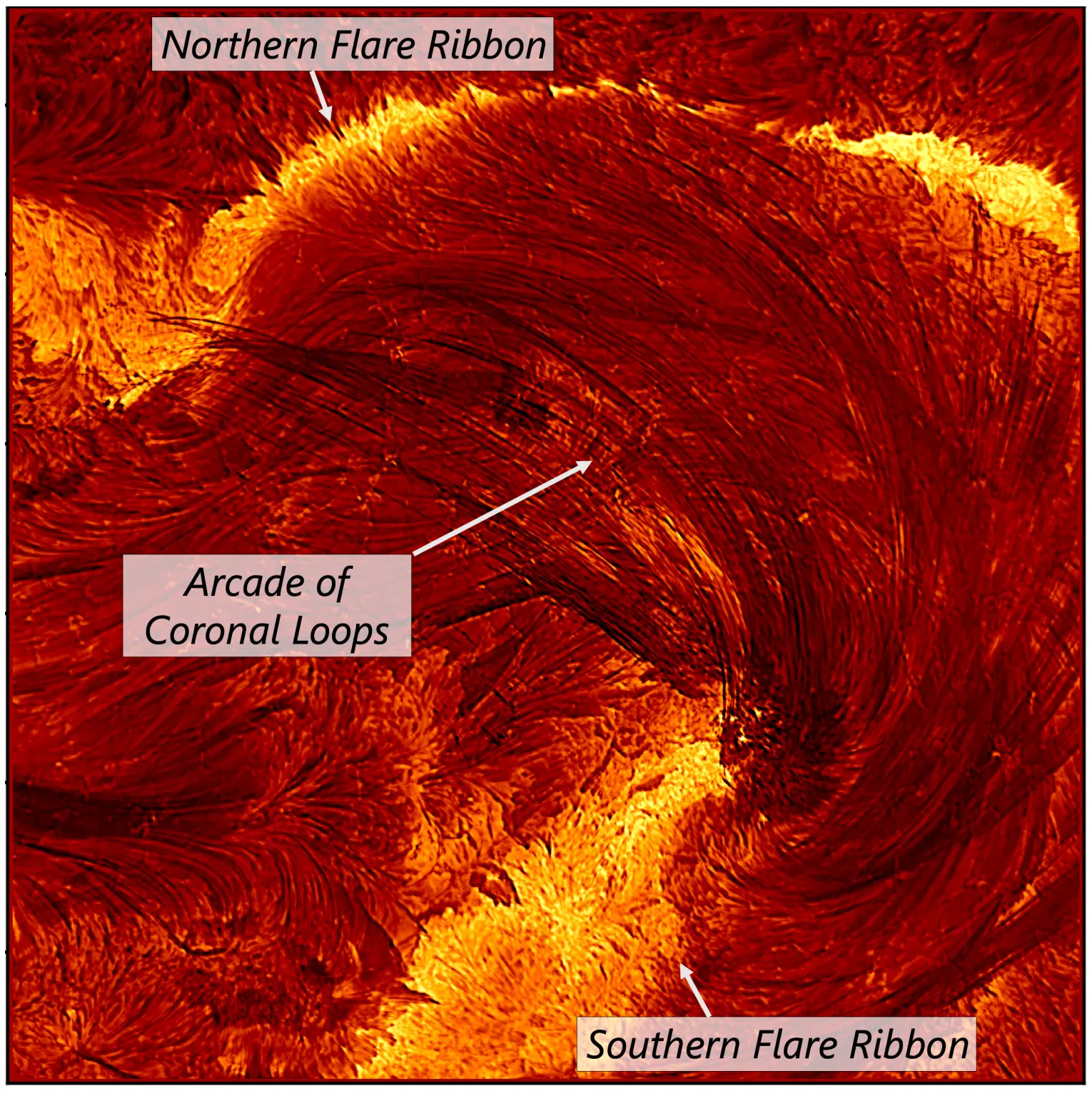
The original research plan involved studying chromospheric spectral line dynamics with the Inouye’s Visible Spectropolarimeter (ViSP). However, the VBI data revealed unexpected ultra-fine coronal structures that can directly inform flare models built with radiative-hydrodynamic codes. “We went in looking for one thing and stumbled across something even more intriguing,” Kazachenko noted.
Theories have long suggested coronal loops could range from 10 to 100 km (6.2 to 62 miles) in width, but confirming this observationally had been impossible until now. “We’re finally peering into the spatial scales we’ve been speculating about for years,” Tamburri said. “This opens the door to studying not just their size, but their shapes, their evolution, and the scales where magnetic reconnection—the engine behind flares—occurs.”
Perhaps most importantly, these loops may represent elementary structures—the fundamental building blocks of flare architecture. “If that’s the case, we’re not just resolving bundles of loops; we’re resolving individual loops for the first time,” Tamburri added. “It’s like going from seeing a forest to suddenly seeing every single tree.”
References:
1 Unveiling Unprecedented Fine Structure in Coronal Flare Loops with the DKIST – Tamburri et al. – The Astrophisical Journal Letters – August 25, 2025 – DOI 10.3847/2041-8213/adf95e

I am an Assistant Editor and Severe Weather & Science Journalist at The Watchers, specializing in real-time severe weather coverage, geophysical event reporting, and research-driven scientific analysis. You can reach me at rishav(at)watchers(.)news.

Commenting rules and guidelines
We value the thoughts and opinions of our readers and welcome healthy discussions on our website. In order to maintain a respectful and positive community, we ask that all commenters follow these rules.