
Seismic ‘snapshot’ reveals new insight into how the Rocky Mountains formed
A new seismic imaging study reveals that the Rocky Mountains formed through the stacking of two massive layers of continental lithosphere beneath western Canada, overturning the long-held view that the range sits above a sharp vertical boundary in the deep Earth.
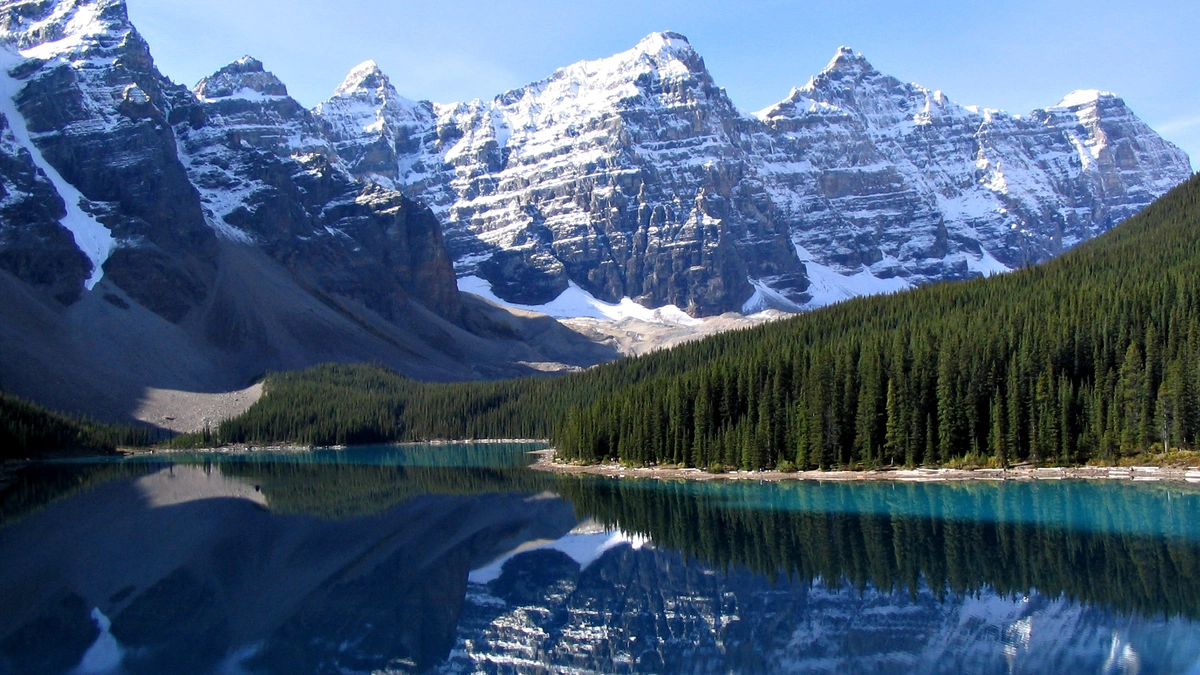
The Rocky Mountains. Credit: Gorgo/Wikimedia Commons
The research, published in Nature Communications on November 25, 2025, shows that the ancient core of North America was pushed beneath younger Cordilleran lithosphere during the Cretaceous period. The result is a layered structure that still influences the evolution of the region today.
The study was led by Songyun Huang, a graduate student at the University of Alberta, together with her supervisor Yu Jeffrey Gu. By analyzing how earthquake vibrations travel through the planet, the team produced one of the clearest images yet of the deep structure beneath the eastern Canadian Cordillera and the Rocky Mountains.
Rather than encountering a vertical step between two tectonic domains, seismic waves revealed two distinct but overlapping layers. The upper layer, known as the Cordilleran lithosphere, extends to a depth of about 75 km (47 miles). Beneath it lies the Laurentian craton, the ancient and mechanically strong core of the North American continent, which reaches down to roughly 180 km (112 miles).
Crucially, the boundary between these layers slopes gently westward at about 6°. This geometry indicates that one plate slid beneath the other instead of meeting it edge-on. For decades, many geological models assumed a near-vertical lithospheric boundary at the edge of the Rockies. The new data show that assumption was incorrect.
To obtain this image, the researchers examined subtle conversions in seismic waves generated by distant earthquakes. As shear waves pass through the Earth, they partially convert into compressional waves when they encounter changes in temperature, composition, or mechanical strength. These conversions act as precise markers of deep boundaries that cannot be observed directly.
The dataset combined recordings from 107 broadband seismic stations across western Canada and the northern United States. Nearly 4 000 high-quality seismic traces from more than 2 000 earthquakes were analyzed to build a detailed picture of the mantle beneath the region.
The geometry of the stacked layers points to a tectonic origin during the Cretaceous period, roughly 100–60 million years ago. At that time, western North America was shaped by the collision of an exotic ribbon-like continental fragment with the North American craton. As convergence continued, part of the craton was forced downward and westward beneath the Cordilleran margin.
This process resembles continental subduction, where buoyant continental lithosphere resists sinking but is nevertheless dragged beneath an adjacent plate. The seismic image preserves this frozen moment of collision deep below the surface, long after mountain building slowed at the surface.
The study also shows that the structure beneath the Rockies is not a static relic of the past. Seismic signals indicate that the base of the craton is being modified by hot mantle flow beneath the Cordillera. This process, known as convective erosion, gradually removes material from the bottom of the lithosphere over tens of millions of years.
According to the researchers, mantle flow beneath western Canada may exceed 4 cm/year (1.6 inches/year). Over geological timescales, this flow is capable of thinning and uplifting even the most stable continental roots, helping explain why the craton edge beneath the Rockies is shallower than expected.
A striking parallel exists beneath the Tibetan Plateau, where the Indian plate is currently sliding beneath Asia. There, continental collision has produced a similarly layered lithosphere extending to depths greater than 250 km (155 miles). The comparison suggests that lithospheric stacking is a common outcome of continental collisions worldwide.
These findings reshape how geologists understand the Rockies. Although the mountain range lies far from today’s active plate boundaries, its deep roots record a history of continental collision, attempted subduction, and ongoing mantle-driven change. The results also demonstrate how modern seismic networks are transforming the ability to image Earth’s interior in unprecedented detail.
The research was supported by the University of Alberta’s Future Energy Systems initiative and Discovery Grants from the Natural Sciences and Engineering Research Council of Canada. The authors note that while seismic resolution has limits, the consistency of the layered structure across multiple profiles gives strong confidence in the interpretation.
Together, the results replace a simple boundary model with a complex, evolving picture of how one of North America’s most iconic mountain ranges came into being and how it continues to change deep below the surface.
References:
1 Seismic ‘snapshot’ reveals new insight into how the Rocky Mountains formed – University of Alberta – January 20, 2026
2 Dual-layered mantle lithosphere beneath southeastern Canadian Cordillera – Huang, S., Gu, Y.J. & Johnston, S.T. – Nature Communications – November 25, 2025 – https://doi.org/10.1038/s41467-025-65437-0 – OPEN ACCESS

I’m a science journalist and researcher at The Watchers, contributing to the Epicenter edition, where I cover peer-reviewed scientific research and emerging discoveries across Earth and space sciences. With a background in astronomy and a passion for environmental science, I’ve worked in shark and coral conservation in Fiji, conducting reef and shark-behavior research, contributing to mangrove restoration, and earning PADI Open Water and Coral Reef Certifications. I bring a blend of scientific rigor and storytelling to illuminate the discoveries shaping our planet and beyond.

Commenting rules and guidelines
We value the thoughts and opinions of our readers and welcome healthy discussions on our website. In order to maintain a respectful and positive community, we ask that all commenters follow these rules.