
Rogue planet devours its birth disk at record speed
Astronomers using the European Southern Observatory’s Very Large Telescope (VLT) in Chile confirmed an extraordinary accretion event in a free-floating planet known as Cha J11070768-7626326, or Cha 1107-7626. Located about 620 light-years (190 parsecs) away in the constellation Chamaeleon, this world is growing faster than any planet ever observed.
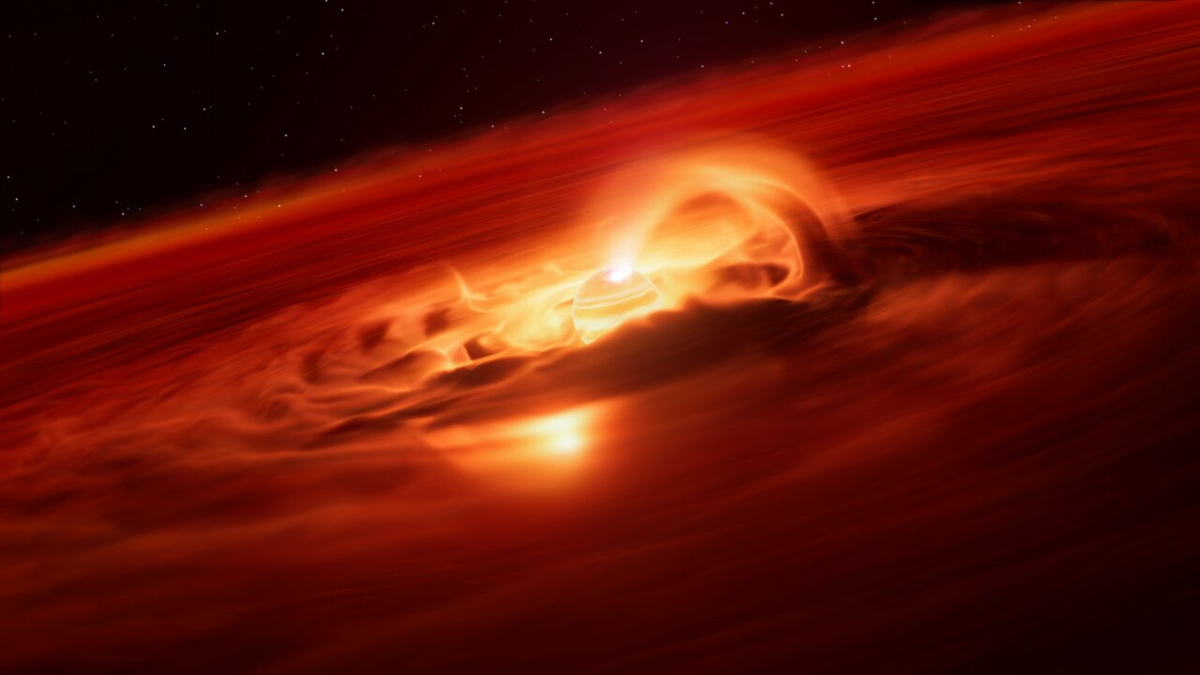
Illustration of the rogue planet Cha 1107-7626. Credit: ESO/L. Calçada/M. Kornmesser
Astronomers have recorded an astonishing burst of growth in Cha 1107-7626, a free-floating planet five to ten times the mass of Jupiter (5–10 MJ). Using ESO’s VLT, they found that this world, drifting through interstellar space without a host star, suddenly began devouring material from a surrounding disk of gas and dust.
In June 2025, the planet’s accretion rate surged to roughly 10⁻⁷ Jupiter masses per year. That is equal to six billion tonnes of gas and dust falling onto the planet every second, or 6 x 10¹² kilograms each second. To put it differently, Cha 1107-7626 is gaining nearly an Earth’s mass every two months. This was about eight times higher than its previous rate earlier that year.
Such rapid growth is the strongest accretion episode ever recorded for a planetary-mass object. The discovery was made with ESO’s X-shooter spectrograph and confirmed by observations from the James Webb Space Telescope (JWST). The data reveal that the object is still in formation, surrounded by a warm and chemically active disk.
The finding shows that planetary birth can be violent and fast, even when a planet forms in isolation rather than orbiting a star. It also suggests that rogue planets can grow in bursts, much like young stars.
Magnetic forces drive the cosmic feeding frenzy
During the outburst, the planet’s light spectrum changed dramatically. Hydrogen emission lines, especially the Hα line, became much broader and stronger, and a double-peaked profile appeared. Astronomers interpret this as evidence of magnetospheric accretion, a process in which magnetic fields guide inflowing gas along arcs from the disk to the planet’s surface.
Until now, this mechanism had only been observed in stars and brown dwarfs. Detecting it in a body with only a few times Jupiter’s mass shows that even very small objects can generate strong magnetic fields capable of controlling accretion. This makes Cha 1107-7626 a bridge between the physics of stars and planets.
In visible light, the planet became up to six times brighter, gaining 1.5 to 2 magnitudes in the R band. Mid-infrared emission increased by 10–20%. These changes reflect both the heating of the infalling material and the energy released as it slammed onto the planet.
In parallel, JWST’s Mid-Infrared Instrument (MIRI) detected water vapour in the disk, at wavelengths of 6.5–7 micrometres. The water appeared only during the burst, disappearing in earlier quiet phases. This shows that the chemistry of the disk shifts rapidly as it heats, an effect seen in young stars but never before in a planet.
The blurry boundary between planet and star
The discovery challenges the old divide between planets and stars. Co-author Aleks Scholz of the University of St Andrews notes that Cha 1107-7626 behaves much like an EXor variable, a class of young stars that undergo short-lived bursts of intense accretion. The event lasted at least two months, and older data from 2016 suggest that similar outbursts may happen repeatedly.
This means that some rogue planets might not form inside planetary systems at all. Instead, they could arise by direct gravitational collapse, the same process that gives birth to stars, only on a smaller scale. The resemblance between Cha 1107-7626 and low-mass stars extends beyond its light curve: its accretion rates, hydrogen emission features, and disk chemistry all match stellar behaviour.
Belinda Damian, also at St Andrews, said the discovery “gives us a sneak peek into the earliest formation periods of rogue planets.” If bursts like this are common, they could explain how such isolated worlds reach their mass so quickly before the disk dissipates.
Amelia Bayo of ESO adds that “the idea that a planetary object can behave like a star is awe-inspiring and invites us to wonder what worlds beyond our own could be like during their nascent stages.”
How astronomers caught it in the act
The discovery came from a campaign of five observations between April and August 2025 using VLT’s X-shooter spectrograph. Early spectra taken in April and May showed only faint hydrogen lines. By June, those lines had intensified, and by August the planet’s optical continuum had tripled, showing that the burst was ongoing.
To measure such faint emissions, the team also relied on the James Webb Space Telescope. JWST’s NIRSpec and MIRI instruments provided infrared spectra between 0.6 and 12 micrometres, revealing the hot gas and newly formed molecules in the disk. Data processing and flux calibration confirmed that the brightening was genuine and not caused by instrumental effects.
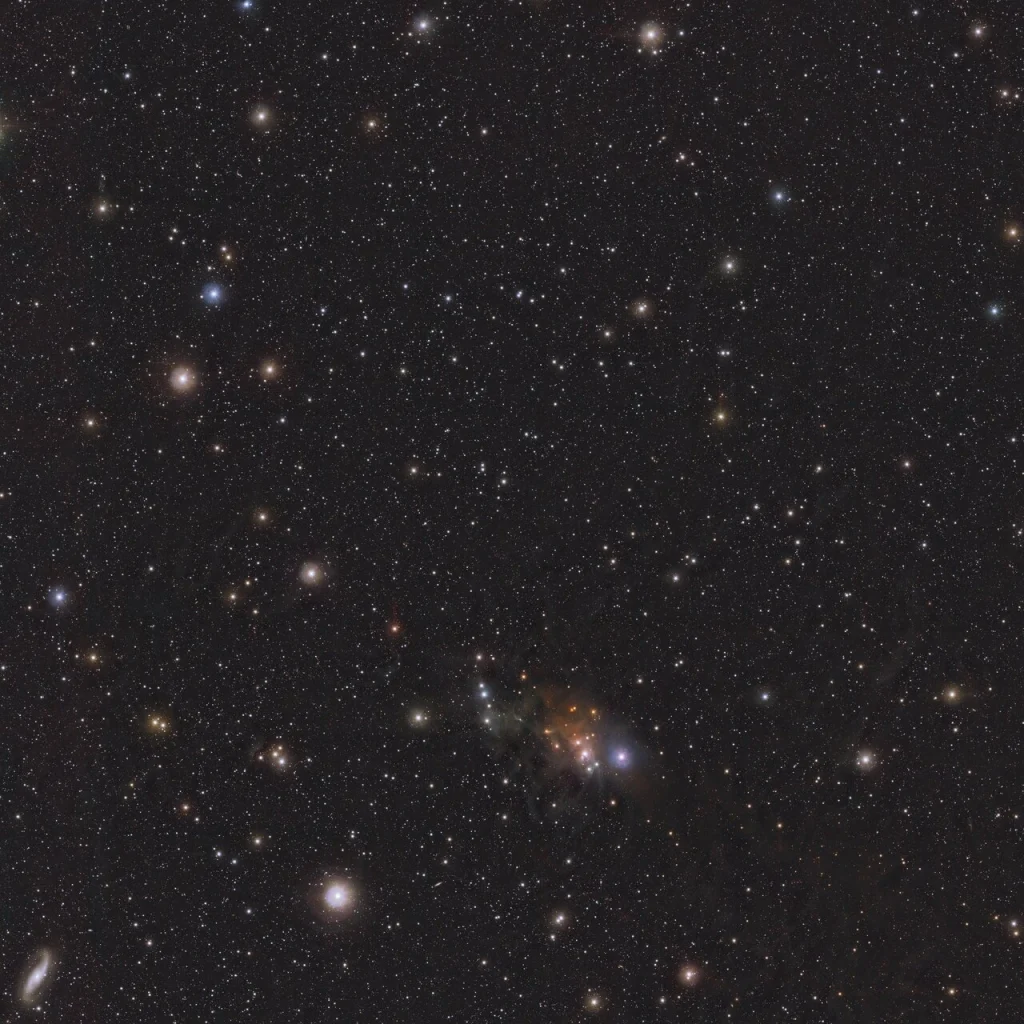
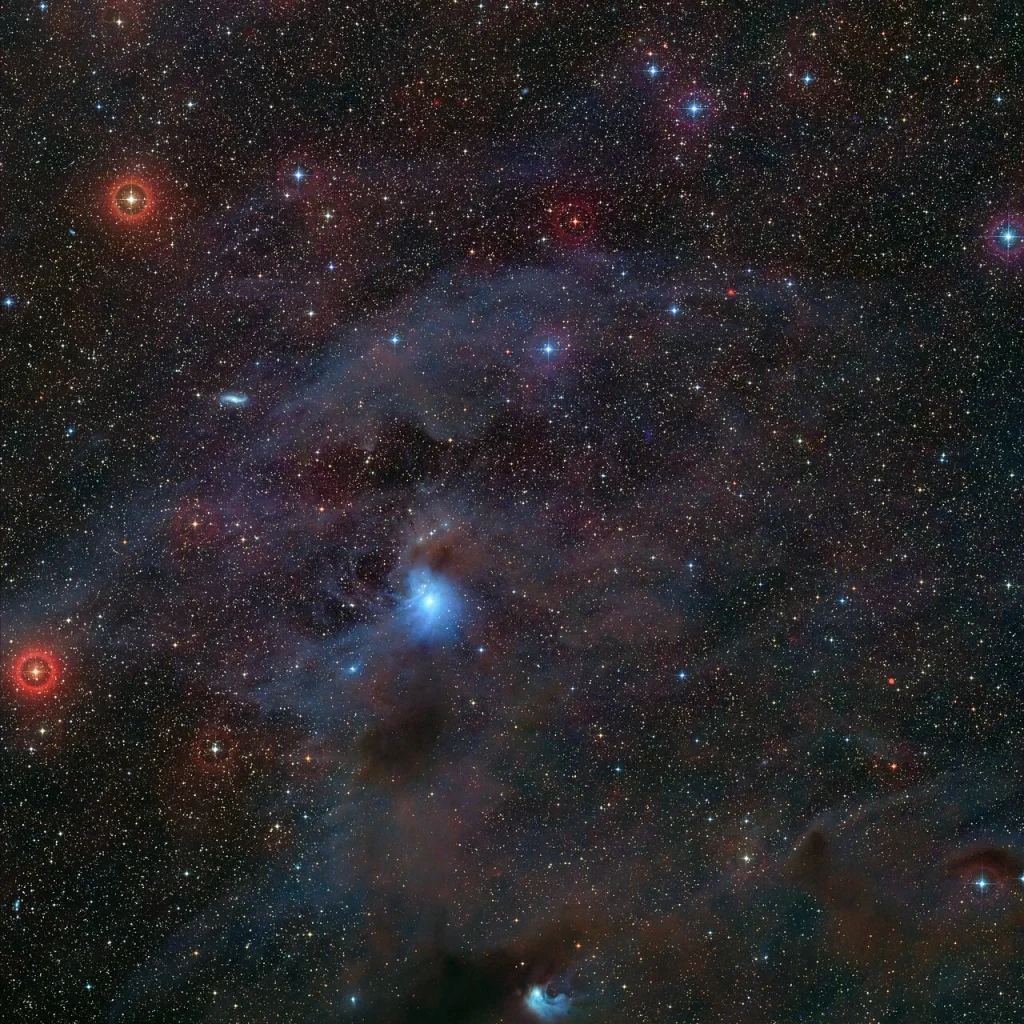
Cha 1107-7626 is located in the Chamaeleon I star-forming region, about 620 light-years (190 parsecs) from Earth. This region is rich in young stellar and substellar objects, making it ideal for studying how stars and planets form side by side. Observing such an event in this environment provides rare insight into how mass growth proceeds in the lowest-mass members of the stellar family.
Why it matters for understanding planet formation
Rogue planets like Cha 1107-7626 remain mysterious. Some may have been ejected from planetary systems, while others form directly in interstellar clouds. The behaviour of this planet supports the latter theory. Its sudden burst of growth, chemical variability, and magnetic accretion suggest it was born in isolation, following a path closer to star formation than to planetary assembly.
The presence of transient water vapour hints that these violent episodes can alter disk chemistry and possibly shape the composition of future moons or rings. Such bursts may also set the final mass of the planet, determining whether it remains a planet or crosses into brown dwarf territory.
The discovery underscores how dynamic early planet formation can be. Even without a star to orbit, a young world can experience powerful accretion episodes that change its structure and atmosphere in weeks. These processes, once thought limited to stars, now appear to operate on every scale of cosmic birth.
The next generation of telescopes will reveal more
Free-floating planets are extremely faint and difficult to detect. ESO’s Extremely Large Telescope (ELT), under construction at Cerro Armazones in Chile’s Atacama Desert, will change that. With its 39-metre mirror and advanced spectrographs, the ELT will be able to spot many more such objects, tracing how they form, grow, and interact with their disks.
By comparing new targets to Cha 1107-7626, astronomers hope to find out whether bursts like this are rare or part of a normal growth pattern for young planetary-mass bodies. Observing these events in real time will link the formation of planets, brown dwarfs, and stars into one continuous process.
The case of Cha 1107-7626 shows that the smallest worlds can behave like miniature stars. In doing so, it redefines what it means to be a planet and reminds us that cosmic evolution is far more fluid than our categories suggest.
References:
1 Six billion tonnes a second: Rogue planet found growing at record rate – ESO – October 2, 2025
2 Discovery of an Accretion Burst in a Free-Floating Planetary-Mass Object – V. Almendros-Abad et al. – ESO – August 29, 2025 – https://www.eso.org/public/archives/releases/sciencepapers/eso2516/eso2516a.pdf – OPEN ACCESS

I’m a science journalist and researcher at The Watchers, contributing to the Epicenter edition, where I cover peer-reviewed scientific research and emerging discoveries across Earth and space sciences. With a background in astronomy and a passion for environmental science, I’ve worked in shark and coral conservation in Fiji, conducting reef and shark-behavior research, contributing to mangrove restoration, and earning PADI Open Water and Coral Reef Certifications. I bring a blend of scientific rigor and storytelling to illuminate the discoveries shaping our planet and beyond.

Commenting rules and guidelines
We value the thoughts and opinions of our readers and welcome healthy discussions on our website. In order to maintain a respectful and positive community, we ask that all commenters follow these rules.