
Rare type Iax supernova bridges key luminosity gap in stellar explosions
Astronomers published detailed observations of SN 2022xlp this month, a rare intermediate luminosity type Iax supernova in the galaxy NGC 3938 about 72 million light years away.
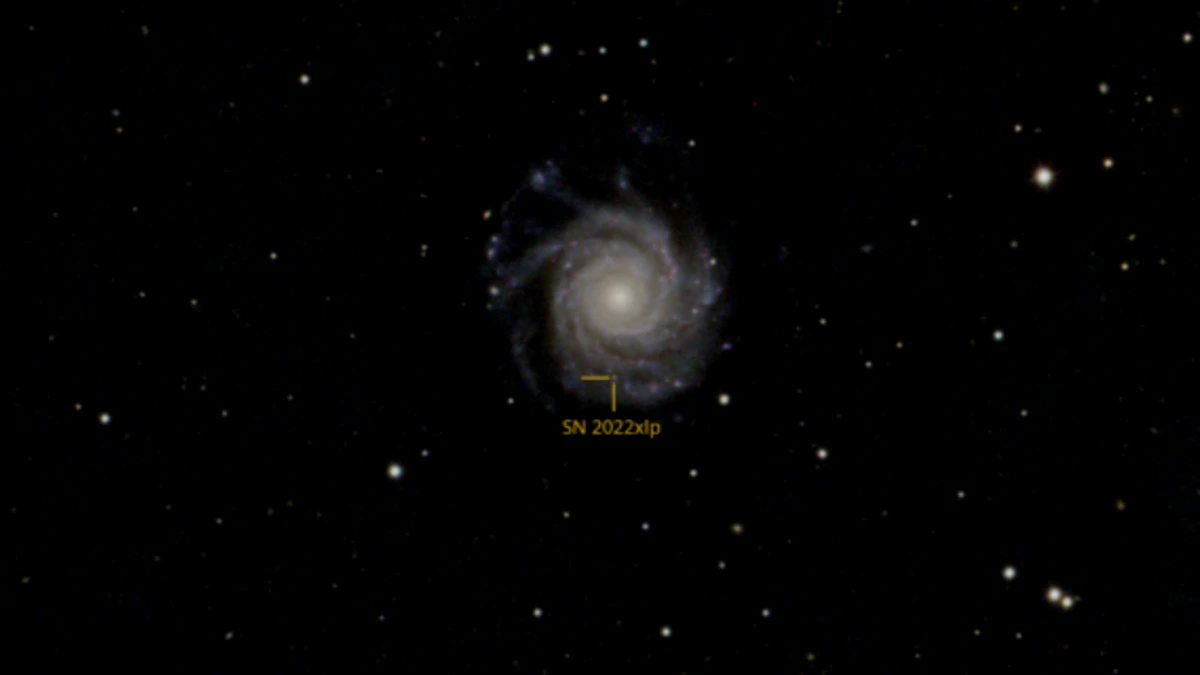
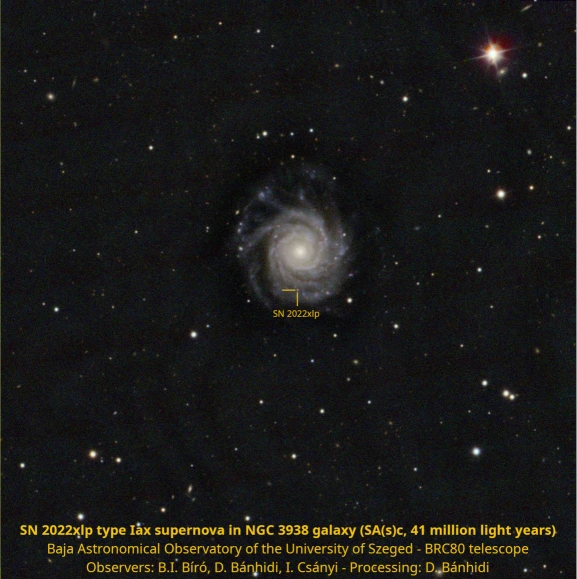
Image of NGC 3938 hosted the SN 2022xlp. Credit: SN 2022xlp: The second-known well-observed, intermediate-luminosity Iax supernova. D. Bánhidi et al.
Type Iax supernovae are a rare subgroup of type Ia events — explosions of white dwarfs in binary systems. Normal Ia supernovae completely disrupt the white dwarf and reach high luminosities, making them useful for measuring cosmic distances. In contrast, Iax explosions leave behind a remnant star, produce lower velocities, and are less bright.
SN 2022xlp was discovered in spiral galaxy NGC 3938. Its peak brightness was −16.04 ± 0.25 magnitude in the V band, placing it between faint events such as SN 2008ha and brighter representatives like SN 2012Z. Until now, only SN 2019muj had been studied in detail at this intermediate brightness.
Watching a white dwarf flicker out
The explosion of SN 2022xlp is estimated to have occurred on MJD 59861.8 ± 0.5. Astronomers began follow up observations about six days later and tracked the event for 73 days. They used multiple ground based telescopes, including the BRC80 in Szeged and the Las Cumbres network, along with the Swift space telescope for ultraviolet data.
The light curve shows a rise time of about 12 days before reaching maximum. Rapid color evolution revealed a cooling photosphere, with color indices shifting by about 1.5 magnitudes between eight days before and 20 days after the explosion. Such a steep reddening is unusual compared to normal type Ia events.
Analysis of the bolometric light curve indicates the production of about 0.0215 ± 0.009 solar masses of radioactive nickel. The explosion released roughly (2.066 ± 0.236) × 10⁴⁹ erg and ejected about 0.142 ± 0.015 solar masses of material. These values are lower than typical type Ia supernovae but close to those of SN 2019muj.
The fingerprints of a partial detonation
Spectral data showed strong similarities to SN 2019muj. Early observations captured photospheric velocities of about 5 400 km/s and temperatures near 11 870 K, which dropped to 4 400 km/s and 6 937 K around 19 days after explosion, and continued to decline at later times.
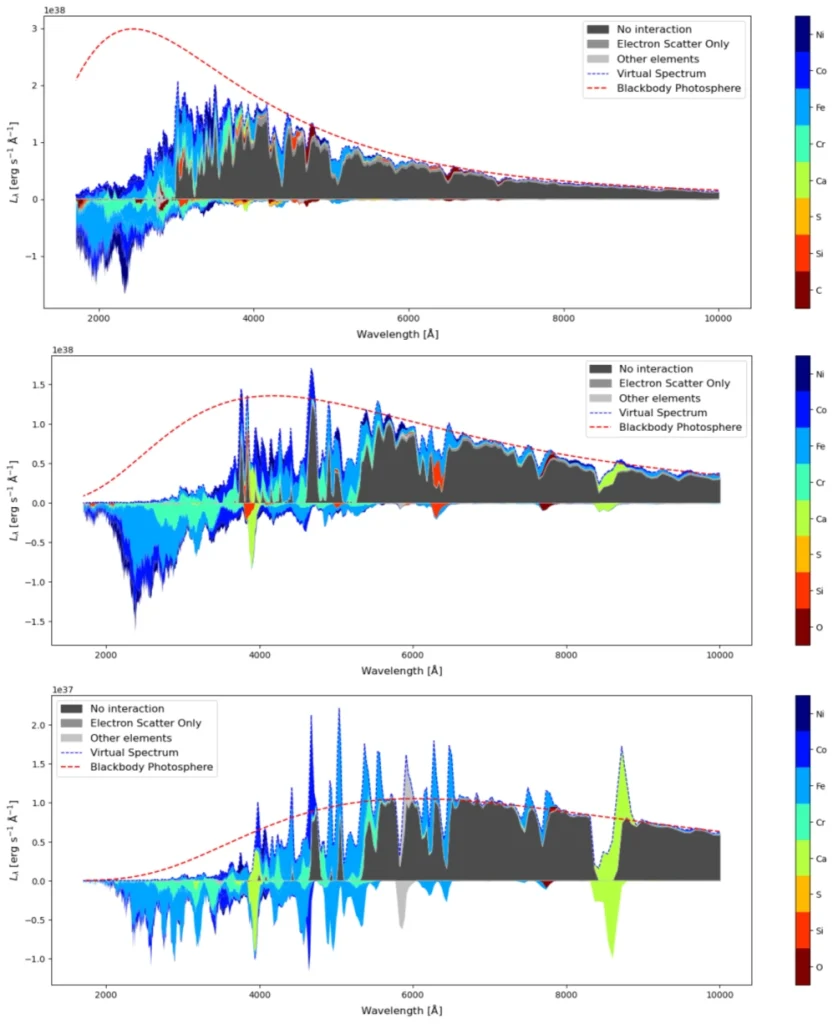
The spectra were dominated by iron group elements such as cobalt, nickel, and iron. Sodium and calcium features strengthened as the supernova cooled, with the Na I D line especially prominent. This required models to assume an unusually high sodium abundance and a corresponding reduction in oxygen.
To analyze the ejecta structure, astronomers applied spectral tomography using the TARDIS radiative transfer code. The best fits required modifying density profiles predicted by pure deflagration models. A steep cutoff above 4 400 km/s had to be imposed to avoid excessively strong early spectral lines, suggesting a different outer ejecta structure than standard models.

Why SN 2022xlp matters for stellar evolution
SN 2022xlp fills an important gap in the observed range of type Iax supernovae. Together with SN 2019muj, it demonstrates that these explosions form a continuous sequence of luminosity, ejecta mass, and explosion energy. This challenges the idea that faint and bright Iax events are separate categories.
The findings also confirm that pure deflagration models, in which burning begins but fails to detonate the entire white dwarf, can explain much of the observed diversity. However, adjustments in outer density and sodium abundance are necessary, showing that more complex physics may be at work.
Because Iax explosions leave behind remnants, they affect the long term evolution of galaxies differently than full disruptions. Understanding their frequency and diversity helps astronomers model how many white dwarfs survive partial explosions and how those remnants evolve.
With its intermediate brightness, SN 2022xlp serves as a bridge between faint and bright members of its class. It confirms that Iax supernovae represent a spectrum of outcomes rather than rare anomalies.
Each new well observed event brings researchers closer to understanding how white dwarfs die, sometimes in total annihilation and sometimes in partial survival.
References:
1 SN 2022xlp: The second-known well-observed, intermediate-luminosity Iax supernova – arXiv – September 9, 2025 – https://arxiv.org/html/2509.07717v1 – OPEN ACCESS

I’m a science journalist and researcher at The Watchers, contributing to the Epicenter edition, where I cover peer-reviewed scientific research and emerging discoveries across Earth and space sciences. With a background in astronomy and a passion for environmental science, I’ve worked in shark and coral conservation in Fiji, conducting reef and shark-behavior research, contributing to mangrove restoration, and earning PADI Open Water and Coral Reef Certifications. I bring a blend of scientific rigor and storytelling to illuminate the discoveries shaping our planet and beyond.

Commenting rules and guidelines
We value the thoughts and opinions of our readers and welcome healthy discussions on our website. In order to maintain a respectful and positive community, we ask that all commenters follow these rules.