
Rare meteorite points to Moon-sized parent body in early Solar System
Researchers from the University of Colorado Boulder report what they describe as the first direct evidence that angrite meteorites originated within a large planetary embryo rather than a small asteroid. The findings, published in Earth and Planetary Science Letters on April 10, 2026, are based on pressure estimates derived from mineral crystals preserved in the rare meteorite Northwest Africa (NWA) 12774.
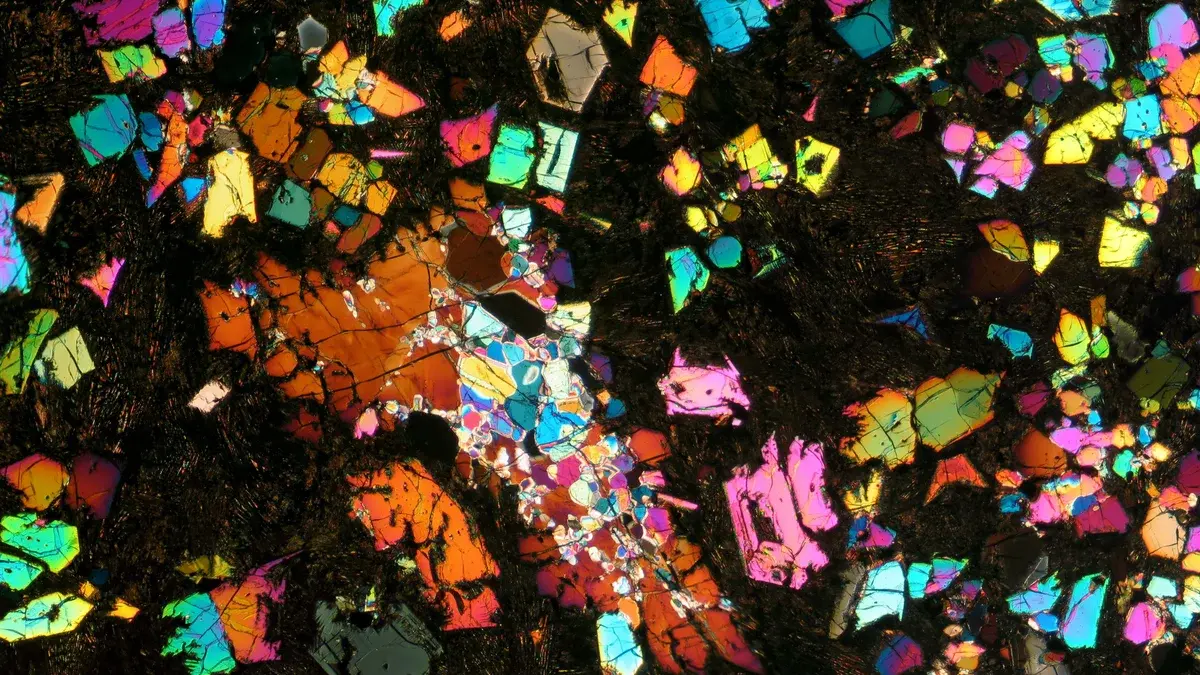
A thin slice of the NWA 12774 meteorite. The colors arise from various minerals responding to the slice’s illumination by cross-polarized light, Credit: John Kashuba
A rare meteorite recovered from the Sahara Desert has provided what researchers describe as the first direct evidence that angrites originated within a large planetary embryo rather than a small asteroid. Pressure estimates derived from mineral crystals preserved in the meteorite indicate its parent body was at least 1 000 km (621 miles) in radius and may have exceeded 1 800 km (1 118 miles), making it comparable in size to Earth’s Moon.
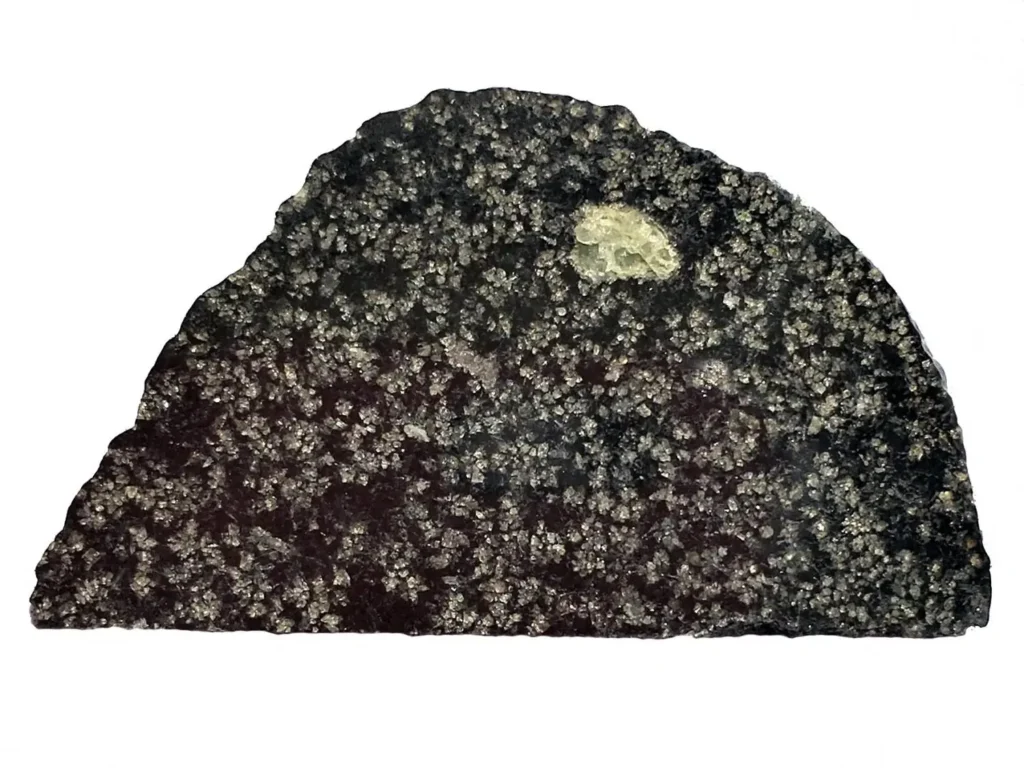
NWA 12774 is an angrite, a rare type of meteorite that formed during the earliest stages of Solar System history. Fewer than 70 angrites are known among more than 80 000 cataloged meteorites, and they rank among the oldest volcanic rocks ever identified, having crystallized only a few million years after the first solids condensed from the solar nebula about 4.56 billion years ago. Despite decades of study, the size and nature of the body from which they originated has remained one of the major unresolved questions in planetary science.
Researchers found that mineral crystals preserved within NWA 12774 formed under pressures far greater than those expected inside a small asteroid. Their analysis suggests the meteorite originated within a much larger body than previously thought, providing the first direct constraints on the size of the angrite parent body.
Angrites have long puzzled researchers because they differ chemically from Earth, Mars and most other rocky planetary bodies. Their unusually low silica content led many scientists to conclude they originated from a relatively small differentiated asteroid with a radius of roughly 100–200 km (62–124 miles).
Aaron S. Bell, Laura Waters, and Mark Ghiorso, researchers at the University of Colorado Boulder and co-author Mark Ghiorso, developed a new clinopyroxene-liquid geobarometer designed specifically for angritic meteorites to test that assumption.
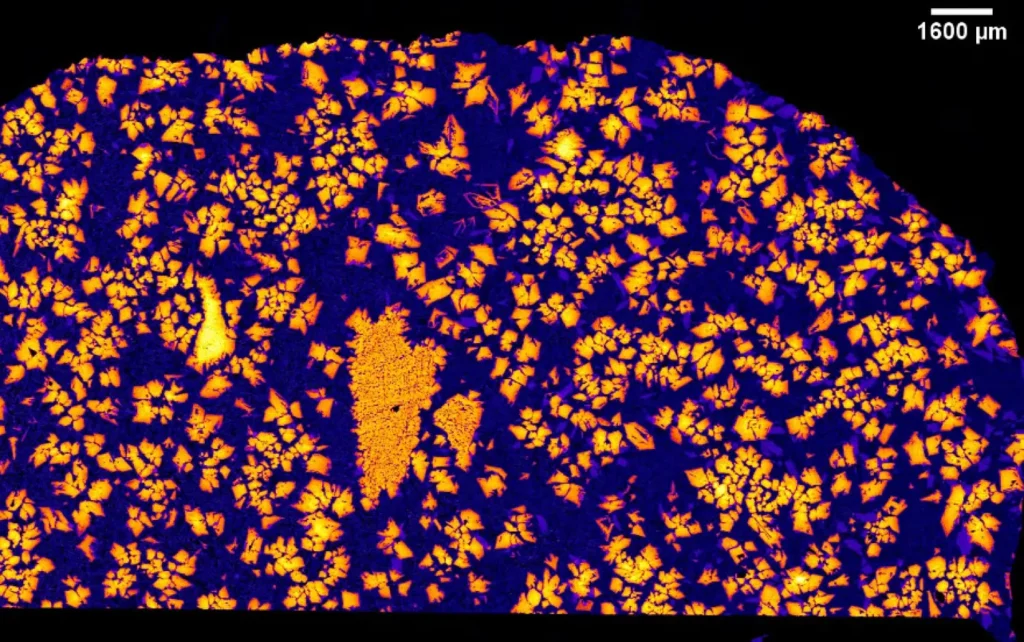
NWA 12774 contains unusually aluminum-rich clinopyroxene crystals. According to the authors, the chemistry of those crystals records formation under pressures far greater than those expected inside a small asteroid.
Existing geobarometers are poorly suited to angrites because angritic melts are strongly depleted in alkalis. To overcome that limitation, the researchers developed a thermodynamic model based on pressure-sensitive relationships between the crystals and the melt from which they formed.
Applied to NWA 12774, the model yielded a mean crystallization pressure of 17.56 ± 0.89 kbar. For comparison, pressure at the bottom of the Mariana Trench is about 1 kbar, indicating the meteorite recorded conditions more than 15 times greater than those found in Earth’s deepest ocean.
The pressure estimates require a parent body at least 1 000 km (621 miles) in radius. According to the paper, this represents the minimum size capable of generating the recorded pressures if crystallization occurred at the greatest possible depth within the body, near the core-mantle boundary.
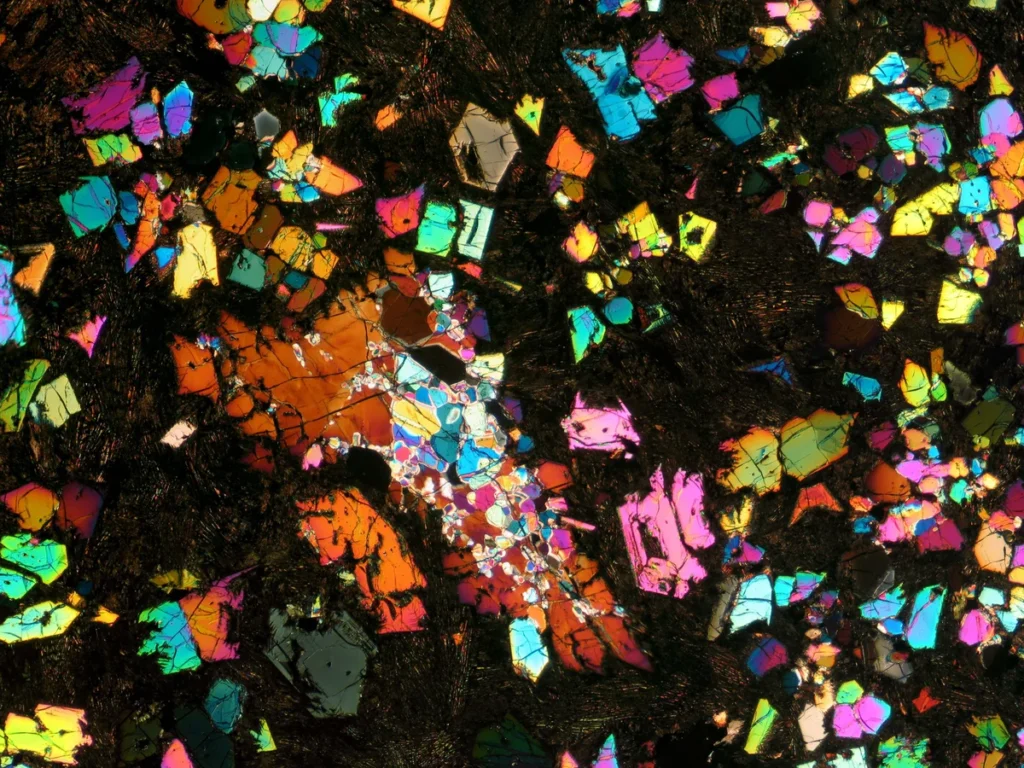
The meteorite preserves additional evidence suggesting the crystals formed much closer to the surface. NWA 12774 retains sharp crystal boundaries and delicate chemical zoning patterns that may not have survived prolonged storage deep within a planetary interior.
If crystallization occurred less than 200 km (124 miles) below the surface, the parent body would need to exceed about 1 800 km (1 118 miles) in radius to generate the same pressure conditions. Earth’s Moon has a radius of about 1 737 km (1 079 miles).
The findings support the large angrite parent body hypothesis proposed by earlier experimental and thermodynamic studies, which suggested angrites may have originated within a Moon- to Mars-sized protoplanet that was later disrupted during the Solar System’s earliest evolution.
Planet formation models predict that numerous planetary embryos formed rapidly during the first few million years of Solar System history before being disrupted, incorporated into larger worlds, or scattered. Bell and colleagues argue that angrites may represent rare surviving fragments of that early population.
The study also has implications for the composition of the early Solar System. Previous work cited by the authors suggests the angrite parent body may have formed from an unusual mixture containing substantial amounts of refractory high-temperature nebular condensates, materials that condensed very early from the solar nebula. The large size inferred for the parent body suggests those materials may have contributed more significantly to the construction of early planetary bodies than previously recognized.
“We only know it existed because a few fragments of it happened to land on Earth,” Bell said in a University of Colorado Boulder release. “These meteorites preserved evidence of a completely different pathway through which early planets developed.”
The parent body has not been identified, and the study does not determine how it was destroyed. However, the pressure signatures preserved in NWA 12774 provide what the authors describe as the first direct evidence that angrites originated within a large planetary embryo rather than a small asteroid.
References:
1 High-pressure clinopyroxene in Northwest Africa 12774 and new geobarometric evidence for a planetary embryo-sized angrite parent body – Aaron S. Bell, Laura Waters, Mark Ghiorso – Earth and Planetary Science Letters – April 10, 2026 – https://doi.org/10.1016/j.epsl.2026.120029
2 Rare meteorite provides evidence of giant early planet – CU Boulder Today – June 1, 2026

I’m a science journalist and researcher at The Watchers, contributing to the Epicenter edition, where I cover peer-reviewed scientific research and emerging discoveries across Earth and space sciences. With a background in astronomy and a passion for environmental science, I’ve worked in shark and coral conservation in Fiji, conducting reef and shark-behavior research, contributing to mangrove restoration, and earning PADI Open Water and Coral Reef Certifications. I bring a blend of scientific rigor and storytelling to illuminate the discoveries shaping our planet and beyond.

Commenting rules and guidelines
We value the thoughts and opinions of our readers and welcome healthy discussions on our website. In order to maintain a respectful and positive community, we ask that all commenters follow these rules.