
Rare 225 m (738 feet) crater discovered on Moon
A 225 m (738 feet) impact crater that formed on the Moon in late spring 2024 has been identified in imagery from NASA’s Lunar Reconnaissance Orbiter, marking the largest crater found to have formed during the mission. According to crater production models, an impact large enough to create a crater of this size should occur only once every 139 years.
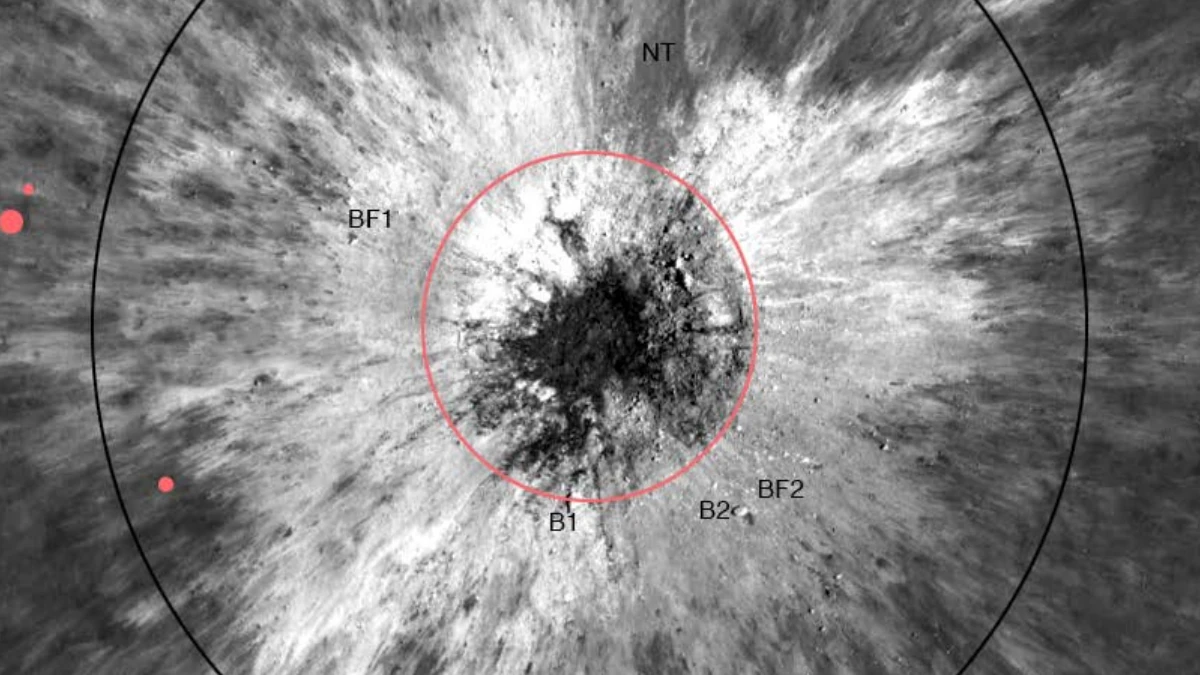
New 225 m (738 feet) crater discovered on the Moon. Image credit: Robinson et al.
A newly formed impact crater measuring about 225 m (738 feet) in diameter was identified on the Moon using imagery from NASA’s Lunar Reconnaissance Orbiter, with analysis indicating the impact occurred in late spring 2024.
It is the largest crater found to have formed during the LRO mission, more than 3 times larger in diameter than the previous record-holder at 70 m (230 feet).
Crater production models indicate that a crater of this diameter should form about once every 139 years on the lunar surface. The event was identified through temporal image comparisons, providing meter-scale observations of the surface before and after impact.
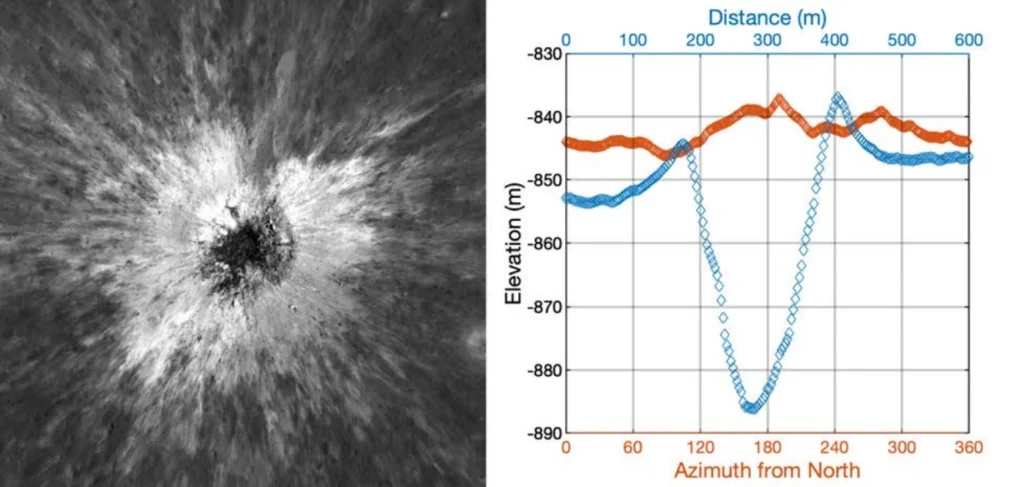
profile tracing lowest slope values around crater rim (red). Profile starts at the 12 o’clock position and runs around the
crater clock-wise. Note the rim is highest on the southern side. The blue profile runs down the NT (Fig. 2) through
the crater center and across the southern rim, near the peak of the rim traverse profile (red). Credit: Robinson et al.
Preliminary morphometric analysis shows the crater has an average diameter of 225 m (738 feet), ranging from 220 to 230 m (722 to 755 feet). The crater has a mean depth of 43 m (141 feet), giving a depth-to-diameter ratio of 0.19, typical of the freshest craters of this size.
A pre-impact LOLA profile indicates the eastern rim stands about 8 m (26 feet) above the pre-existing terrain at that point, close to the 9 m (30 feet) predicted by theory. The crater is funnel-shaped, with wall slopes typically above 25° and locally exceeding 35° along a ledge about 10 m (33 feet) below the eastern rim.
The crater interior contains a small hummocky floor about 15 x 30 m (49 x 98 feet) in size. Low-reflectance material within the crater is interpreted as glassy, quenched impact melt, although no pooled melt deposits were observed, consistent with the impact veneer class.
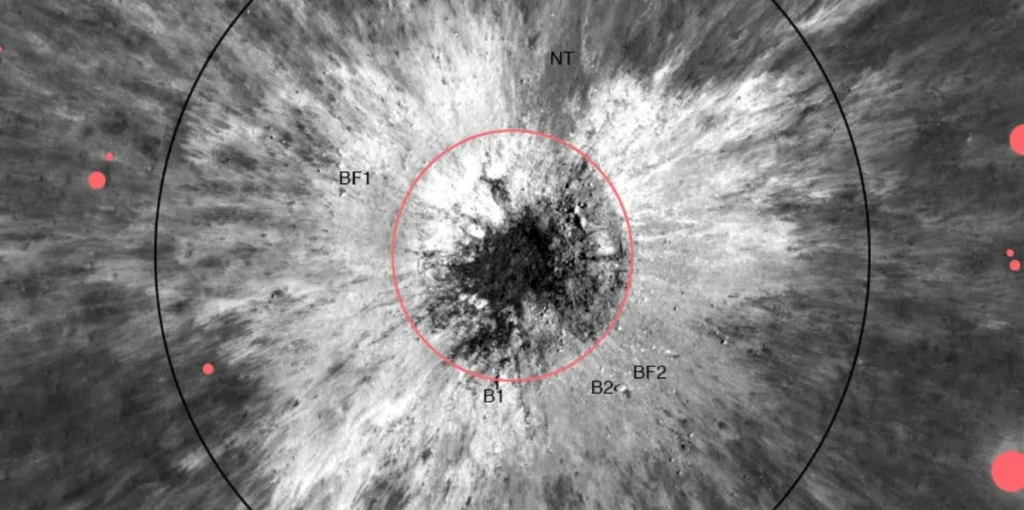
The highest-reflectance ejecta lies primarily within two crater radii of the rim, where reflectance exceeds twice that of relatively undisturbed nearby terrain. Most preexisting craters within this zone were either obliterated or degraded beyond detection.
Two block fields were identified on opposite sides of the crater, with the largest ejected blocks measuring 13 x 9 x 6 m (43 x 30 x 20 feet) and 9 x 6 x 3 m (30 x 20 x 10 feet). The ejecta pattern and block distribution suggest an impact azimuth from the south-southwest toward the north-northeast.
The meter-scale before-and-after imagery provides a rare opportunity to test models of small-impact crater formation against direct observations.
References:
1 Robinson, M. S., Boyd, A. K., Mahanti, P., Manheim, M. R., Speyerer, E. J., & Wagner, R. V. (2026, March). A new 225-m diameter crater on the Moon [Conference abstract]. 57th Lunar and Planetary Science Conference, Abstract 1896.

I am an Assistant Editor and Severe Weather & Science Journalist at The Watchers, specializing in real-time severe weather coverage, geophysical event reporting, and research-driven scientific analysis. You can reach me at rishav(at)watchers(.)news.

Commenting rules and guidelines
We value the thoughts and opinions of our readers and welcome healthy discussions on our website. In order to maintain a respectful and positive community, we ask that all commenters follow these rules.