
New data refine the number of eruptions within the Yellowstone caldera
Scientists at the Yellowstone Volcano Observatory have identified at least 28 eruptions within the Yellowstone Caldera since it formed 631 000 years ago, a minimum estimate based on preserved geologic evidence. Ongoing work is focused on refining this count by identifying older eruptions whose deposits were buried or obscured by younger lava flows.

The Grand Prismatic hot spring in Yellowstone National Park is sourced from a magma chamber beneath it. The bright colours are produced by hydrophilic bacteria in the mineral-rich water. Credit: Bing Li
The findings were presented in Yellowstone Caldera Chronicles, a weekly column written by scientists and collaborators of the Yellowstone Volcano Observatory. The analysis was authored by Mark Stelten, Deputy Scientist in Charge of the observatory, and Nicole Thomas, a geologist with the U.S. Geological Survey.
Yellowstone’s volcanic history includes three caldera-forming eruptions over the past 2.1 million years. The most recent, 631 000 years ago, created the present-day caldera and marked a shift toward smaller rhyolite lava flows and domes confined largely within the caldera rather than continent-wide eruptions.
Geologic mapping and age dating identify at least 28 eruptions within the caldera since its formation. This is a minimum count based on eruptions that can be confidently recognized in the geologic record, as earlier eruptive deposits are often obscured by younger lava flows, and in many areas, only small, isolated outcrops remain, limiting insight into their extent or age. Glaciation and erosion have further modified the landscape, removing or redistributing volcanic material.
To reconstruct Yellowstone’s eruptive history, geologists combined detailed field mapping with geochemistry, geochronology, and paleomagnetics. Chemical compositions distinguish magma batches, radiometric ages constrain eruption timing, while paleomagnetic signatures preserved during lava cooling separate eruptions that formed at different times.
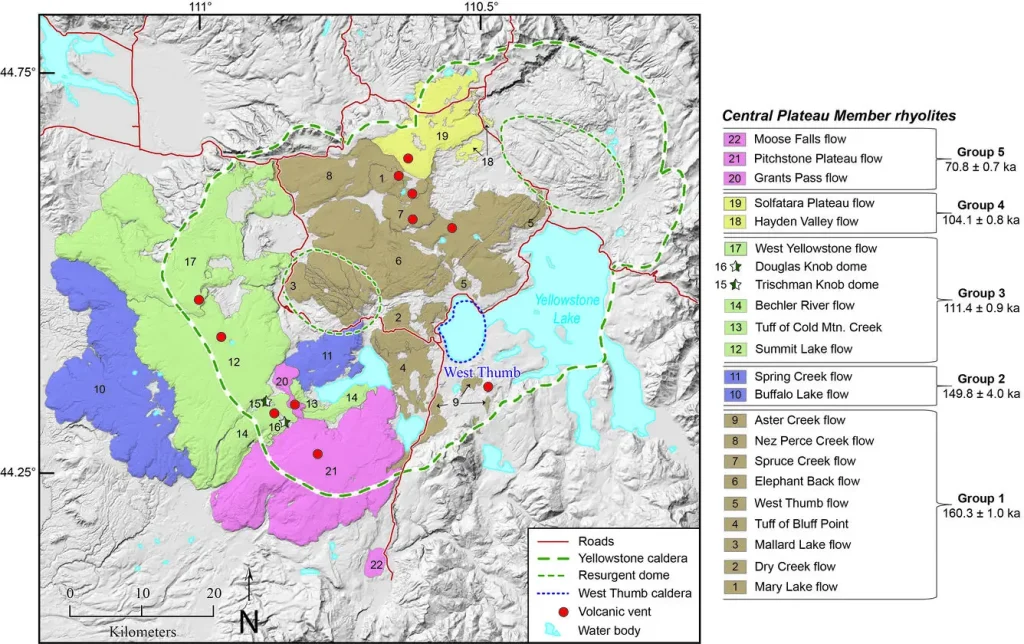
The Central Plateau Member rhyolites form one of the best-studied post-caldera eruptive sequences and cover much of the caldera floor. New 40Ar 39Ar dating divides these flows into five informal eruption groups, with mean ages reported at the 95 percent confidence level, improving resolution between closely spaced eruptions.
The West Thumb region of Yellowstone Lake adds another layer to this picture. It is thought to be the vent area for an explosive eruption that produced the Tuff of Bluff Point, showing that post-caldera volcanism was not limited to lava flows alone.
A lava flow exposed in Hayden Valley was previously linked to an eruption dated at about 102 000 years but the new data suggest the lava may be closer to 160 000 years old, suggesting a previously unrecognized eruption. USGS scientists collected samples from this flow in 2025 for argon dating, with results pending.
Field work in 2025 also identified a small lava exposure along the Gibbon River near Nez Perce Creek that appears to lie beneath a known flow. Geochemical analysis and argon dating will determine whether this exposure represents a distinct eruption or part of an already identified unit.
In addition, researchers from Montana State University have identified volcanic deposits northwest of the caldera near Madison Junction. The deposits may represent eruptions that occurred shortly before the caldera-forming event 631 000 years ago, helping overcome the gap between pre-caldera and post-caldera activity.
References:
1 How many eruptions has Yellowstone had? – USGS – January 19, 2026

I’m a science journalist and researcher at The Watchers, contributing to the Epicenter edition, where I cover peer-reviewed scientific research and emerging discoveries across Earth and space sciences. With a background in astronomy and a passion for environmental science, I’ve worked in shark and coral conservation in Fiji, conducting reef and shark-behavior research, contributing to mangrove restoration, and earning PADI Open Water and Coral Reef Certifications. I bring a blend of scientific rigor and storytelling to illuminate the discoveries shaping our planet and beyond.

Commenting rules and guidelines
We value the thoughts and opinions of our readers and welcome healthy discussions on our website. In order to maintain a respectful and positive community, we ask that all commenters follow these rules.