
Maui residents showed elevated metal burdens months after 2023 wildfires
A study of 1 400 Maui adults found unusually high urinary concentrations of several metals 6–18 months after the August 2023 wildfires, while participants with greater combined metal burdens were more likely to have abnormal lung-function tests. Antimony showed the largest difference, at nearly 40 times U.S. reference values, but the researchers caution that the study identifies statistical associations and cannot determine how much of the measured burden came directly from the fires.
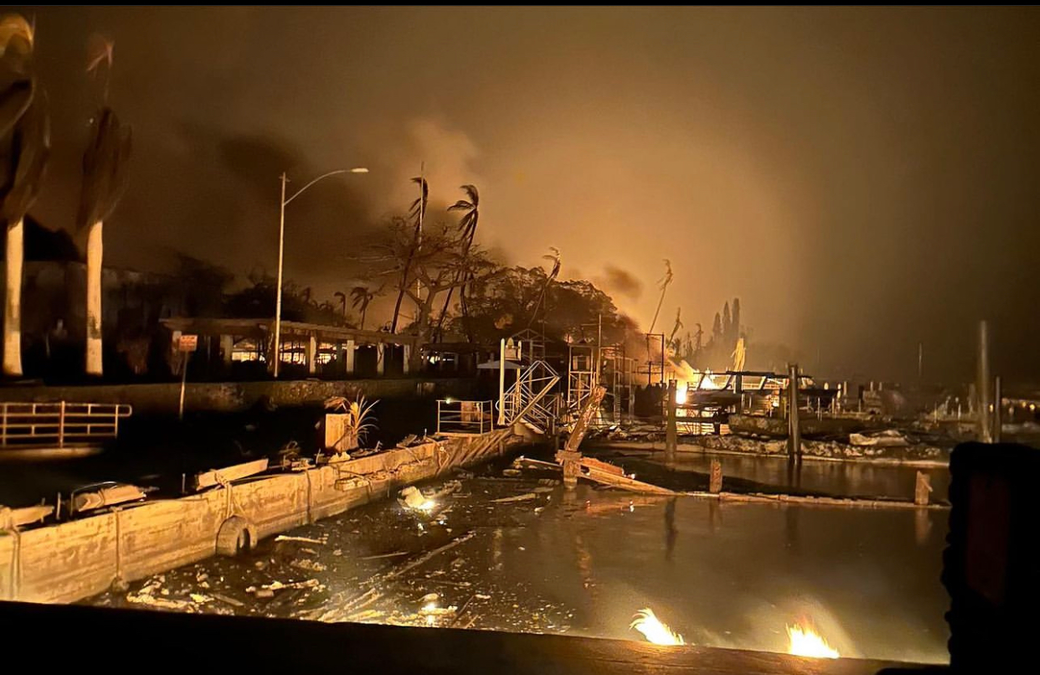
On August 8, 2023, the island of Maui experienced a major wildfire disaster fueled by windy and dry conditions. Credit: U.S. Coast Guard Hawai'i Pacific District 14
Wildland–urban interface fires burn much more than vegetation. When flames move through towns, homes, vehicles, electrical systems and other manufactured materials can become part of the combustion environment, creating exposure pathways that extend beyond the smoke normally associated with wildfires. Acute respiratory effects of wildfire smoke are well established, but persistent internal metal mixtures and their relationship with lung function after urban-interface fires have remained poorly characterized.
Researchers with the University of Hawaiʻi-led Maui Wildfire Exposure Study examined that question using the August 2023 disaster as a case study. They evaluated 1 400 adults 6–18 months after the fires, measured 24 metals in urine and assessed pulmonary function by standardized spirometry during the same visit. The paired measurements allowed the researchers to compare internal metal burden with objective measures of how well participants’ lungs were functioning.
Compared with U.S. reference values, urinary antimony concentrations were nearly 40-fold higher in the Maui cohort. Manganese was 3.8-fold higher, barium 2.3-fold higher and arsenic 2.2-fold higher. The highest concentrations clustered in regions most affected by the fires.
Urinary biomonitoring does not mean that researchers found metals inside participants’ lungs. It measures substances that have entered the body and are being excreted, providing a different view of exposure from environmental sampling of air, soil or ash. Spirometry was conducted separately during the same study visit to assess pulmonary function.
Rather than evaluate each metal only in isolation, the researchers used three complementary statistical approaches to examine the combined burden from metal mixtures. Across those analyses, greater cumulative exposure was consistently associated with higher odds that pulmonary measurements would fall below the lower limit of normal. The models measure exposure-response associations; they do not establish that the metals caused the observed abnormalities.
In the weighted quantile sum analysis, each one-quantile increase in the positive metal-mixture index was associated with odds ratios of 1.71 for abnormal forced vital capacity (FVC), 1.53 for abnormal forced expiratory volume in one second (FEV1), 1.83 for an abnormal FEV1/FVC ratio and 1.84 for abnormal forced expiratory flow between 25% and 75% of FVC (FEF25–75). An odds ratio above 1 represents greater odds of the measured outcome as the mixture index rises. Arsenic, cadmium and copper made the strongest contributions to that positive mixture index.
FVC measures how much air a person can forcefully exhale after a full breath, while FEV1 measures the volume expelled during the first second. Together with the FEV1/FVC ratio and mid-expiratory flow, the measurements give researchers different views of airway and overall ventilatory function. In this study, they served as objective respiratory outcomes against which the internal metal mixture was statistically evaluated.
The exposure environment created by a wildland–urban interface fire is more complicated than that produced by burning vegetation alone. The PNAS researchers noted that such fires can mobilize legacy contaminants while producing smoke. University of Hawaiʻi researchers said the Maui fire environment included burned homes, cars, electronics, treated lumber, electrical systems and other infrastructure, each potentially contributing to a complex mixture of substances in ash, dust and debris.
Environmental monitoring carried out during Maui’s recovery provides a separate view of that contamination. The Hawaiʻi Department of Health collected daily airborne-particle samples in Lahaina from January 15, 2024 through February 19, 2025 and tested them for 16 metals. With two exceptions on August 25, 2024, the department said measured concentrations were extremely low and below levels designed to protect public health.
Those air-monitoring results and the MauiWES biomonitoring findings are not measurements of the same thing. Air sampling records contaminants present at particular locations during a defined sampling period. Human biomonitoring captures substances that have entered the body through potentially multiple routes and over different time frames. The study authors concluded that reliance on air monitoring alone may underestimate longer-term internal toxic burden following wildland–urban interface disasters.
The study cannot determine that the 2023 fires caused every elevated metal concentration measured in participants. University of Hawaiʻi researchers said the observed burden may reflect overlapping geological, agricultural, industrial, dietary and other environmental exposures that existed before the disaster, together with contaminants newly introduced or remobilized by the fires. No pre-fire biomonitoring baseline was available to determine precisely how much of each participant’s burden came directly from the wildfire.
That limitation defines the next scientific problem. Longitudinal biomonitoring, combined with continued environmental sampling, is needed to determine which metal burdens persist, where they originate and how they change as communities move further from the disaster.
The Maui results provide evidence that post-fire health surveillance may need to examine internal exposure as well as conditions in the surrounding environment, while leaving the relative contribution of individual exposure sources unresolved.
References:
1 Manika, A. K., Le, B., de la Hoz, R. E., Lee, A. G., Zhang, Z., Kamaka, M., Lowery, M., Umeda, L., Yamamoto, B., Schilling, K., & Juarez, R. (2026). Climate-amplified wildland-urban interface disasters create persistent internal metal mixtures associated with pulmonary impairment. Proceedings of the National Academy of Sciences of the United States of America, 123(40), e2613208123. https://doi.org/10.1073/pnas.2613208123
2 VNR: Toxic metals found in Maui residents months after 2023 wildfires, UH study finds – University of Hawaiʻi at Mānoa – September 28, 2026
3 Maui Wildfire Data: Air – State of Hawaiʻi Department of Health – accessed October 13, 2026

I’m a science journalist and researcher at The Watchers, contributing to the Epicenter edition, where I cover peer-reviewed scientific research and emerging discoveries across Earth and space sciences. With a background in astronomy and a passion for environmental science, I’ve worked in shark and coral conservation in Fiji, conducting reef and shark-behavior research, contributing to mangrove restoration, and earning PADI Open Water and Coral Reef Certifications. I bring a blend of scientific rigor and storytelling to illuminate the discoveries shaping our planet and beyond.
