
Marine volcanic plateaus tied to at least 4 Triassic extinction events
A study published recently in Geology identifies marine large igneous provinces (LIPs) as the cause of at least four mass extinctions during the Triassic period, addressing a long-standing question about what triggered the era’s repeated die-offs.
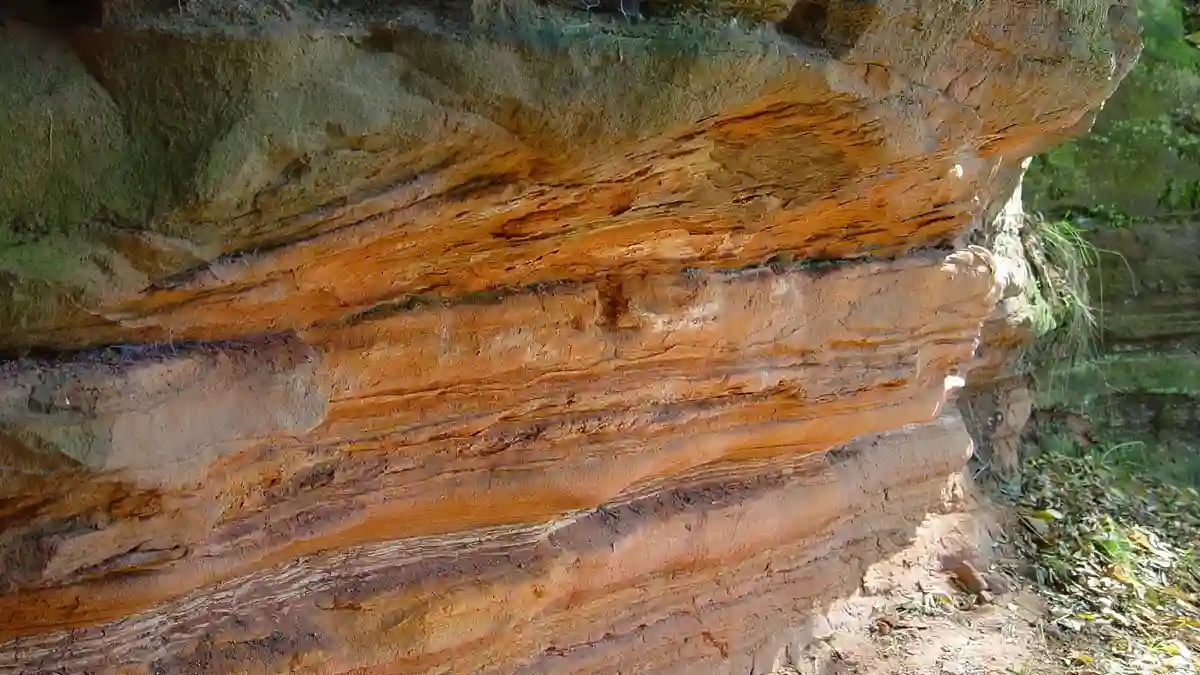
Early Triassic sandstone (Buntsandstein) near Stadtroda, Germany. Credit: ArtMechanic
While the five major mass extinctions in Earth’s history are well studied, the mechanisms behind frequent smaller extinctions have been poorly understood. Events like the Norian-Rhaetian Extinction during the Triassic have lacked clear explanations, leaving gaps in our understanding of how life responded to environmental shocks during this period.
Jian-Jun Fan and colleagues analyzed oceanic island, seamount, and plateau remnants preserved in the Tibetan Plateau to trace the evolution of the Meso- and Neo-Tethys oceans. These geological features contain the physical evidence needed to reconstruct ancient volcanic activity and connect it to biological crises.
The research team found three major episodes of marine LIP formation during the Triassic, at 250–248 million years ago, 233–231 million years ago, and 210–208 million years ago.
When they compared the timing of volcanic episodes with Triassic extinction records, they found a direct match with at least four marine die-offs.
The extinctions were driven by anoxic-euxinic events, periods when massive volcanic eruptions stripped oxygen from ocean waters and created toxic conditions for marine life. Marine LIPs account for roughly half of all Triassic extinctions with an identifiable geological trigger, making them a primary driver of recurrent mass extinctions during this time.
Studying ancient marine LIPs presents a serious challenge. Subduction destroys much of the evidence when ocean basins close, making these volcanic events difficult to identify and even harder to date with precision.
The authors write that “this destruction renders such records difficult to identify and, even when identified, challenging to interpret and date precisely.”
Fan and colleagues propose that orogenic belts, the remnants of vanished ocean basins, contain fragments of previously unrecognized marine LIPs. If correct, this means numerous unexplained extinctions throughout Earth’s history could be traced back to marine volcanic activity now hidden within mountain ranges.
If marine LIP fragments are preserved in orogenic belts around the world, the geological record may contain evidence for extinction triggers that have gone undetected because the volcanic sources were destroyed by tectonics.
The study offers a new approach to investigating what the authors call “a persistent and unresolved frontier issue in Earth sciences” by examining mountain belts for traces of ancient ocean floor volcanism that standard methods would miss.
References:
1 Fan, J.-J., Sun, S.-L., Zhou, J.-B., Wilde, S. A., Wang, Y., & Lv, J.-P. (2026). Marine large igneous provinces: Key drivers of Triassic recurrent extinction. Geology. https://doi.org/10.1130/G53406.1 – OPEN ACCESS

I’m a science journalist and researcher at The Watchers, contributing to the Epicenter edition, where I cover peer-reviewed scientific research and emerging discoveries across Earth and space sciences. With a background in astronomy and a passion for environmental science, I’ve worked in shark and coral conservation in Fiji, conducting reef and shark-behavior research, contributing to mangrove restoration, and earning PADI Open Water and Coral Reef Certifications. I bring a blend of scientific rigor and storytelling to illuminate the discoveries shaping our planet and beyond.

Fellow Watchers, here are the major recognised episodes of marine LIP formation based on recent data:
Triassic (Mass Extinction Links)
250–248 Ma: Early Triassic.
233–231 Ma: Mid-Triassic.
210–208 Ma: Late Triassic.
Jurassic
Central Atlantic Magmatic Province (CAMP): ~201–197 Ma (marine basins associated with the opening of the Atlantic).
Karoo-Ferrar Province: 183–180 Ma.
Cretaceous (Highest Frequency)
Caribbean Large Igneous Province (CLIP): Approximately 139–69 Ma, with intense phases around 120 Ma, 90 Ma, and late-stage eruptions.
Ontong Java Plateau (OJP): ~122 Ma (main pulse), with massive volcanic activity occurring between 125–120 Ma.
Kerguelen Plateau: Initiated around 110 Ma.
High Arctic Large Igneous Province (HALIP): 130–95 Ma.
Madagascar Plateau & Mozambique Ridge: Part of the Cretaceous clustering, closely tied to the breakup of Gondwana. ?-?Ma
Paleogene (Early Cenozoic)
North Atlantic Igneous Province (NAIP): 62–50 Ma, with significant volcanic activity occurring 60.5–55 Ma (related to the Palaeocene-Eocene Thermal Maximum).
Deccan Traps (Marine/Coastal segments): 66–65 Ma (connected with the Réunion hotspot).
My apologies for not citing. Feel Earth changing through those! Sense nested-cycles?
Cool how this spans what is assumed to be one Galactic Year. And to think the LLSVPs are suggested in-place through this.