
Hidden solar waves explain the Sun’s million-degree corona
Scientists have directly observed small-scale torsional Alfvén waves in the Sun’s corona for the first time using the Daniel K. Inouye Solar Telescope in Hawaii, as reported in Nature Astronomy on October 24, 2025.

Exterior of the U.S. National Science Foundation (NSF) Daniel K. Inouye Solar Telescope in Hawaii. Credit: NSF/NSO/AURA
For decades, solar physicists have searched for evidence of magnetic waves that twist through the Sun’s atmosphere, transferring energy from its surface into space. These elusive motions, known as torsional Alfvén waves, were first predicted by Swedish physicist and Nobel laureate Hannes Alfvén in 1942.
The new observations confirm that these waves are not rare events triggered by flares but are instead a constant feature of the quiet Sun. They continuously twist magnetic field lines back and forth across the corona, acting as invisible threads that carry energy outward.
The research team was led by Professor Richard Morton of Northumbria University in the United Kingdom. “This discovery ends a search that began in the 1940s,” Morton said. “We have finally been able to directly observe these torsional motions in the corona.”
Morton and his collaborators used the world’s most powerful solar telescope, the Daniel K. Inouye Solar Telescope, operated by the U.S. National Science Foundation (NSF) and its National Solar Observatory (NSO), in Hawaii. The telescope’s four-meter mirror allows it to capture more light and finer detail than any solar instrument before it.
The discovery marks a turning point in our understanding of how magnetic energy moves through the Sun’s outer layers. It provides the missing observational link between the Sun’s turbulent surface and the searing heat of its corona.
How the discovery was made
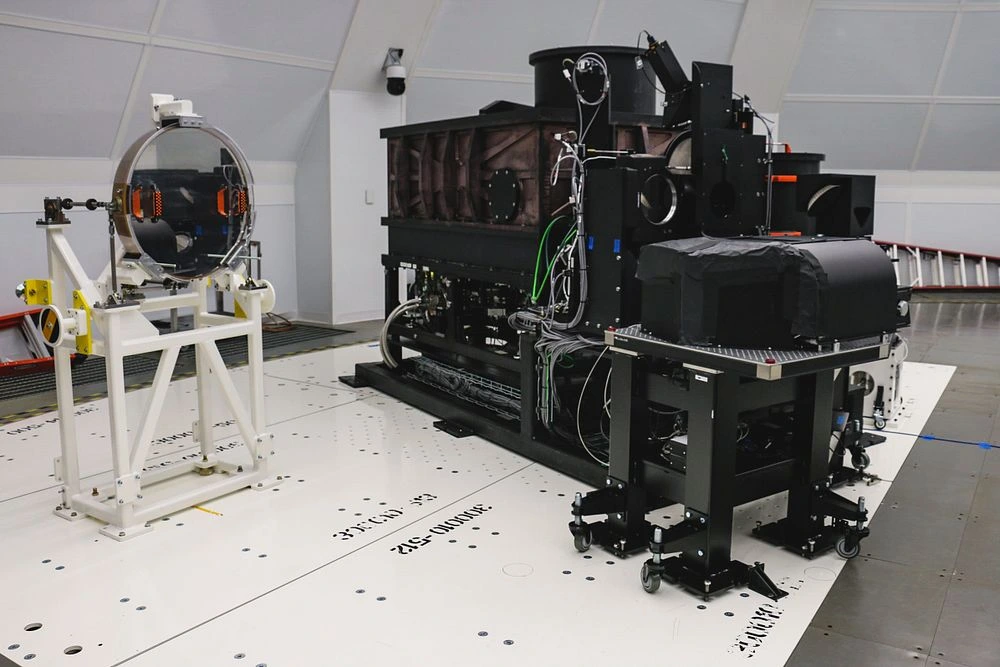
The breakthrough relied on the telescope’s Cryogenic Near Infrared Spectropolarimeter, or Cryo-NIRSP. This advanced instrument can detect minute shifts in the wavelength of light, revealing how plasma in the corona moves toward or away from Earth.
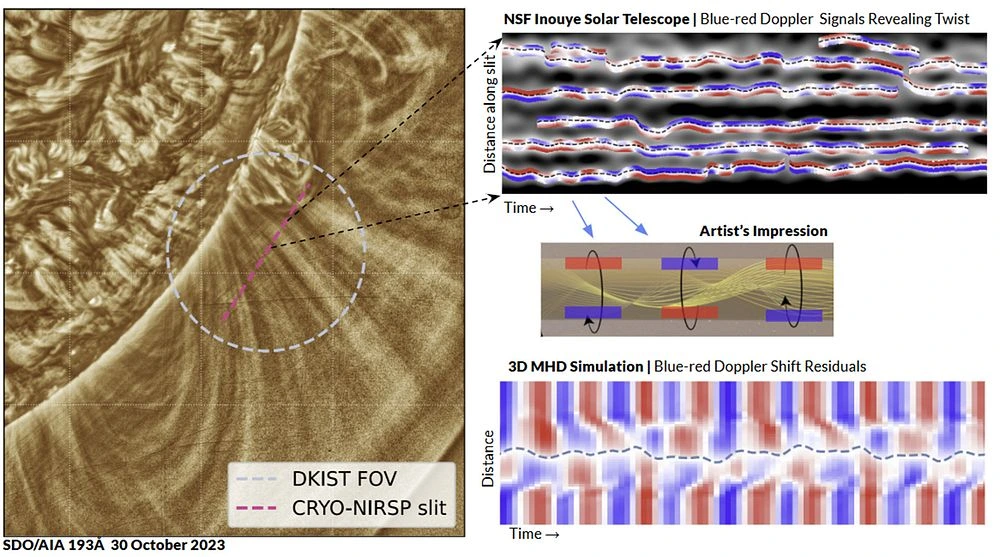
Morton’s team observed emission from highly ionized iron at 1 074.7 nanometers, produced by plasma heated to about 1.6 million°C (2.9 million°F). By analyzing Doppler shifts in this spectral line, the researchers could detect opposing motions on either side of thin magnetic loops. These red and blue shifts are the telltale signatures of twisting plasma — the long-sought torsional Alfvén waves.
To separate these twisting motions from larger oscillations that cause whole structures to sway, known as kink waves, Morton developed new data analysis techniques. By removing the dominant swaying patterns, the team uncovered the smaller twisting signals hidden beneath.
The observations were supported by 3D magnetohydrodynamic simulations, which recreated the twisting motions within coronal flux tubes and confirmed that the Doppler signatures matched theory. This cross-validation between observation and modeling was essential in distinguishing genuine torsional waves from other types of plasma motion.
Taken together, the results show that the corona supports a dynamic mixture of both kink and torsional Alfvén waves, providing new insight into how magnetic energy travels through the Sun’s atmosphere.
The mystery of the million-degree corona
One of the biggest puzzles in solar physics has been how the Sun’s outer atmosphere reaches temperatures of over one million kelvin (about 1.8 million°F), while its surface remains only 5 500°C (9 932°F).
This temperature inversion defies normal expectations. In most systems, moving away from the heat source results in cooler temperatures. Yet the corona, hundreds of kilometers above the solar surface, is hundreds of times hotter.
Alfvén waves have long been a prime suspect. These waves can carry energy along magnetic field lines without compressing the plasma, allowing energy to move upward from the convective zone to the outer atmosphere. The new findings show that these waves are not only present but pervasive, offering a direct route for energy to flow from the solar surface to the corona.
The research estimates that torsional Alfvén waves have velocity amplitudes of about 19.5 km/s (12 mps). When combined with kink waves, the total energy flux is between 100 and 400 watts per square meter, enough to heat the corona and drive the solar wind.
This result validates decades of theoretical modeling and finally provides the observational proof that the corona’s heat can be sustained by Alfvénic turbulence — a mechanism that converts magnetic motion into thermal energy.
Why this matters beyond the Sun
Understanding how magnetic energy is transferred and dissipated in the Sun’s atmosphere is not just a matter of astrophysical curiosity. It directly affects the solar wind, the constant stream of charged particles that flows through the solar system.
The solar wind carries magnetic disturbances that can disturb Earth’s magnetosphere, affecting satellites, communication systems, and power grids. By revealing how Alfvén waves form and evolve, the new observations improve models of solar wind acceleration and space weather forecasting.
NASA’s Parker Solar Probe has detected sudden magnetic reversals known as switchbacks in the solar wind. These could be linked to torsional Alfvén waves originating in the corona. The direct detection of these twisting motions provides a new framework for interpreting Parker’s in situ measurements.
Understanding wave-driven energy transport also helps explain phenomena in other stars. Many magnetically active stars show outer atmospheres that are far hotter than their surfaces, suggesting that similar mechanisms may operate throughout the galaxy.
For researchers studying space weather, this discovery represents a leap toward predictive models that connect the smallest magnetic motions on the Sun to their far-reaching effects across the solar system.
An international effort and technological milestone
The Inouye Solar Telescope is the culmination of more than twenty years of design and construction involving hundreds of scientists and engineers worldwide. Its four-meter aperture gathers sixteen times more light than previous solar telescopes, allowing it to observe features as small as 87 km (54 miles) across on the Sun’s surface.
Northumbria University played a key role as part of a United Kingdom consortium that developed cameras for the telescope’s Visible Broadband Imager. The same expertise in solar imaging contributed to the analysis techniques used in this study.
Morton obtained telescope time while DKIST was still in its commissioning phase, a rare opportunity that allowed him to test new observational strategies. These early experiments produced the first clear view of twisting plasma motions in coronal loops.
The research team included scientists from Peking University, KU Leuven in Belgium, Queen Mary University of London, the Chinese Academy of Sciences, and the U.S. National Solar Observatory in Hawaii and Colorado. Funding came from the UK Research and Innovation Future Leaders Fellowship, the National Natural Science Foundation of China, and the European Union’s Horizon Europe program.
The study represents the third major paper from Morton’s group in 2025. Earlier this year, he published two related works on Alfvén waves in The Astrophysical Journal and The Astrophysical Journal Letters, building toward this milestone in Nature Astronomy.
A new window into solar physics
The direct detection of torsional Alfvén waves signals the beginning of a new era in high-resolution solar observation. The Inouye Solar Telescope, with its combination of large aperture and advanced infrared instruments, now allows scientists to study the Sun’s magnetic field in unprecedented detail.
Future observations will focus on how these waves propagate and dissipate their energy, shedding light on the processes that heat the corona and accelerate the solar wind. By tracking how the twisting motions evolve over time, researchers hope to understand how magnetic turbulence transforms motion into heat.
Because the telescope can resolve motions on scales of only 0.12 arcseconds — about 87 km (54 miles) — it can reveal structures smaller than any other solar instrument. The Cryo-NIRSP’s ability to measure polarization also opens the possibility of mapping the magnetic field directly in the corona.
As Morton’s team concluded, the corona is not static but alive with constant twisting, a reminder that even in its quietest moments, the Sun is a vast ocean of magnetic motion. This discovery transforms a decades-old hypothesis into observable reality, providing the foundation for the next generation of solar physics.
References:
1 Discovery of elusive solar waves that could power the Sun’s corona – Northumbria University – October 24, 2025
2 Evidence for small-scale torsional Alfvén waves in the solar corona – R. J. Morton et al. – Nature Astronomy – October 24, 2025 – https://doi.org/10.1038/s41550-025-02690-9 – OPEN ACCESS

I’m a science journalist and researcher at The Watchers, contributing to the Epicenter edition, where I cover peer-reviewed scientific research and emerging discoveries across Earth and space sciences. With a background in astronomy and a passion for environmental science, I’ve worked in shark and coral conservation in Fiji, conducting reef and shark-behavior research, contributing to mangrove restoration, and earning PADI Open Water and Coral Reef Certifications. I bring a blend of scientific rigor and storytelling to illuminate the discoveries shaping our planet and beyond.

Commenting rules and guidelines
We value the thoughts and opinions of our readers and welcome healthy discussions on our website. In order to maintain a respectful and positive community, we ask that all commenters follow these rules.