
Global assessment documents unprecedented atmospheric impacts of the 2022 Hunga Tonga–Hunga Haʻapai eruption
An international scientific assessment published on December 18, 2025, concludes that the January 15, 2022, eruption of the Hunga Tonga–Hunga Haʻapai volcano caused the most severe stratospheric disruption ever observed in the satellite era, increasing global stratospheric water vapor by about 10%.
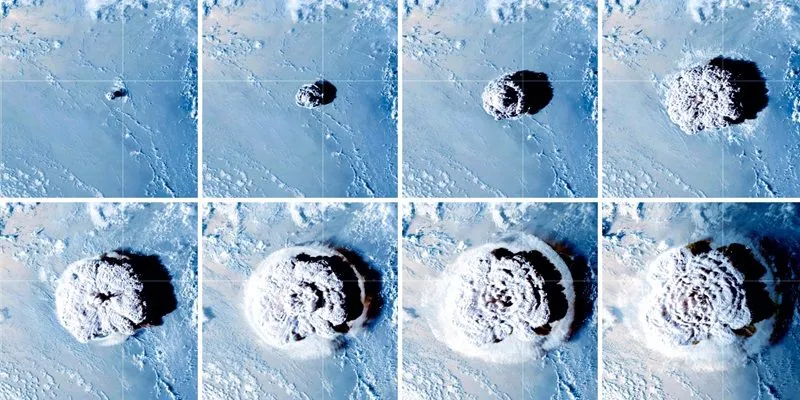
This sequence of still images from GOES-17 shows the plume at various stages on January 15, 2022. Credit: GOES (Geostationary Operational Environmental Satellites)/ NOAA Chemical Sciences Laboratory
The Hunga Volcanic Eruption Atmospheric Impacts Report represents an unprecedented scientific effort focused on a single geophysical event. Coordinated under the Atmospheric Processes and their Role in Climate (APARC) project of the World Climate Research Programme, the assessment departs from standard practice by devoting an entire international report to a single eruption.
The assessment brought together 159 scientists from 21 countries, making it one of the largest coordinated research efforts ever assembled for an individual volcanic event. Contributors represented a wide range of expertise, including atmospheric chemistry, climate modelling, satellite remote sensing, and in situ observations.
Four academics from the University of Leeds were among the contributors, reflecting the institution’s long-standing role in research on stratospheric processes and volcano–climate interactions. Their participation linked the assessment to decades of prior work on major eruptions such as Mount Pinatubo.
The World Climate Research Programme, which is co-sponsored by the World Meteorological Organization, coordinated the effort to ensure consistency across observations and models. The resulting report provides a definitive reference that consolidates early findings into a single, peer-reviewed assessment.
All conclusions in the report are based entirely on peer-reviewed research, combining satellite measurements, balloon campaigns, ground-based observatories, and global climate–chemistry models.
The most powerful underwater explosion ever recorded
The eruption of Hunga Tonga–Hunga Haʻapai on January 15, 2022, produced the largest underwater volcanic explosion ever recorded by modern scientific instruments. Pressure waves from the blast propagated around the globe and were detected multiple times by atmospheric sensors.
In terms of explosive energy, scientists have compared the eruption to the 1883 Krakatoa event, one of the most powerful volcanic explosions in recorded history. Like Krakatoa, Hunga generated global-scale atmospheric disturbances that immediately signalled an event of exceptional magnitude.
Unlike Krakatoa, however, Hunga Tonga-Hunga Ha’apai erupted in shallow seawater. This crucial difference fundamentally altered the way volcanic material and gases entered the atmosphere and shaped the eruption’s long-term impacts.
Rapid interaction between magma and seawater caused vast volumes of ocean water to be instantaneously vaporised. This process greatly amplified the explosivity of the eruption and enabled material to reach altitudes rarely observed for volcanic plumes.
These characteristics place Hunga in a category of its own among modern eruptions, combining extreme explosivity with an unusual chemical signature.
A plume that redefined stratospheric observations
The eruption generated a massive volcanic plume that penetrated deep into the stratosphere, a layer of the atmosphere extending roughly from 10–50 km (6–31 miles) above Earth’s surface. This region is normally extremely dry and highly sensitive to changes in water vapour.
Satellite instruments captured a sequence of images showing the plume rising rapidly and expanding outward over the Pacific Ocean. In total, eight satellite images documented the plume’s evolution, revealing its unprecedented vertical reach and lateral spread.
No previous eruption in the satellite era had been observed injecting such large quantities of water vapour into the stratosphere. The plume’s composition and behaviour forced scientists to reassess how volcanic eruptions interact with upper-atmospheric processes.
The report documents the plume’s evolution on both short time scales of less than one month and multi-year time scales extending through 2025. This dual perspective allowed researchers to distinguish immediate impacts from longer-term atmospheric adjustments.
The findings demonstrate that eruption environment and plume composition can be as important as eruption size in determining atmospheric outcomes.
A ten percent surge in global stratospheric water vapor
One of the most significant findings of the assessment is that the Hunga eruption increased global stratospheric water vapour by about 10 percent. In the context of the stratosphere, this represents an extraordinary and abrupt perturbation.
Water vapour concentrations at these altitudes typically change slowly over decades. Hunga compressed that scale of change into a single event, altering the radiative and chemical balance of the stratosphere almost instantly.
Much of the injected water vapour remained in the atmosphere through 2025. The slow circulation of air in the middle atmosphere allows material to persist for years before gradually descending and dissipating.
Unlike sulphur-rich aerosols, which generally fall out or chemically transform within one to two years, water vapour decays much more slowly. This gives the eruption a long atmospheric memory.
The assessment concludes that elevated stratospheric water vapour from Hunga will continue to influence atmospheric processes for several more years.
Cooling the stratosphere instead of warming it
Large volcanic eruptions usually warm the stratosphere because sulphate aerosols absorb radiation. These same aerosols typically cool Earth’s surface by reflecting incoming sunlight back to space.
Hunga produced the opposite response. Despite releasing a similar amount of sulphur to the 1991 Mount Pinatubo eruption, observations and model simulations show that the stratosphere cooled rather than warmed.
The report attributes this reversal to the dominant influence of water vapour, which altered radiative balances and atmospheric circulation patterns in ways that outweighed aerosol heating.
This finding demonstrates that sulphur emissions alone are an incomplete metric for assessing volcanic climate impacts. Eruption chemistry and injection height play equally critical roles.
The unexpected stratospheric cooling explains why early assumptions of a Pinatubo-like climate response did not materialise.
Surface climate effects are indistinguishable from natural variability
Although water vapour is a greenhouse gas, the assessment finds that Hunga’s impact on surface climate was small. Model simulations estimate a surface cooling influence of about 0.05 K, equivalent to roughly 0.05°C.
This magnitude is indistinguishable from natural climate variability and far too small to explain the record global temperatures observed in 2023 and 2024. The report explicitly rules out the eruption as a driver of recent global warming.
The key factor limiting surface impact was injection altitude. Because most of the water vapour was delivered deep into the stratosphere, its ability to trap outgoing infrared radiation from the surface was limited.
Simulations indicate that if the same amount of water vapour had been injected closer to the tropopause, surface warming would have been substantially larger.
This clarification is critical for correctly attributing recent climate trends.
Ozone impacts confined to short-term regional changes
The assessment also examined how the eruption affected stratospheric ozone, particularly in the Southern Hemisphere. Elevated water vapour can enhance chemical reactions that deplete ozone, raising concerns about potential damage.
Observations and modelling show that while Hunga perturbed stratospheric ozone in the months following the eruption, the effects were small compared with natural year-to-year variability.
The Antarctic ozone hole was not significantly worsened, and long-term recovery trends driven by reductions in ozone-depleting substances remain intact.
Advanced models allowed scientists to isolate Hunga’s contribution from both natural variability and human-caused chemical influences.
These results reinforce confidence that international efforts under the Montreal Protocol remain on track.
Global modelling and observational collaboration
The report’s seven chapters synthesize findings from observations, data analyses, and climate model simulations. These include basic eruption characteristics, plume evolution on short and long time scales, impacts on atmospheric chemistry and dynamics, ozone responses, upper-atmospheric effects, and surface radiative and temperature impacts.
A major contribution came from the Hunga Tonga–Hunga Haʻapai Impact Model Observation Comparison project, an international modelling effort involving more than ten global climate models. This framework allowed researchers to directly compare simulations with observations.
The assessment was co-chaired by Yunqian Zhu, William Randel, Graham Mann, and Paul A. Newman, representing institutions across the United States and Europe. Their leadership ensured coordination across observational and modelling communities.
Decades of investment in international satellite missions, balloon campaigns, and ground-based networks enabled the rapid tracking of Hunga’s plume from minutes after the eruption through subsequent years.
The report warns that future observational gaps, whether from aging infrastructure or satellite mission cancellations, could severely limit the ability to monitor similar events.
A benchmark for future eruptions
Hunga’s legacy lies not in surface destruction, but in how it reshaped scientific understanding of volcano–atmosphere interactions. The eruption exposed gaps in how climate models represent water-rich eruptions.
Supporting datasets from the assessment, including modelling outputs, will be made publicly available through the Centre for Environmental Data Analysis, ensuring transparency and enabling further research.
The assessment provides a benchmark for interpreting future eruptions and refining projections of short-term climate variability.
In this sense, Hunga reshaped not Earth’s surface, but the scientific framework used to understand how extreme volcanic events interact with the atmosphere.
References:
1 The Hunga Volcanic Eruption Atmospheric Impacts Report – APARC – December 2025
2 International report reveals atmospheric impact of Hunga eruption – University of Leeds – December 18, 2025

I’m a science journalist and researcher at The Watchers, contributing to the Epicenter edition, where I cover peer-reviewed scientific research and emerging discoveries across Earth and space sciences. With a background in astronomy and a passion for environmental science, I’ve worked in shark and coral conservation in Fiji, conducting reef and shark-behavior research, contributing to mangrove restoration, and earning PADI Open Water and Coral Reef Certifications. I bring a blend of scientific rigor and storytelling to illuminate the discoveries shaping our planet and beyond.

Commenting rules and guidelines
We value the thoughts and opinions of our readers and welcome healthy discussions on our website. In order to maintain a respectful and positive community, we ask that all commenters follow these rules.