
For decades the heavy rocks that carve trails across a Death Valley lakebed were never seen moving, until cameras caught them gliding on thin rafts of melting ice pushed by a light wind
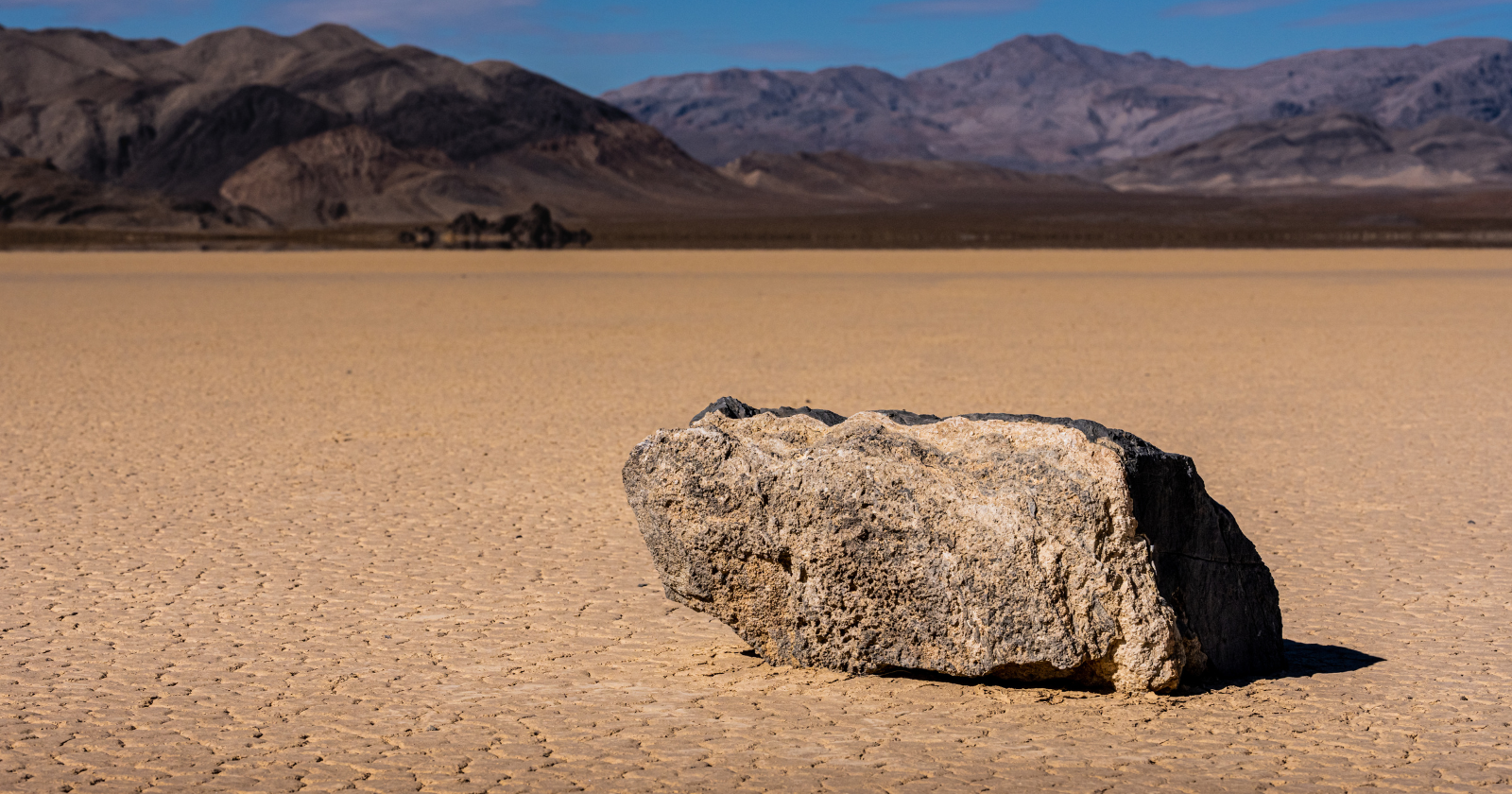
On a remote dry lake in Death Valley, hundreds of rocks sit on a cracked, flat floor of mud. Behind many of them are long trails, some straight, some curving, as if the rocks had been dragged across the ground.
Some of these rocks weigh as much as 320 kilograms. For more than 70 years, nobody had ever seen one move. Then, on a cold December morning in 2013, two researchers watched it happen.
A desert mystery
The lake is called Racetrack Playa, a dry lakebed about 4.5 kilometres long in a remote corner of Death Valley National Park in California. Reaching it means a long, rough drive on an unpaved road.
The trails behind the “sailing stones” have puzzled visitors and scientists since the 1940s. Over the years, people suggested hurricane-force winds, thick sheets of ice, slippery algae, magnetic fields and even pranksters. But because nobody had seen the rocks in motion, nobody could prove any of these ideas.
Setting a trap for the rocks
In 2011, a team led by Richard Norris, a palaeobiologist at the Scripps Institution of Oceanography, decided to try catching the rocks in the act. Working with his cousin, engineer James Norris, and planetary scientist Ralph Lorenz, they set up a weather station that measured wind every second, along with time-lapse cameras overlooking the lakebed.
The National Park Service wouldn’t let them tamper with the existing rocks. So the team brought in 15 rocks of their own, fitted with motion-activated GPS trackers, and placed them on the playa. They expected a long wait, since the rocks can sit still for a decade or more.
The pond appears
In December 2013, Richard and James Norris arrived at the playa to find something unusual. Winter rain and snowmelt had formed a shallow pond across the lakebed, no more than about 7 centimetres deep. On cold nights, the surface froze into a thin sheet of ice.
On 20 December, the rocks began to move. The next day, Richard Norris heard popping and cracking across the frozen pond as the ice broke up just before noon. The rocks were on the move again, and this time the researchers watched it happen in front of them.
Pushed by windowpane ice
What they saw was surprisingly gentle. As the morning sun warmed the pond, the thin ice, only 3 to 6 millimetres thick, broke into large floating panels. A light breeze of around 3 to 5 metres per second, roughly enough to rustle leaves, pushed the panels across the water.
The ice panels shoved the rocks ahead of them through the soft mud, leaving trails behind. The rocks moved at just 2 to 5 metres per minute, so slowly that the motion would be almost impossible to notice from a distance. In one event, more than 60 rocks moved at once, and one GPS rock travelled more than 160 metres over several weeks.
Why the mystery lasted so long
The findings, published in the journal PLOS ONE in 2014, overturned the most popular theories. The rocks didn’t need powerful winds or thick ice. They needed a rare combination of conditions: just enough water to form a pond, cold nights to make ice, sunny mornings to melt it, and a light wind to push it.
That combination doesn’t come often. Lorenz estimated that the rocks may move only about one millionth of the time. The researchers also found that some trails without rocks, which park rangers had suspected were left by tourists stealing stones, were actually carved by grounded ice panels.
A changing climate, a rarer sight
The researchers noted that rock movements may have become less common since the 1970s, possibly because warming has reduced the number of cold nights needed to form ice. If that trend continues, new trails could become rarer still.
For visitors, the lesson is to look closely and leave the rocks where they are. The tracks on the playa are a record of rare winter mornings when ice, water and wind came together, and each one took years of patience before anyone understood what made it.

The Watchers Staff covers earthquakes, volcanoes, severe weather, space weather and other natural events. Published since 2011, The Watchers reports on a changing planet and the science behind it.
Published in the last 24 hours
- Scientists in Iceland drilled straight into 900°C magma by accident, and the well was so energy-dense it could produce nearly ten times the power of a conventional geothermal well Epicenter
- Bay of Bengal system to become Cyclone Akvan, landfall forecast between Nellore and Tuni on November 20, India
- El Niño floods kill 2 in Guayaquil as 172.8 mm of rain swamps Milagro, Ecuador's toll rises to 14
- Southern Thailand braces for heavy rain, 15 provinces on flood and landslide alert for November 18-22
