
Discovery of billion-year-old water flow on Ryugu reshapes Earth models
Liquid water flowed on the parent body of asteroid Ryugu more than 1 billion years after its formation, according to a study published on September 11, 2025, based on Hayabusa2 mission samples.
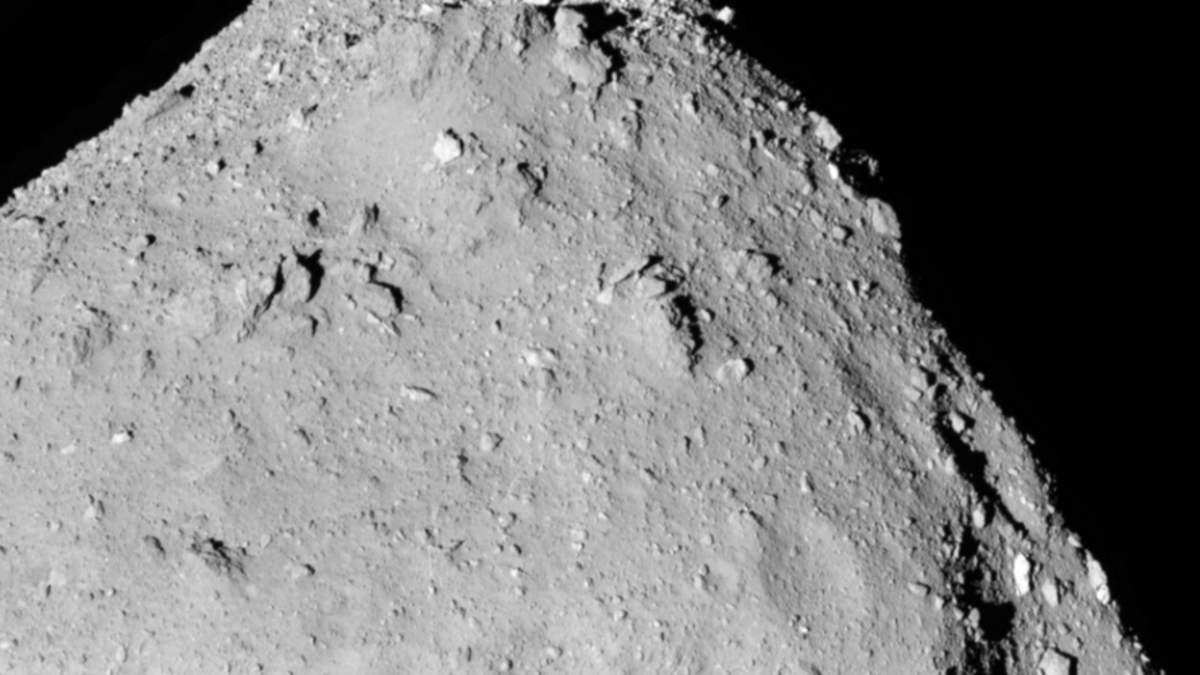
Ryugu close-up. Ryugu is named after a magical underwater palace in a Japanese folktale — appropriately enough it seems to be a palace for water in the real world too. Credit: UTokyo
A new study led by researchers at the University of Tokyo, with collaborators in Japan and abroad, found evidence that liquid water once moved through the rocks of Ryugu’s parent asteroid.
The results challenge the long-held view that water activity on asteroids occurred only in the earliest solar system. Instead, Ryugu’s record shows that fluids were present much later, fundamentally changing how scientists think about the delivery of water to Earth.
Ryugu itself is a near-Earth asteroid visited by the Japan Aerospace Exploration Agency (JAXA) Hayabusa2 spacecraft in 2018. The mission returned several grams of pristine rock samples to Earth in December 2020, enabling highly precise laboratory studies.
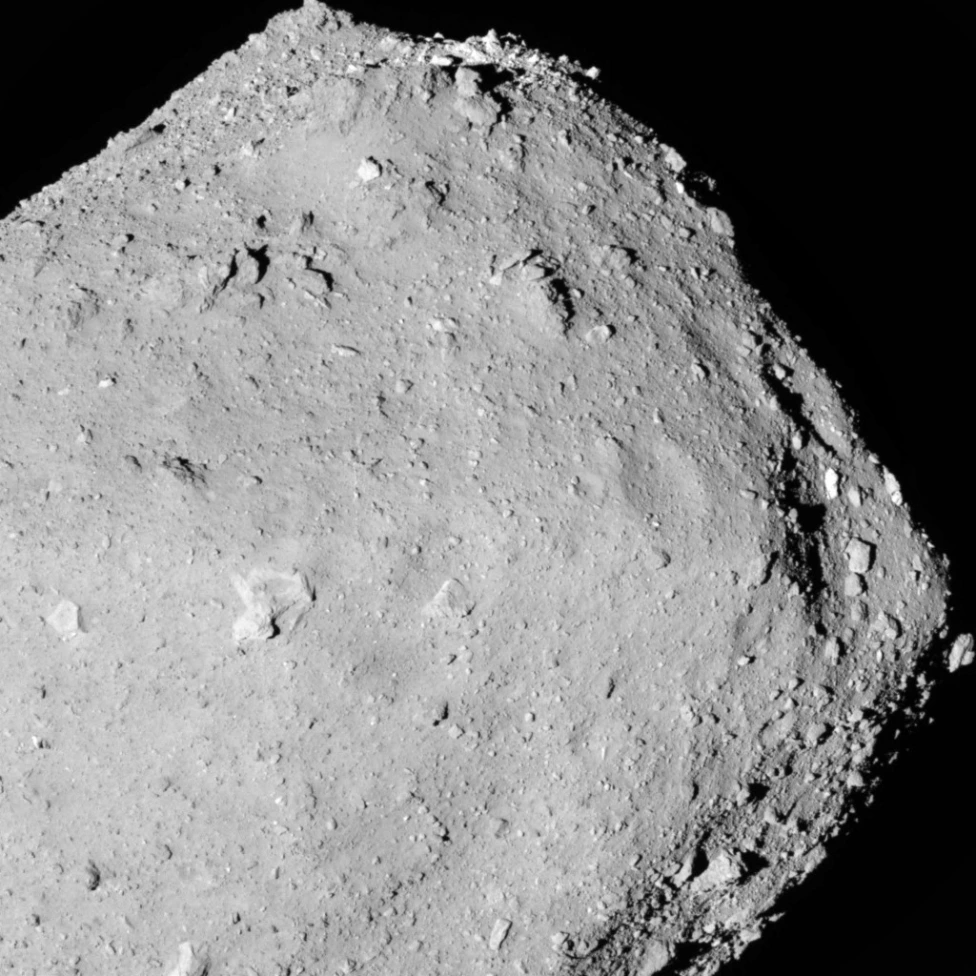
The asteroid takes its name from “Ryūgū-jō,” a legendary underwater palace in Japanese folklore — a fitting connection now that it is known to have once hosted flowing water.
Isotopes as a geological clock
The team analyzed the isotopic system of lutetium (176Lu) and hafnium (176Hf). Normally, the radioactive decay of 176Lu to 176Hf provides a reliable clock for geological processes.
But in the Ryugu samples, the ratio of 176Hf to 176Lu was far higher than expected. This anomaly indicated that lutetium was mobilized by fluid activity long after the asteroid formed.
“We thought that Ryugu’s chemical record would resemble certain meteorites already studied on Earth,” said Associate Professor Tsuyoshi Iizuka from the University of Tokyo. “But the results were completely different. This meant we had to carefully rule out other possible explanations and eventually concluded that the Lu–Hf system was disturbed by late fluid flow.”
A billion-year-old impact
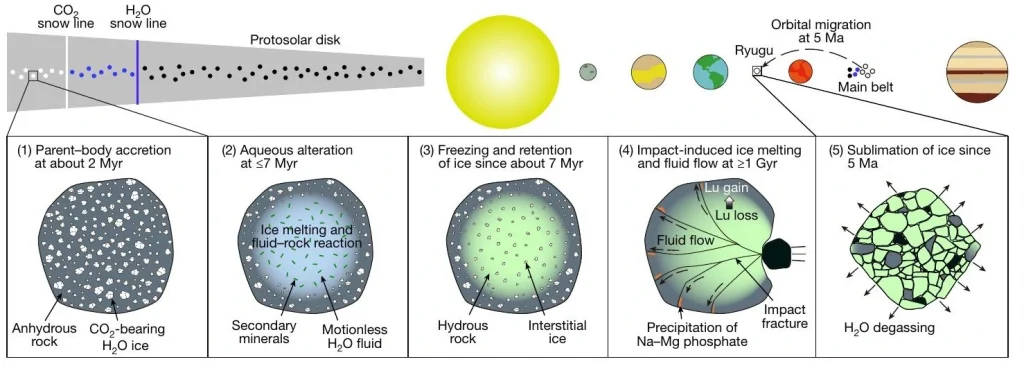
The most likely explanation is that Ryugu’s larger parent body was struck by another object.
The impact fractured the rock, melted buried ice, and created channels for water to move through the asteroid. This collision may also have disrupted the parent body, eventually giving rise to present-day Ryugu.
This scenario differs sharply from earlier models, which assumed that aqueous activity on carbonaceous asteroids was restricted to a few million years after formation, when short-lived radionuclides provided heat. Early activity was thought to involve only limited fluid circulation with little elemental fractionation.
In contrast, the late-stage process recorded in Ryugu involved significant chemical mobilization, reshaping the asteroid’s isotopic record.
Implications for Earth’s water
The discovery carries major implications for the origin of Earth’s oceans and atmosphere.
Carbonaceous asteroids like Ryugu are believed to have delivered volatiles, including water, to the early Earth. If such bodies retained ice for over 1 billion years, they could have supplied far more water than previously estimated.
“It suggests that the building blocks of Earth were far wetter than we imagined,” said Iizuka. “This forces us to rethink the starting conditions for our planet’s water system.”
The researchers estimate that water delivery to Earth may need to be revised upward by a factor of two to three.
Challenges of studying tiny samples
Hayabusa2 returned only a few grams of material, divided among many research teams. Each experiment used just tens of milligrams — smaller than a fraction of a grain of rice.
“Our small sample size was a huge challenge,” said Iizuka. “We had to design new chemistry methods that minimized elemental loss while still isolating multiple elements from the same fragment. Without this, we could never have detected such subtle signs of late fluid activity.”
To overcome this, the team developed advanced separation and measurement techniques, realizing the full potential of modern geochemical analysis.
Next steps
The researchers plan to study phosphate veins within Ryugu samples to better constrain the age of the fluid activity.
They also aim to compare their results with samples collected by NASA’s OSIRIS-REx mission from asteroid Bennu, which arrived on Earth in 2023. This will help determine whether billion-year water persistence was unique to Ryugu or common among carbonaceous asteroids.
If similar evidence emerges from Bennu, scientists may need to revise models of water distribution across the early solar system — with implications for planetary habitability and the conditions that made Earth capable of supporting life.
References:
1 Water flowed on ancient asteroid Liquid water on asteroids reshapes our understanding of the early solar system – UTokyo – September 11, 2025
2 Late fluid flow in a primitive asteroid revealed by Lu–Hf isotopes in Ryugu – Tsuyoshi Iizuka, Takazo Shibuya – Nature – September 10, 2025 – https://doi.org/10.1038/s41586-025-09483-0

I’m a science journalist and researcher at The Watchers, contributing to the Epicenter edition, where I cover peer-reviewed scientific research and emerging discoveries across Earth and space sciences. With a background in astronomy and a passion for environmental science, I’ve worked in shark and coral conservation in Fiji, conducting reef and shark-behavior research, contributing to mangrove restoration, and earning PADI Open Water and Coral Reef Certifications. I bring a blend of scientific rigor and storytelling to illuminate the discoveries shaping our planet and beyond.

Commenting rules and guidelines
We value the thoughts and opinions of our readers and welcome healthy discussions on our website. In order to maintain a respectful and positive community, we ask that all commenters follow these rules.