
Deep ocean earthquakes drive massive phytoplankton blooms near Antarctica
Wintertime earthquakes along the Australian Antarctic Ridge were found to influence massive summer phytoplankton blooms in the Southern Ocean, according to a Nature Geoscience study published on December 9, 2025.

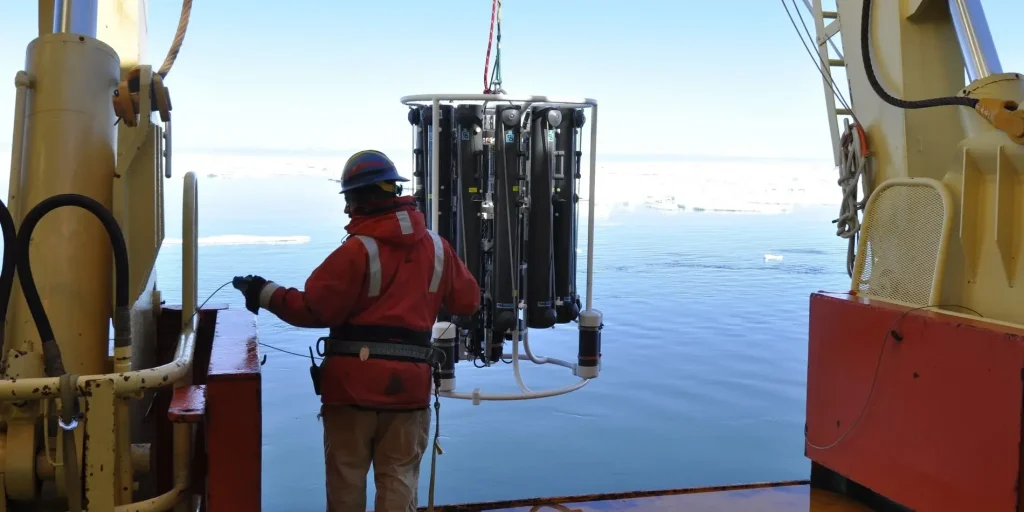
Severe weather encountered in the northern Ross Sea that temporarily delayed sampling of the AAR phytoplankton bloom in 2014 on board the research icebreaker Nathaniel B. Palmer. Credit: Gert van Dijken
Wintertime earthquakes along the Australian Antarctic Ridge have been found to control the intensity of vast phytoplankton blooms that emerge each summer across the Southern Ocean. The discovery, published on December 9 in Nature Geoscience, provides the first direct evidence that seismic activity deep in the ocean can influence the productivity of life at the surface.
Scientists from Stanford University analyzed satellite records of phytoplankton growth and global earthquake data. They discovered that when the seafloor near Antarctica experienced stronger shaking during the winter months, summer phytoplankton blooms became significantly denser and more extensive. These blooms cover a huge area and play a key role in removing carbon dioxide from the atmosphere.
The findings show that physical processes in Earth’s crust may have an unexpected impact on climate regulation. The Southern Ocean, which encircles Antarctica, absorbs nearly half of all the carbon taken up by the world’s oceans. Any factor that affects its biological activity could alter global carbon storage and climate balance.
According to study co-author Kevin Arrigo, the results reveal a “hidden link between the planet’s geology and its ability to support life.” The researchers describe it as an overlooked connection between seismic energy, hydrothermal activity, and biological productivity.
When the ground shakes, the ocean responds
The Southern Ocean is home to one of the planet’s most productive but least understood ecosystems. In certain regions, dense blooms of phytoplankton appear every summer, yet their size varies greatly from year to year. In 2014, scientists aboard the research icebreaker Nathaniel B. Palmer observed a large bloom over the Australian Antarctic Ridge and began investigating what caused these fluctuations.
By reviewing satellite images dating back to 1997, researchers noticed that the same bloom recurred annually in the same location but sometimes expanded to the size of California and other times shrank to the size of Delaware. Surface temperature, sea ice cover, and sunlight levels could not explain this variability.
The team hypothesized that changes below the surface were to blame. Seismic activity along the ridge, which is part of a vast underwater mountain chain, might alter the behavior of hydrothermal vents that emit mineral-rich water. These vents release iron, a nutrient critical for phytoplankton growth. When earthquakes occur, shaking can open new fractures or unblock channels within the vents, releasing larger quantities of iron into surrounding waters.
The researchers compared seismic records with bloom patterns and found a strong correlation. When magnitude 5 or larger earthquakes struck in the months before summer, blooms were far more intense. This revealed that tectonic events in the deep ocean can directly modulate the amount of biological activity at the surface.
Iron, currents, and the chemistry of life
Hydrothermal vents along the ridge release heated water loaded with iron and other dissolved metals. In the Southern Ocean, where iron is scarce, this supply can determine how much phytoplankton grows. Iron acts as a limiting nutrient, meaning that even small increases can trigger large blooms.
The new study found that earthquakes not only boost iron release but also influence how that iron spreads. Using computer models, scientists traced how vent plumes travel through ocean currents. They discovered that when surface waters carry the iron farther downstream, it becomes diluted and less effective in stimulating local blooms. Areas closer to the vents remain richer, while distant regions see weaker productivity.
This process, known as advective spread, helps explain why the same bloom changes size each year despite forming in the same place. Both earthquake frequency and ocean circulation together determine how much iron reaches surface waters and how long it stays concentrated enough to support growth.
These findings refine our understanding of how nutrients move through the ocean and highlight the complexity of interactions between geology, chemistry, and biology in polar environments.
Rapid ascent through the depths
Perhaps the most surprising result of the research was the apparent speed of iron transport from the seafloor to the surface. The hydrothermal vents studied lie about 1 800 m (5 900 feet) below the ocean surface, yet their influence on surface blooms was seen within weeks to months.
Traditionally, scientists believed that hydrothermal iron would take a decade or more to reach surface waters, traveling thousands of kilometers through deep ocean circulation. The rapid ascent observed here challenges that view and suggests an unknown physical process may be driving the metal-rich water upward more quickly than expected.
Possible explanations include buoyant plumes rising through turbulent mixing or convective updrafts driven by heat and chemical gradients. The mechanism remains unconfirmed, but its speed implies a previously unrecognized pathway by which deep-sea nutrients reach the surface on seasonal timescales.
To better understand this process, researchers collected new data during an expedition in December 2024. Early results from that mission are expected to shed light on how hydrothermal emissions rise so fast and whether similar rapid transport occurs elsewhere in the world’s oceans.
Ecosystem and climate implications
The discovery extends beyond biology and into climate science. Phytoplankton blooms absorb vast amounts of atmospheric carbon dioxide through photosynthesis. When these microscopic organisms die, some of their carbon sinks into the deep ocean, effectively locking it away for centuries. This natural “biological pump” helps regulate the global climate.
Because the Southern Ocean accounts for nearly half of all oceanic carbon uptake, any factor that influences its productivity is globally significant. Earthquakes that temporarily boost hydrothermal activity could enhance carbon sequestration by fertilizing phytoplankton. Conversely, periods of lower seismicity might reduce it.
Field observations also revealed a direct ecological impact. The recurring bloom on the ridge supports swarms of krill and other small crustaceans, which in turn feed penguins, seals, and whales. Researchers even documented humpback whales visiting the bloom region during peak productivity. While these links are based on observation rather than direct measurement, they illustrate how tightly the deep Earth and marine ecosystems are connected.
Scientists caution that it remains unknown whether similar processes operate globally. Many hydrothermal vent systems exist along other ridges, but most are difficult to sample. Determining their role in global carbon and nutrient cycles will require new expeditions and long-term monitoring.
A deeper understanding of a living planet
The study highlights the Southern Ocean as a critical testing ground for understanding how geological forces sustain life. It also demonstrates that Earth’s systems cannot be studied in isolation. Processes in the crust, ocean, and atmosphere are deeply intertwined.
By linking tectonic motion to ocean productivity, researchers have identified a new feedback loop between the solid Earth and the climate system. This connection could help refine models of carbon cycling and improve predictions of how the planet might respond to future environmental changes.
As lead author Casey Schine explained, the finding shows that “life and geology are inseparable parts of the same global machine.” The seafloor’s pulse, measured in earthquakes, can ripple upward to shape ecosystems thousands of meters above.
This discovery invites scientists to look at the planet as a single, dynamic system — one where even the rumble of distant tectonic plates can influence the air we breathe.
References:
1 Deep ocean earthquakes drive Southern Ocean’s massive phytoplankton blooms, study finds – Stanford DOERR – December 17, 2025
2 Southern Ocean net primary production influenced by seismically modulated hydrothermal iron – Casey M. S. Schine et al. – Nature Geoscience – December 9, 2025 – https://doi.org/10.1038/s41561-025-01862-6 – OPEN ACCESS

I’m a science journalist and researcher at The Watchers, contributing to the Epicenter edition, where I cover peer-reviewed scientific research and emerging discoveries across Earth and space sciences. With a background in astronomy and a passion for environmental science, I’ve worked in shark and coral conservation in Fiji, conducting reef and shark-behavior research, contributing to mangrove restoration, and earning PADI Open Water and Coral Reef Certifications. I bring a blend of scientific rigor and storytelling to illuminate the discoveries shaping our planet and beyond.

The TIROS-1 satellite, launched on April 1, 1960, was the world’s first successful weather satellite and provided early imagery that included views of the Southern Ocean region.
The question is:
Why weren’t these observations and simple assertions on show here being made 30+ years ago? Large satellite area differences and seismic data historic data-sets were easily available to academics. Perhaps even oceanic samplings? From data going back 10, 15, 20years before that.
Good on the team for digging back historically, fundamental ‘why’s’ to need to be asked.
Reet, this is the perfect sort of article helpful for us independent researchers, your richness of skills in finding these, served to us perfectly enscribed, across our planet like an international masterchef creating dishes that tantalise, satiate yet leave craving, daily, nightly, we are blessed to have you and The Watchers team.
How a large sediment event might cover that that bottom-laying sequestered carbon for a time; MM 5+ pure shaking release, or ‘hurled’ upwards by volcanicity involvement yet awaiting discovery hence the ‘remarkable’ mobility suspicion? Running the kinetics numbers should reveal.
Always we seem to find ourselves back at the mantle-core…
Puthoff – The ground state of the hydrogen atom.
Core – Beta circa unity; plasma-pressure balancing the magnetic force. Beautiful mono-structural geometries.