
Cosmic dust identified as a driver of life-forming chemistry in space
A new study published in The Astrophysical Journal on October 23, 2025, reveals that cosmic dust grains may be critical to the chemistry that forms life’s earliest building blocks, enabling complex molecules to form at –190°C (–310°F) in the icy regions of space.
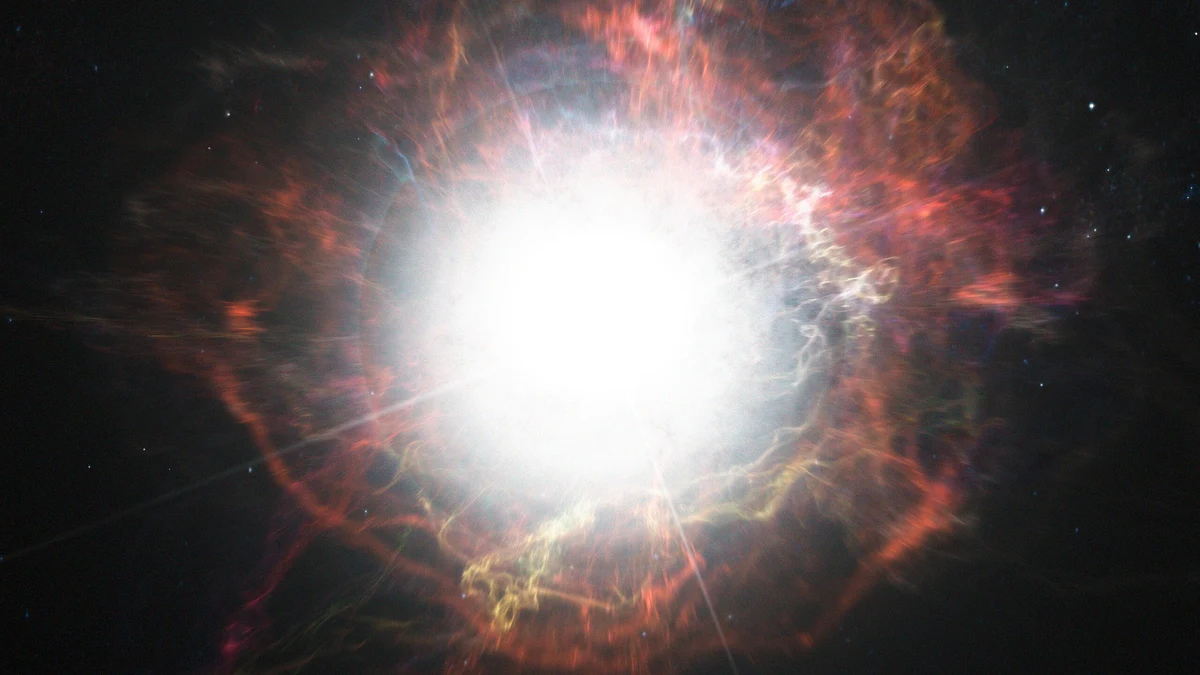
Artist's impression of cosmic dust formation around a supernova explosion. Credit: ESO/M. Kornmesser
For decades, astronomers viewed cosmic dust as little more than the debris of dying stars. But a new international study suggests that these tiny grains may be the universe’s most powerful chemical engines. Researchers from Heriot-Watt University, Friedrich Schiller University Jena, and the University of Virginia have found that mineral dust can trigger reactions that create complex organic molecules under extreme conditions.
The team showed that carbon dioxide and ammonia, two of the most common molecules in interstellar space, can react on the surface of dust grains to form ammonium carbamate, a compound that could eventually lead to the formation of urea and other organic molecules central to life. Without dust, these reactions barely happen at all.
Professor Martin McCoustra, an astrochemist at Heriot-Watt University, explained that dust is not a passive bystander. “It provides surfaces where molecules can meet, react, and form more complex species,” he said. “In some regions of space, this dust chemistry is a prerequisite for making life’s molecular building blocks.”
At temperatures near 80 K, equivalent to –190°C (–310°F), these surface reactions occur efficiently, overcoming one of the biggest barriers in astrochemistry: how to drive molecular complexity in the absence of heat or sunlight.
The discovery changes how scientists understand the chemistry of interstellar space. Instead of seeing dust as inert particles, the study shows that it acts as a microscopic catalyst, accelerating reactions that might otherwise take millions of years to occur in the gas phase.
Recreating space conditions inside the laboratory
To probe this chemistry, Dr. Alexey Potapov’s team at Friedrich Schiller University Jena built miniature analogs of interstellar environments. They created “dust sandwiches,” layering frozen carbon dioxide and ammonia with a thin sheet of porous magnesium silicate grains, which mimic the structure of real cosmic dust.
The experiment simulated the cold depths of molecular clouds, where temperatures fall to about –260°C (–436°F). As the samples were gently warmed to –190°C (–310°F), the molecules began to migrate through the dust layer and react. The result was clear: in the presence of dust, ammonium carbamate formed rapidly, while in its absence, the reaction was negligible.
The team identified this as acid–base catalysis, a chemical process that involves the transfer of protons between molecules. This marks the first time such catalysis has been observed under space-like conditions in a laboratory setting.
Dr. Potapov explained that these findings reveal a hidden vitality in the universe’s smallest particles. “Dust grains play a far more active role in astrochemistry than previously thought,” he said. “Floating through interstellar clouds and protoplanetary disks, these particles provide the micro-environments where molecules meet and evolve into more complex forms.”
The researchers also noted that the dust’s porous texture, made up of countless tiny channels and cavities, offers a vast reactive surface area. This allows molecules to diffuse and encounter each other even at near-absolute-zero temperatures, something impossible in a vacuum.
The chemistry of creation on cold cosmic surfaces
On Earth, most chemical reactions require heat or light to overcome activation barriers. In space, where the temperature can drop far below –250°C (–418°F), such reactions should be nearly frozen. Yet this study shows that cosmic dust offers a way for chemistry to proceed even in these hostile conditions.
The magnesium silicate grains used in the experiment were riddled with pores only a few dozen nanometers wide, providing channels for molecules to move and collide. When the researchers varied the dust layer’s thickness from 10 to 210 nanometers, they discovered that the reaction rate peaked around 100 nanometers, where about half of the carbon dioxide molecules converted into ammonium carbamate.
Beyond this point, thicker dust layers slowed the reaction, likely because molecules took longer to diffuse through the material. The team concluded that dust chemistry depends critically on both the availability of reactive surface area and the diffusion efficiency of the reactants.
Ammonium carbamate is of particular interest because it represents a bridge between simple inorganic molecules and the more complex organic compounds required for life. It contains both a nitrogen-based and carbon-based functional group, a combination essential to prebiotic chemistry.
The reaction occurs through proton transfer, a process common in acid–base chemistry on Earth but rarely documented in space. By observing this mechanism under ultra-cold conditions, the study demonstrates that molecular evolution can begin in places once thought chemically inert.
How dust drives complexity across the cosmos
In interstellar clouds, dust grains are typically coated in thin layers of ice, composed mainly of water, carbon dioxide, and ammonia. As stars begin to form and heat their surrounding disks, these grains collide, aggregate, and gradually warm. The new study suggests that this warming process may trigger the kind of dust-driven chemistry that produces ammonium carbamate and other organic molecules.
Over time, these compounds can become part of larger aggregates and even comets or asteroids, delivering prebiotic material to young planets. This pathway helps explain how the building blocks of life could arise long before any world becomes habitable.
The research also redefines how scientists model astrochemical processes. Rather than treating dust as chemically inert, future simulations will likely need to include surface catalysis and diffusion effects. These processes may account for the unexpectedly high abundance of organic molecules detected in protoplanetary disks and interstellar clouds.
Recent observations by the James Webb Space Telescope support this idea. The telescope has already detected ammonium carbamate in the disk of a young star system known as d216-0939, a direct confirmation that such reactions occur naturally beyond our solar system.
Dust grains, it turns out, may be acting as the universe’s first chemical reactors, tiny laboratories that operate continuously in the coldest corners of the cosmos.
The implications for life beyond Earth
If dust can promote reactions that form the precursors of life, then the conditions for prebiotic chemistry may be widespread throughout the galaxy. Wherever dust, carbon dioxide, and ammonia coexist—in interstellar clouds, protoplanetary disks, or cometary cores—complex molecules could emerge long before planets are born.
This study strengthens the idea that the seeds of life are not unique to Earth. Instead, they may be an inevitable byproduct of cosmic chemistry, unfolding quietly across the universe on the surfaces of dust grains smaller than a thousandth of a millimeter.
“We’ve shown that dust can promote the chemistry needed to build more complex organics, even at extremely low temperatures,” McCoustra said. “This could be how nature overcomes the harshness of space to kickstart chemistry that ultimately leads to life.”
The next phase of research will explore whether other molecular combinations can react through the same mechanism. If so, dust-driven catalysis could explain how a diverse array of organic molecules, amino acids, sugars, and even simple proteins, might arise naturally in space.
Understanding this process brings us closer to answering one of the oldest questions in science: how did lifeless matter become living chemistry? The answer, it seems, may lie in the dust between the stars.
References:
1 Cosmic dust necessary to spark life in space – Heriot Watt University – November 24, 2025
2 Cosmic Dust as a Prerequisite for the Formation of Complex Organic Molecules in Space? – Alexey Potapov et al. – The Astrophysical Journal – October 23, 2025 https://iopscience.iop.org/article/10.3847/1538-4357/ae08ae – OPEN ACCESS

I’m a science journalist and researcher at The Watchers, contributing to the Epicenter edition, where I cover peer-reviewed scientific research and emerging discoveries across Earth and space sciences. With a background in astronomy and a passion for environmental science, I’ve worked in shark and coral conservation in Fiji, conducting reef and shark-behavior research, contributing to mangrove restoration, and earning PADI Open Water and Coral Reef Certifications. I bring a blend of scientific rigor and storytelling to illuminate the discoveries shaping our planet and beyond.

We are just Dust in the Wind
Hot and cold Entropy made Man to be
All we are is dust blown from the wind
Lack of order or Scientific predictability
We are just collected dust from the wind
The Suns thermal Neutron radiation energy
Converts rock minerals into dust in the wind
Thermodynamics and all minerals quantity
The creation of life from just dust in the wind
Wet and dry to damp happens eventually
All that lives comes from dust blown wind
Entropy increases in time thermodynamically
Creating life known from dust in the winds
Man evolved smarter from stress and misery
Built windmills for energy turned by the winds
Politicians evolved to control population that be
Pitting man against man where no one wins
Nuclear Wars, Sun CME climate extinguish thee
Breaking it all back down to dust in the wind
Gradual mental decline into disorder you see
We will all return to just dust in the winds
~Gasser Classic~