
Contactless space debris removal proposed through new plasma thruster design
Researchers at Tohoku University, Japan, have validated in laboratory experiments a cusp-type bidirectional plasma thruster designed for contactless removal of orbital debris. The design eliminates destabilizing reaction forces while achieving 25 mN of thrust at 5 kW, marking a step toward scalable active debris removal in increasingly congested Earth orbit.
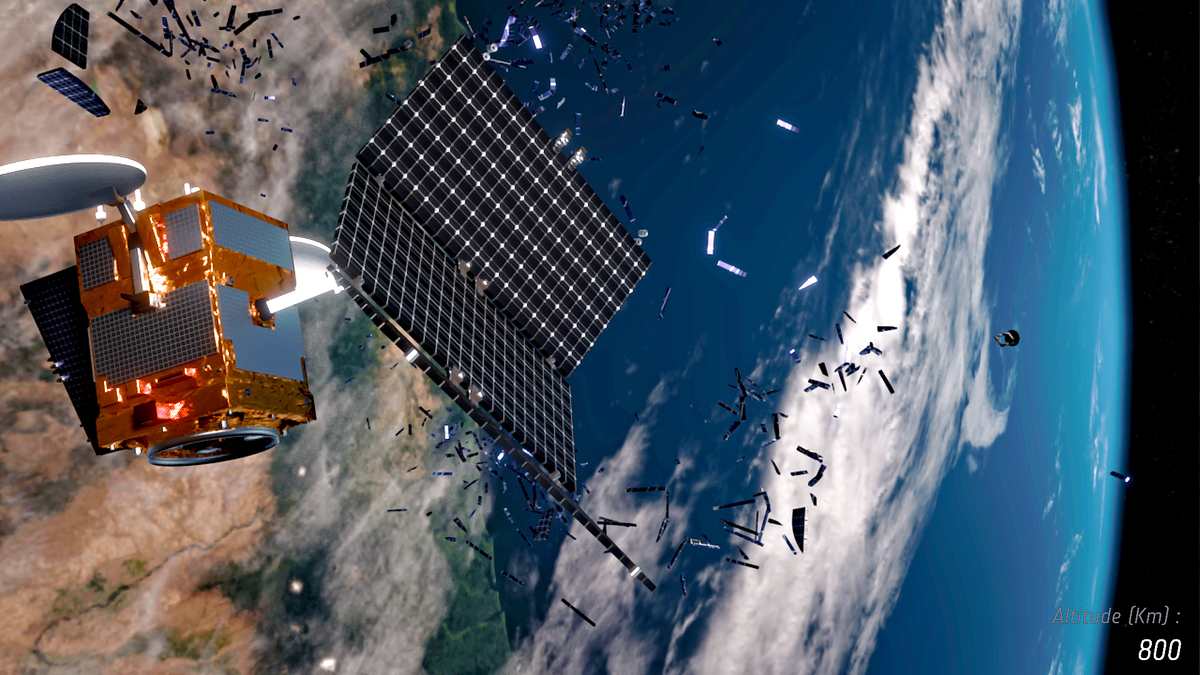
Illustration of a satellite breaking up into multiple pieces at higher altitudes. Credit: ESA
Earth’s orbit is becoming increasingly congested, with more than 36 000 tracked pieces of debris larger than 10 cm (4 inches), and millions of smaller fragments, now circling the planet at speeds exceeding 7 km/s (4 mi/s). At such velocities, even debris only a few centimeters across can release enough energy on impact to disable a satellite.
This accumulation poses the risk of a runaway cascade of collisions, known as the Kessler syndrome, where each impact generates further fragments, compounding the hazard for spacecraft and satellites. As nations and private companies continue launching satellites in growing numbers, the urgency of developing reliable active debris removal (ADR) technologies increases.
Most ADR proposals have focused on direct-contact methods: nets, robotic arms, tether systems, or even harpoons. While technically feasible, these approaches risk entanglement or destabilization because orbital debris often tumbles unpredictably.
To avoid physical contact, researchers have explored contactless methods such as laser ablation, ion beams, and plasma beams. These methods aim to slow debris enough for atmospheric drag to take over, eventually leading the object to burn up during re-entry.
Yet a persistent problem arises: whenever a plasma or ion beam pushes on debris, the reaction force pushes the removal satellite backward, reducing efficiency and stability.
A bidirectional solution
Kazunori Takahashi and colleagues at Tohoku University’s Graduate School of Engineering addressed this challenge with a bidirectional plasma thruster.
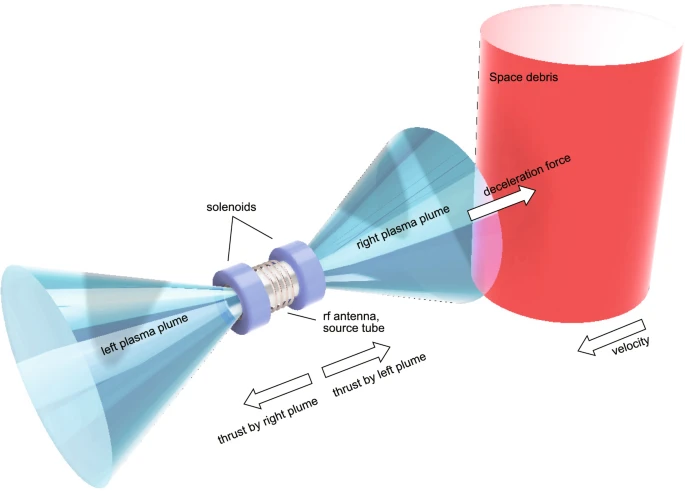
The concept is straightforward in principle: the thruster ejects plasma in two directions. One plume strikes the debris, exerting a decelerating force. The other plume ejects in the opposite direction, balancing the reaction force and keeping the removal satellite stable.
This symmetry allows the satellite to maintain its position relative to the debris while still applying net deceleration.
The role of the cusp magnetic field
What makes this work novel is the addition of a cusp magnetic field inside the thruster. In plasma physics, a cusp field can trap and guide charged particles more effectively than a simple open configuration.
By confining and directing the plasma more efficiently, the cusp increases the momentum transfer to the debris. In laboratory vacuum chamber experiments, this configuration significantly enhanced performance compared to earlier designs.
At an input power of 5 kW, the thruster generated a maximum deceleration force of about 25 mN. Previous experiments had only reached about 8 mN under similar conditions. The new performance is close to the ~30 mN estimated as necessary to deorbit a 1-ton, 1-meter-class piece of debris within 100 days.
Why propellant choice matters
Many electric propulsion systems rely on xenon, which is effective but costly and relatively scarce. Takahashi’s thruster instead demonstrated compatibility with argon, an abundant and much cheaper noble gas.
This compatibility could make large-scale ADR missions economically viable. Using argon rather than xenon would reduce fuel costs while avoiding supply constraints that limit other electric propulsion technologies.
What remains before space deployment
Although promising, the bidirectional cusp thruster remains at the laboratory validation stage.
Key uncertainties include:
- Plasma expansion in space: In orbit, plasma beams will spread differently than in vacuum chambers, potentially lowering efficiency.
- Beam–debris interaction: Actual debris surfaces may respond differently depending on material, geometry, and charge accumulation.
- Scaling and durability: Operating at high power for long durations in space requires robust engineering and thermal management.
Future experiments in large space-simulation chambers, and eventually in orbital demonstrations, will be needed before the technology can transition to real ADR missions.
Cost-effective method for cleaning space debris
If successful, the cusp-type bidirectional thruster could provide a scalable, safe, and cost-effective method for cleaning up Earth’s orbit. Unlike direct-contact approaches, it avoids entanglement risks. Unlike single-beam contactless methods, it preserves satellite stability. And by using argon, it reduces mission costs.
The same principles could be adapted to other space applications requiring fine control of forces without imparting unwanted thrust, such as satellite formation flying or controlled deorbiting at the end of a spacecraft’s mission.
In an era when megaconstellations like Starlink and Kuiper plan tens of thousands of satellites, technologies that prevent orbital overcrowding are not just innovative — they may be essential for sustainable use of near-Earth space.
References:
1 Improved Propulsion System May Help Remove Space Debris Without Contact – Tohoku University – September 8, 2025
2 Cusp-type bi-directional radiofrequency plasma thruster toward contactless active space debris removal – Kazunori Takahashi – Scientific Reports – August 20, 2025 – 10.1038/s41598-025-16449-9 – OPEN ACCESS

I’m a science journalist and researcher at The Watchers, contributing to the Epicenter edition, where I cover peer-reviewed scientific research and emerging discoveries across Earth and space sciences. With a background in astronomy and a passion for environmental science, I’ve worked in shark and coral conservation in Fiji, conducting reef and shark-behavior research, contributing to mangrove restoration, and earning PADI Open Water and Coral Reef Certifications. I bring a blend of scientific rigor and storytelling to illuminate the discoveries shaping our planet and beyond.

Commenting rules and guidelines
We value the thoughts and opinions of our readers and welcome healthy discussions on our website. In order to maintain a respectful and positive community, we ask that all commenters follow these rules.