
China unveils planetary defense and asteroid resource utilization plan
Chinese scientists presented a blueprint for near-Earth asteroid defense and resource utilization at the third International Deep Space Exploration Conference, held in Hefei, Anhui Province, on September 4 and 5, 2025.
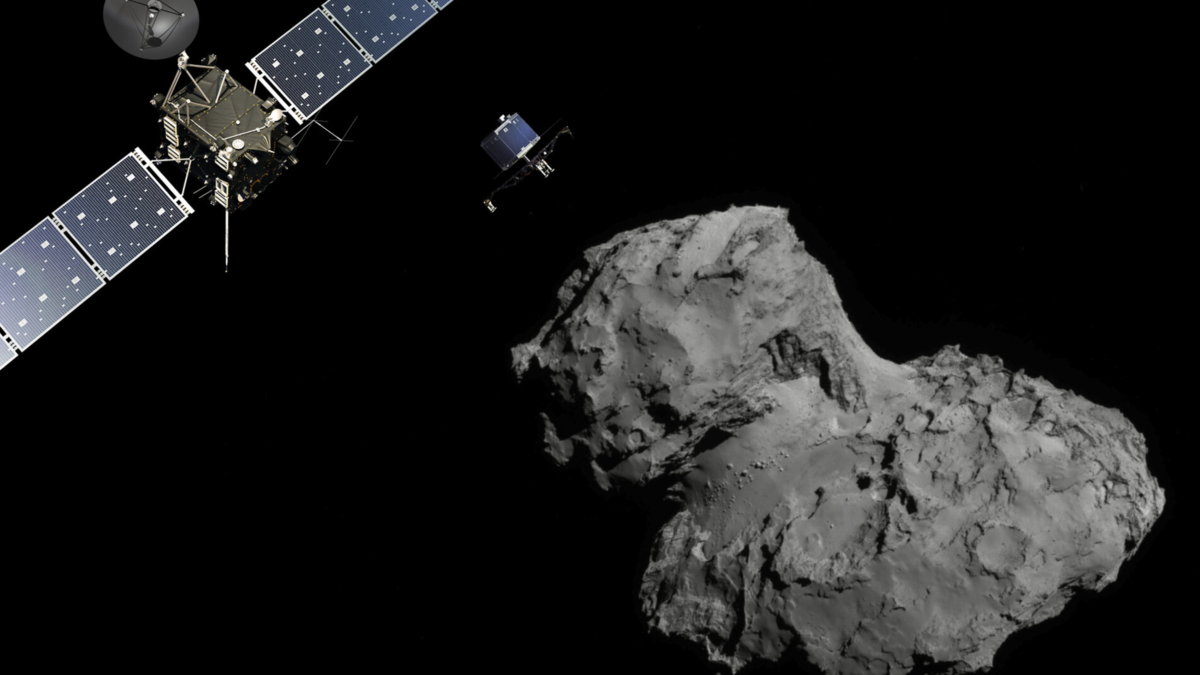
Rosetta Asteroid. Credit: ESA
At the third International Deep Space Exploration Conference, also known as Tiandu Forum, held in Hefei, east China’s Anhui Province, on September 4 and 5, Chinese scientists outlined a strategic concept for planetary defense.
The plan, proposed under the United Nations Committee on the Peaceful Uses of Outer Space (COPUOS), covers four main areas: monitoring, early warning, in-orbit handling, and systematic response.
According to Wu Weiren, chief designer of China’s lunar exploration program and director of the Deep Space Exploration Laboratory, the objective is to establish a comprehensive, space-ground collaborative system capable of routine monitoring and precise alerts.
Planetary defense requires not just detection but also the capacity to deflect or neutralize hazardous objects. This is one of the few scientific domains where global cooperation is essential because a single impact anywhere can affect the entire biosphere.
Historical impacts of asteroids
Near-Earth asteroids are among the most hazardous natural objects in the solar system, with impacts that have repeatedly reshaped Earth’s history.
Around 66 million years ago, an asteroid about 10 km (6 miles) in diameter struck Earth, triggering the extinction of nearly 75 percent of species, including the dinosaurs.
On June 30, 1908, the Tunguska explosion in Siberia flattened over 2 000 km2 (772 mi2) of forest while in 2013, a meteor airburst over Chelyabinsk, Russia, injured 1 500 people and damaged 3 000 buildings.
These events show that even relatively small asteroids can cause regional or global devastation, yet unlike most natural hazards, their impacts are preventable with sufficient preparation.
China’s preparations
China began systematic preparation for asteroid defense nearly two decades ago. In 2006, the China National Space Administration launched its near-Earth object survey program. A 2022 white paper formally outlined plans to demonstrate and develop planetary defense capabilities.
On May 29, 2025, China launched the Tianwen-2 probe with the objective of sampling asteroid 2016 HO3 before proceeding to study main-belt comet 311P. To support the mission and strengthen long-term monitoring capabilities, China has developed a network of ground-based telescopes. These include the 1 m telescope at Purple Mountain Observatory in Nanjing, the 2.5 m wide-field survey telescope in Lenghu, Gansu Province, the 2.16 m telescope in Xinglong, Hebei Province, and the 2.4 m and 1.8 m telescopes in Lijiang, Yunnan Province.
By integrating space missions with large-scale ground surveys, China is positioning itself to provide data and operational capacity for global planetary defense.
International cooperation
Planetary defense requires synchronized action across borders as no single country can fully monitor the skies or respond to impact threats alone.
Since 2014, the International Asteroid Warning Network (IAWN) and the Space Mission Planning Advisory Group (SMPAG) have operated under the United Nations framework to coordinate planetary defense. China has been an active participant in both organizations.
At the Hefei conference, Wu Weiren announced that China would share its asteroid observation data with international partners via the IAWN platform. He also invited cooperation in ground-based monitoring, payload hosting, and data exchange.
Driss El Hadani, deputy director of the United Nations Office for Outer Space Affairs (UNOOSA), commended China’s plan, describing it as “both timely and highly relevant.” Hadani said that asteroids present not only risks but also opportunities for humanity.
Christian Feichtinger, executive director of the International Astronautical Federation (IAF), noted that coordination is essential and that organizations such as IAF and the Deep Space Exploration Laboratory can play a key role.
Expanding the deep space economy
In July 2025, the International Deep Space Exploration Association (IDSEA), the first China-based global academic body for deep space exploration, was founded in Hefei to promote scientific exchange and train new aerospace talent.
At the conference, the Deep Space Exploration Laboratory outlined ten major sectors expected to define the future deep space economy:
- resource utilization,
- internet,
- energy,
- biology,
- transportation,
- smart technologies,
- construction,
- tourism,
- security,
- and cultural creativity.
Near-Earth asteroids contain abundant metals such as iron, nickel, and platinum-group elements, as well as rare earth minerals. Some are also rich in water, which could be used to produce propellant and life support resources in space.
Exploiting asteroid resources could drastically reduce the costs of space missions and support long-term human activity beyond Earth. This positions asteroid defense not only as a matter of safety but also as a foundation for future space economies.
A shared responsibility
Wu Weiren stressed that the exploration and utilization of space resources must serve the well-being of all humanity. Bernard Foing, vice chair of the Committee on Space Research (COSPAR) planetary commission, praised China’s openness to collaboration, pointing to opportunities for emerging countries to participate in upcoming Chang’e lunar missions through international payload calls.
NASA’s Planetary Defense Coordination Office (PDCO) currently tracks more than 35 000 near-Earth objects, with roughly 2 300 classified as potentially hazardous asteroids.
The European Space Agency (ESA) is advancing similar efforts through its Flyeye telescope in Sicily and the forthcoming Hera mission to the Didymos system, following NASA’s DART impact test in 2022.
China’s growing role adds another layer of global capability, combining spacecraft missions like Tianwen-2 with a distributed network of ground-based telescopes.
International coordination remains essential, as no single agency or nation can independently monitor, characterize, and mitigate all potential impact threats.
References:
1 3rd International Deep Space Exploration Conference – Tiandu Forum – Accessed September 10, 2025

I’m a science journalist and researcher at The Watchers, contributing to the Epicenter edition, where I cover peer-reviewed scientific research and emerging discoveries across Earth and space sciences. With a background in astronomy and a passion for environmental science, I’ve worked in shark and coral conservation in Fiji, conducting reef and shark-behavior research, contributing to mangrove restoration, and earning PADI Open Water and Coral Reef Certifications. I bring a blend of scientific rigor and storytelling to illuminate the discoveries shaping our planet and beyond.

Commenting rules and guidelines
We value the thoughts and opinions of our readers and welcome healthy discussions on our website. In order to maintain a respectful and positive community, we ask that all commenters follow these rules.