
Astronomers detect rare ammonia signal from comet 12P/Pons-Brooks
Scientists at the Shanghai Astronomical Observatory used the Tianma 65 m Radio Telescope in China to detect hydroxyl and ammonia radio emissions from comet 12P/Pons-Brooks between December 2023 and March 2024, marking the most distant ammonia detection ever recorded in a Halley-type comet and revealing how volatile gases drive its powerful outbursts.
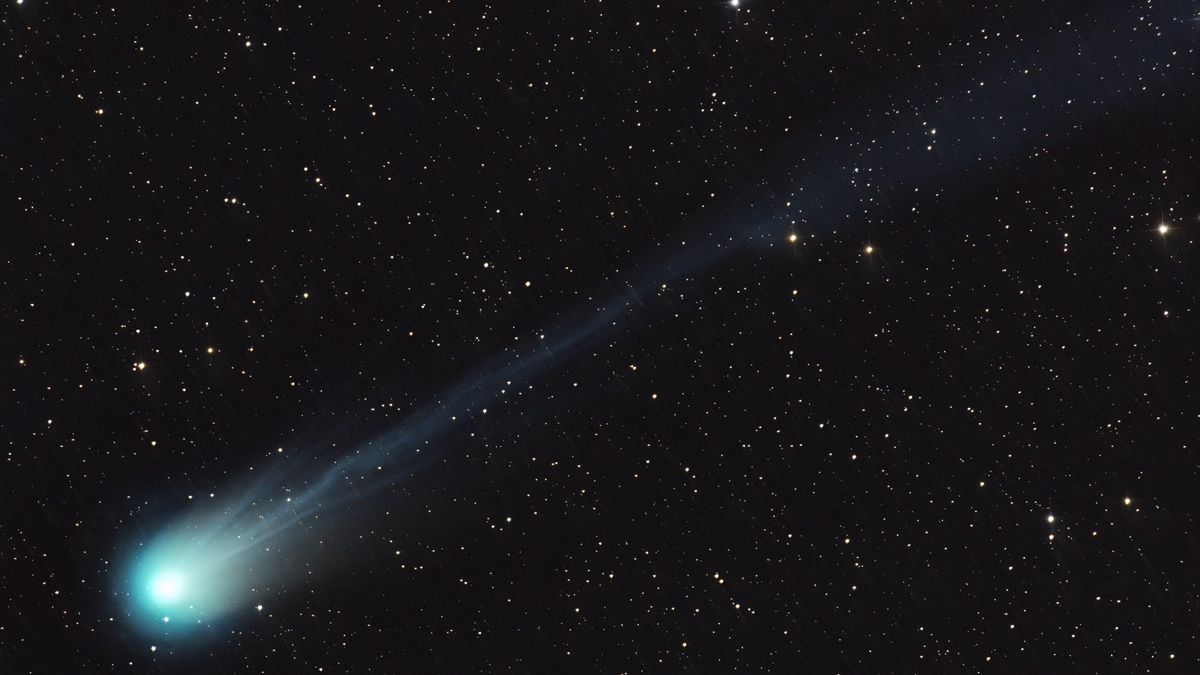
12P/Pons–Brooks photographed on March 7, 2024. Credit: ESA
A research team at the Shanghai Astronomical Observatory detected radio signals from comet 12P/Pons-Brooks using the Tianma 65 m Radio Telescope in China. The observations captured hydroxyl emissions linked to water and a faint signature of ammonia, marking the most distant radio detection of this molecule ever recorded in a Halley-type comet.
These findings offer a rare view of the chemical engine driving one of the Solar System’s most active comets. The detection of ammonia, a volatile with a low sublimation temperature, helps explain why 12P experiences repeated and violent outbursts as it nears the Sun.
During its 2024 return, 12P brightened sharply several times, producing rapid gas releases from beneath its icy crust. When the comet was 1 astronomical unit from the Sun, it released more than 4.5 metric tons (5 short tons) of water vapor every second. Such production rates exceed those of most short-period comets and rival some long-period ones.
The study, published in Astronomy & Astrophysics, provides new observational evidence that connects internal volatile reservoirs with outburst behavior. The findings also demonstrate the power of radio astronomy to probe the chemistry of comets from Earth-based telescopes.
How scientists captured the comet’s signal
Between December 2023 and March 2024, the team performed a series of coordinated observations at L-band (18 cm) and K-band (1.3 cm) frequencies. The Tianma Radio Telescope, with its 65 m (213 ft) dish, allowed sensitive measurements of spectral lines emitted by hydroxyl and ammonia molecules as 12P approached the Sun.
The L-band receiver operated at system temperatures between −253-−243°C (−424–406°F), while the K-band system functioned near −113°C (−172°F). Each observing session lasted about five hours, covering a range of heliocentric distances from 2.22 to 1.18 astronomical units. Data were processed using radiative transfer modeling to determine water production rates and gas velocities.
The hydroxyl emission lines at 1665 and 1667 megahertz were clearly detected in all observing runs. Their intensity ratios matched theoretical expectations, confirming that they originated from photodissociation of water molecules in the comet’s coma. The water production rate increased threefold over the observation period, reflecting strong variability linked to episodic outbursts.
On December 14, 2023, during one of the comet’s brightest outbursts, the researchers switched to K-band mode and captured a tentative detection of ammonia at a 3σ confidence level. The signal corresponded to the (3,3) inversion line of NH₃ and marked the most distant detection of ammonia by radio wavelengths in any Halley-type comet.
What the gas tells us about 12P’s activity
The observed hydroxyl emissions serve as a proxy for water vapor, revealing how the comet’s activity evolved as it moved toward the Sun. From late January to early March 2024, the expansion velocity of water vapor varied between 0.5–1.4 km/s (0.3–0.9 mps), a change closely tied to specific outburst events.
Radiative transfer analysis showed that 12P’s water production rate peaked at around 2.2 x 1029 molecules per second on March 2 and dropped to 1.4 x 1029 molecules per second one day later. This rapid decline, following an outburst on February 29, suggests that the comet’s volatile release responds almost immediately to surface disruptions.
The researchers calculated that, under steady conditions, 12P maintains a minimum active area of about 70 km² (27 mi2). This value roughly represents the portion of the nucleus that must sublimate to sustain the observed outgassing. Assuming a completely active surface, the comet’s nucleus would need a radius of at least 2.2 km (1.4 miles).
When water production rates were plotted against heliocentric distance, the data followed a shallow power-law slope of −1.2, indicating that 12P continues to release gas efficiently even at large distances from the Sun. This sets it apart from most Halley-type comets, which typically show much steeper declines in activity.
A chemical clue hidden in ammonia
Ammonia plays a special role in cometary chemistry because it evaporates at lower temperatures than water, carbon monoxide, or carbon dioxide. Detecting ammonia in 12P therefore provides a window into the comet’s interior composition and the processes that trigger its outbursts.
The ammonia signal observed in December 2023 was narrow, only about 0.11 km/s (0.07 mps) wide, and slightly red-shifted. This implies that the gas jet producing it was directed away from Earth, possibly originating on the comet’s nightside. Using this line, the team estimated an ammonia-to-water ratio of about 1.4%, among the highest recorded for comets at similar distances from the Sun.
Such a high abundance of ammonia could mean that 12P’s interior still preserves volatile-rich ices or ammonium salts that decompose when heated. The breakdown of these salts, such as ammonium chloride, releases ammonia gas and may trigger surface ruptures or mini-explosions. These rapid releases could account for the frequent outbursts seen in 12P during its 2024 return.
The researchers caution that their ammonia detection remains tentative until confirmed by independent measurements. However, even this marginal signal aligns with infrared observations of other comets showing similar nitrogen-rich emissions as they near the Sun.
Why this comet matters
Comet 12P/Pons-Brooks has intrigued astronomers since its discovery in the 19th century for its unpredictable outbursts and high activity. Its 2024 apparition offered a rare chance to observe these behaviors with modern radio instrumentation and to compare them with optical and infrared results.
The Tianma observations revealed that water and ammonia emissions rise sharply during outbursts and fade within days, demonstrating the dynamic exchange between a comet’s frozen interior and its gas envelope. These short-lived bursts of volatility are likely driven by pockets of ice sealed beneath insulating dust layers.
Understanding how 12P’s outbursts work may help scientists reconstruct the thermal history of comets and, by extension, the early Solar System. Comets preserve pristine material from 4.6 billion years ago, and studying their volatile composition provides clues about the chemistry of the Sun’s birthplace.
As one of the few Halley-type comets accessible to ground-based radio telescopes, 12P continues to act as a natural laboratory for understanding how ancient ices evolve. Future observations, especially near its next perihelion passage, will determine whether ammonia detections like this one are common or a unique feature of this volatile and unpredictable comet.
References:
1 Scientists Capture Radio Signals from Comet 12P/Pons-Brooks – Chinese Academy of Sciences – October 17, 2025
2 Pre-perihelion radio observations of comet 12P/Pons-Brooks with the Tianma Radio Telescope – Juncen Li et al. – Astronomy & Astrophysics – September 17, 2025 – https://doi.org/10.1051/0004-6361/202554867 – OPEN ACCESS

I’m a science journalist and researcher at The Watchers, contributing to the Epicenter edition, where I cover peer-reviewed scientific research and emerging discoveries across Earth and space sciences. With a background in astronomy and a passion for environmental science, I’ve worked in shark and coral conservation in Fiji, conducting reef and shark-behavior research, contributing to mangrove restoration, and earning PADI Open Water and Coral Reef Certifications. I bring a blend of scientific rigor and storytelling to illuminate the discoveries shaping our planet and beyond.

Commenting rules and guidelines
We value the thoughts and opinions of our readers and welcome healthy discussions on our website. In order to maintain a respectful and positive community, we ask that all commenters follow these rules.