
Astronomers detect first repeating day-long gamma-ray burst in deep space
A day-long gamma-ray burst, GRB 250702B, was detected on July 2, 2025, and later identified as extragalactic by the European Southern Observatory’s Very Large Telescope in Chile.

Astronomers detected a highly unusual gamma-ray burst (GRB), designated GRB 250702B, that repeated multiple times over the course of nearly 24 hours. The initial detection came on July 2, from NASA’s Fermi Gamma-ray Space Telescope, which recorded three distinct bursts from the same source within several hours.
Retrospective analysis of data from the Einstein Probe, an X-ray mission led by the Chinese Academy of Sciences in collaboration with the European Space Agency (ESA) and the Max Planck Institute for Extraterrestrial Physics, revealed that the source had already been active nearly a day earlier.
Gamma-ray bursts (GRBs) are among the most energetic events in the Universe, typically produced when massive stars collapse or when compact stars are disrupted by black holes. They usually last from milliseconds to minutes, with extreme cases extending to a few hours. The repeating signal from GRB 250702B lasted about one day, making it 100–1 000 times longer than most GRBs and unlike anything astronomers have recorded in 50 years of observations.
Why this GRB is different
GRBs are normally single, catastrophic events. The processes that power them, such as the collapse of a massive star or the merger of two compact objects, destroy their progenitors completely, leaving no opportunity for repetition.
“This is 100–1 000 times longer than most GRBs,” said Andrew Levan, astronomer at Radboud University in the Netherlands and co-lead author of the study. “Gamma-ray bursts never repeat since the event that produces them is catastrophic,” added Antonio Martin-Carrillo of University College Dublin, Ireland.
For GRB 250702B, not only was the burst unusually long, it also produced multiple peaks of emission over many hours. The abstract of the study notes that the third burst occurred at an integer multiple of the interval between the first two, hinting at a possible periodicity in the progenitor system, though no firm conclusion has yet been drawn.

Locating the source
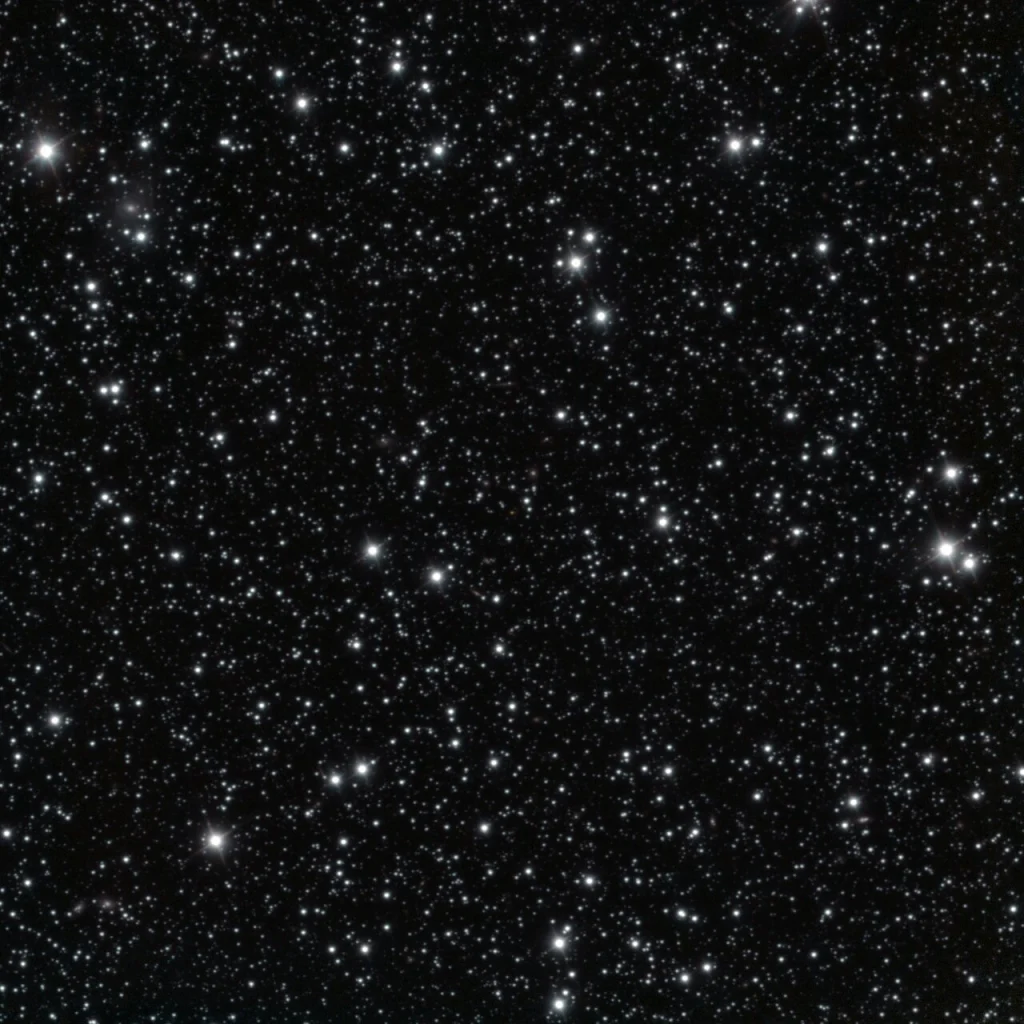
Only approximate coordinates for the origin of the burst was provided by Fermi and the Einstein Probe, placing the event near the crowded plane of the Milky Way. Initially, astronomers suspected it might lie within our own galaxy.
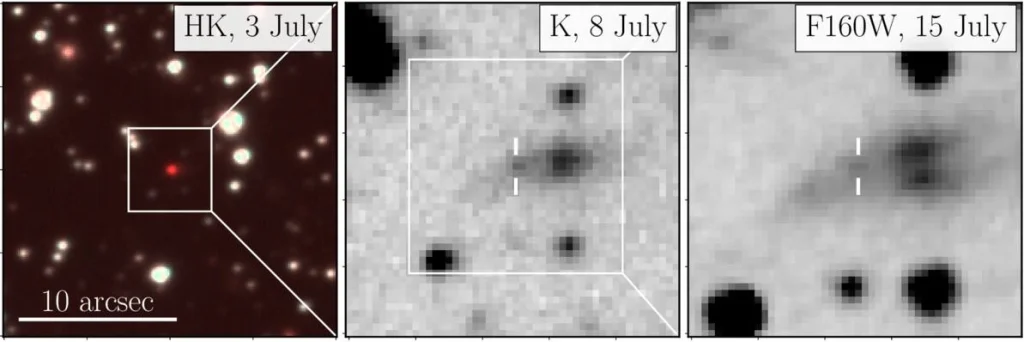
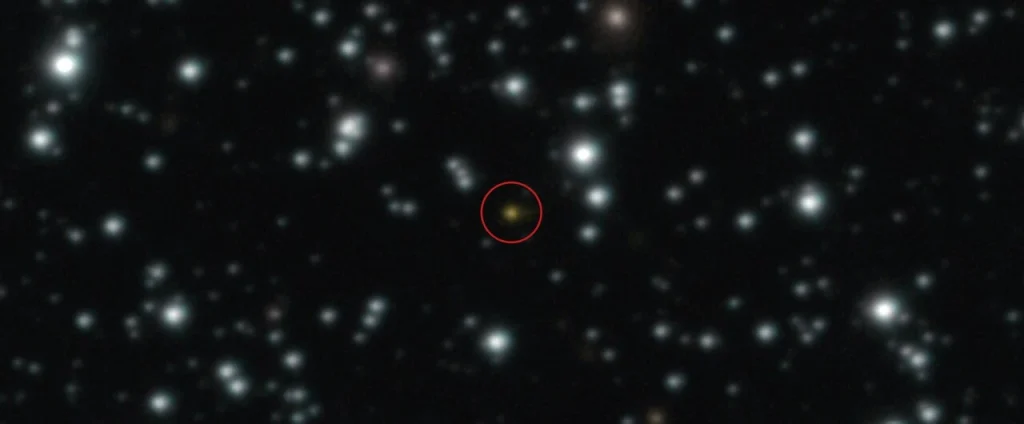
Follow-up imaging with the European Southern Observatory’s Very Large Telescope (VLT) and its HAWK-I infrared camera in Chile changed that view. The team identified a faint, extremely red host galaxy at the source location. Subsequent observations with the NASA/ESA Hubble Space Telescope confirmed that GRB 250702B originated in a galaxy with a complex morphology outside the Milky Way.
Spectroscopic data suggest a redshift of approximately z = 0.3, corresponding to a distance of several billion light-years. This extragalactic origin means the burst was far more energetic than if it had been a local Galactic event.
Possible explanations
While the nature of the event remains uncertain, one possibility is that it was caused by the collapse of a massive star. However, such events typically produce bursts lasting only seconds. To explain GRB 250702B, the collapse would have to be unlike any ever observed.
Another possibility is a tidal disruption event, a star being torn apart by a black hole. While this could potentially account for the day-long emission, it does not easily explain the repeating pattern of bursts.
The authors of the study suggest that the most plausible scenario may involve a white dwarf star shredded by an intermediate-mass black hole. White dwarfs are the dense remnants of stars like our Sun.
Intermediate-mass black holes, with masses between 100 and 100 000 times that of the Sun, are a poorly understood class of objects that remain elusive to direct observation. The disruption of a white dwarf by such a black hole could produce extended, variable gamma-ray emission consistent with the observations.
Why it matters
GRB 250702B is the first gamma-ray burst known to repeat and to last on day-long timescales. Its extragalactic location and unusual properties challenge established models of gamma-ray burst physics.
The team continues to monitor the aftermath with a range of instruments, including the VLT’s X-shooter spectrograph, the James Webb Space Telescope (JWST), and the MeerKAT radio telescope in South Africa. These observations will help constrain the nature of the progenitor system and the mechanisms driving such extreme energy release.
GRBs are probes of extreme physics, from stellar death to black hole growth, and they illuminate conditions in the early Universe. A repeating, day-long GRB introduces a new class of phenomena, suggesting that astrophysicists may need to revise current models of how stars end their lives and how black holes interact with their environment.
“Finding that this explosion took place in another galaxy will be key to deciphering what caused it,” said Martin-Carrillo. “We are still not sure what produced this, but with this research we have made a huge step forward towards understanding this extremely unusual and exciting object.”
References:
1 The Day-long, Repeating GRB 250702B: A Unique Extragalactic Transient – Andrew J. Levan, Antonio Martin-Carrillo et al. – August 29, 2025 – DOI 10.3847/2041-8213/adf8e1 – OPEN ACCESS
2 Astronomers spot mysterious gamma-ray explosion, unlike any detected before – ESO – September 9, 2025

I’m a science journalist and researcher at The Watchers, contributing to the Epicenter edition, where I cover peer-reviewed scientific research and emerging discoveries across Earth and space sciences. With a background in astronomy and a passion for environmental science, I’ve worked in shark and coral conservation in Fiji, conducting reef and shark-behavior research, contributing to mangrove restoration, and earning PADI Open Water and Coral Reef Certifications. I bring a blend of scientific rigor and storytelling to illuminate the discoveries shaping our planet and beyond.

Commenting rules and guidelines
We value the thoughts and opinions of our readers and welcome healthy discussions on our website. In order to maintain a respectful and positive community, we ask that all commenters follow these rules.