
Asteroid 2024 YR4 and the missions that could stop a Moon impact in 2032
NASA scientists are preparing mission scenarios to prevent asteroid 2024 YR4, a 60 m (197 feet) object, from striking the Moon on December 22, 2032, where it carries about a 4 percent impact probability.

Asteroid 2024 YR4 orbit visualization - February 18, 2025. Image credit: ESA/NEOCC, The Watchers
2024 YR4 is a near-Earth asteroid discovered on December 27, 2024. Initially, it appeared to have a small chance of striking Earth in 2032. By February 18, 2025, Earth impact probability peaked at about 3.1%, before additional observations in late February eliminated the risk.
The Moon, however, remains in play. By May 2025, refined orbit models indicated a ∼4% chance of impact with the lunar surface on December 22, 2032. Although low, this probability is significant for planetary defense because of the potential consequences.
A lunar impact of an object around 60 m (197 feet) wide would excavate large amounts of debris. Because the Moon has no atmosphere, all ejecta would travel unimpeded. Some fragments would achieve escape velocity and enter cislunar space.
Models suggest that under worst-case assumptions, micrometeoroid flux in low Earth orbit could spike by factors of 100 to 1 000 for several days. Scientists emphasize uncertainties, but even conservative scenarios suggest a sharp, temporary rise in hazards for spacecraft.
This is why planetary defense extends beyond Earth alone. A lunar impact of this scale could turn Earth’s orbital environment into a debris field, threatening satellites, space stations, and any crewed missions underway.
Measuring the asteroid before taking action
Before attempting disruption, detailed measurements are needed. The James Webb Space Telescope observed 2024 YR4 in March and May 2025, using mid-infrared instruments to estimate a diameter of 60 ± 7 m (197 ± 23 feet) and identify it as an S-type asteroid. These data provide a solid baseline, but spacecraft reconnaissance would sharpen the picture.
A dedicated flyby probe launched in late 2028 could pass the asteroid in mid-2029. Such a mission would measure its orbit precisely, record its spin state, and map its surface properties, giving engineers the data needed for a disruption mission.
A rendezvous spacecraft is another option. Instead of a brief encounter, the spacecraft would match velocity with the asteroid and travel alongside it for months. This would return detailed information about its structure and mass. The trade-off is greater complexity, higher propellant needs, and longer mission times.
NASA also studied whether existing spacecraft, such as OSIRIS-APEX or Psyche, could be redirected for reconnaissance. Some align with possible flyby opportunities, but limited maneuvering fuel and instrumentation mean they could not replace a dedicated mission. A purpose-built probe remains the most reliable choice.

Why traditional deflection will not work
When dealing with asteroids, the first instinct is often deflection. A kinetic impactor can nudge a space rock off course, while a nuclear explosive device can impart a velocity change through energy deposition. For 2024 YR4, this approach is not feasible.
The problem lies in both physics and timing. To prevent a lunar impact, the asteroid’s speed would need to be altered by more than 10 percent of its escape velocity. Applying such force risks shattering it into large fragments, many of which could still collide with the Moon.
A kinetic impactor would need to launch by June 2028, allowing arrival years before the 2032 encounter. That leaves little time for spacecraft development and testing, making it unrealistic with today’s schedules. Nuclear deflection shares the same limitation, with required launch dates in late 2028 at the latest.
Because of these constraints, scientists conclude that deflection cannot reliably protect the Moon from 2024 YR4. Instead, robust disruption offers a better solution.
Breaking the asteroid apart to save the Moon
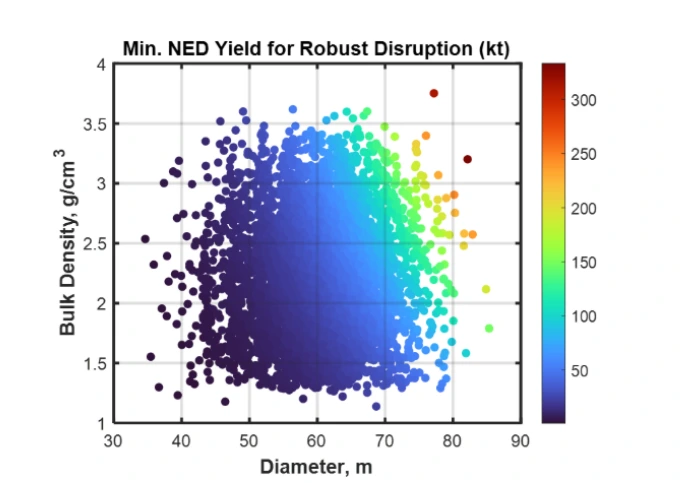
Robust disruption differs from deflection. Rather than nudging the asteroid, the aim is to break it apart into many smaller fragments that disperse safely.
Kinetic disruption would use a spacecraft of 4 to 12 tonnes striking the asteroid at 15–25 km/s (9–15 miles/s). A launch in April 2030 could achieve interception by August 2032, just months before the possible lunar strike. Even later opportunities, up to April 2032, remain viable but would leave less time for dispersal.
A standoff detonation of about 1 megaton could disperse fragments of even the largest size estimates for 2024 YR4. Viable launch windows exist between late 2029 and late 2031. Radar-guided fuzing simulations suggest reliable detonation at standoff distances of 80 to 300 m (262 to 984 feet) for approach speeds up to about 15 km/s (9 miles/s).
Simulations show that breaking the asteroid at least one month before the possible impact allows debris to spread widely, reducing the chance of hazardous concentrations near Earth by up to three orders of magnitude.

Mission campaigns to reduce risk
The study outlines several candidate mission campaigns that combine reconnaissance and disruption. Each provides different levels of redundancy and operational complexity.
One straightforward approach launches a flyby reconnaissance probe in late 2028, followed by a kinetic disruption mission in 2030. This combination delivers early orbit refinements and a clear disruption attempt two years later.
A second option layers redundancy by adding a rendezvous observer. After the flyby in 2029, a spacecraft launched in November 2029 would rendezvous with the asteroid and monitor it until 2032. This observer would record the disruption attempt in detail, yielding valuable data for future planetary defense missions.
The most complex plan couples a rendezvous probe with a nuclear disruption spacecraft. A rendezvous craft launched in 2029 would arrive in mid-2032, while a nuclear disruption spacecraft launched in 2030, with a backup in 2031, would stand ready to destroy the asteroid. This campaign offers the highest assurance but also requires the greatest resources.
Each plan demonstrates that a feasible defense exists, but the narrow launch windows mean decisions must be made years in advance. Delay could close off practical options.
Lessons for planetary defense
Even if 2024 YR4 is eventually found to miss the Moon entirely, the exercise of planning missions carries long-term value. It forces the planetary-defense community to consider short-warning scenarios, decision timelines, and technical trade-offs.
The asteroid’s discovery just eight years before a possible impact illustrates the challenge. Objects in the 50 to 100 m (164 to 328 feet) range are faint and difficult to detect early. A space-based survey mission, such as NASA’s planned NEO Surveyor, would extend detection horizons, offering decades rather than years of warning.
Policy frameworks are also evolving. The U.S. National Academies of Sciences and the 2023 White House planetary-defense strategy both emphasize reconnaissance, rapid-response mission readiness, and realistic simulations. 2024 YR4 fits directly into those goals, providing a live test case.
Planetary defense is no longer only about Earth. Protecting the Moon and cislunar space is critical because any disturbance there can directly affect human infrastructure in orbit. The 2024 YR4 case shows why a broader vision is essential for long-term space security.
References:
1 Space Mission Options for Reconnaissance and Mitigation of Asteroid 2024 YR4 – Brent W. Barbee et al. – arXiv – September 15, 2025 – https://arxiv.org/pdf/2509.12351 – OPEN ACCESS

I’m a science journalist and researcher at The Watchers, contributing to the Epicenter edition, where I cover peer-reviewed scientific research and emerging discoveries across Earth and space sciences. With a background in astronomy and a passion for environmental science, I’ve worked in shark and coral conservation in Fiji, conducting reef and shark-behavior research, contributing to mangrove restoration, and earning PADI Open Water and Coral Reef Certifications. I bring a blend of scientific rigor and storytelling to illuminate the discoveries shaping our planet and beyond.

Commenting rules and guidelines
We value the thoughts and opinions of our readers and welcome healthy discussions on our website. In order to maintain a respectful and positive community, we ask that all commenters follow these rules.