
Ancient Mesoamerican builders shaped a cosmic city in Mexico 3 000 years ago
Archaeologists in southeastern Mexico uncovered a vast ceremonial complex at Aguada Fénix, dating to about 1 000 B.C. The site measures nearly 1.4 km (0.9 miles) long, 400 m (0.25 miles) wide, and 9–15 m (30–50 feet) high, making it the oldest and largest known monument in the Maya region.
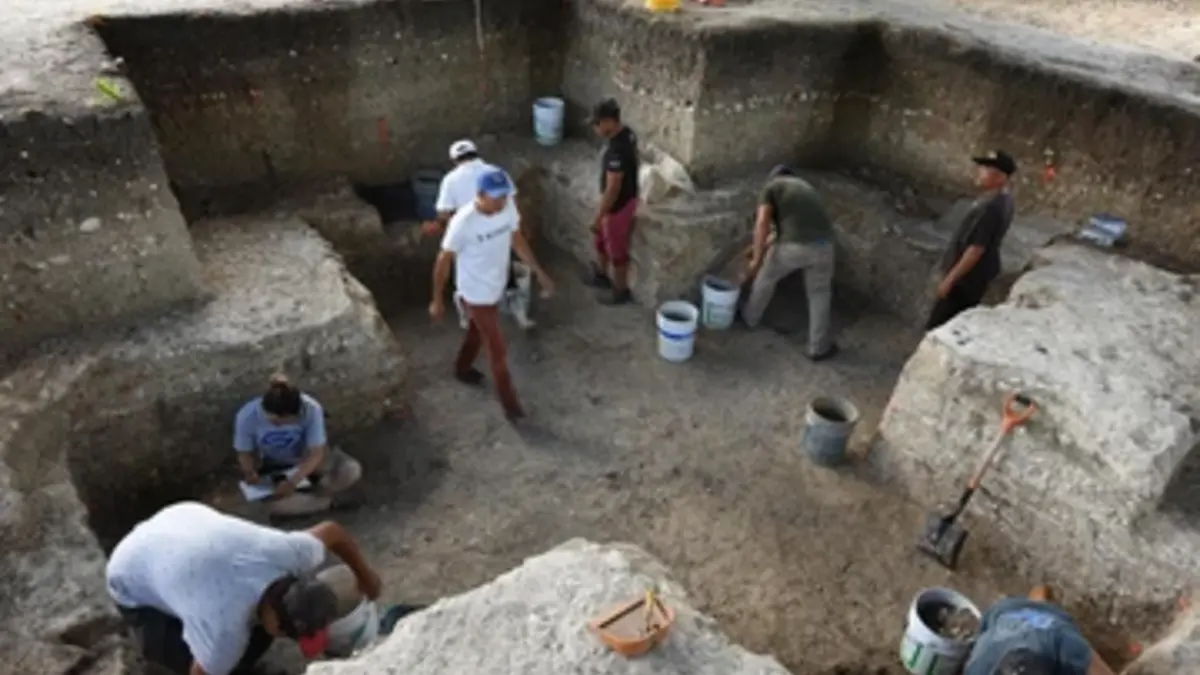
Archaeologists excavating the cruciform, before discovering the cache in the center of the pit. Credit: Takeshi Inomata/School of Anthropology
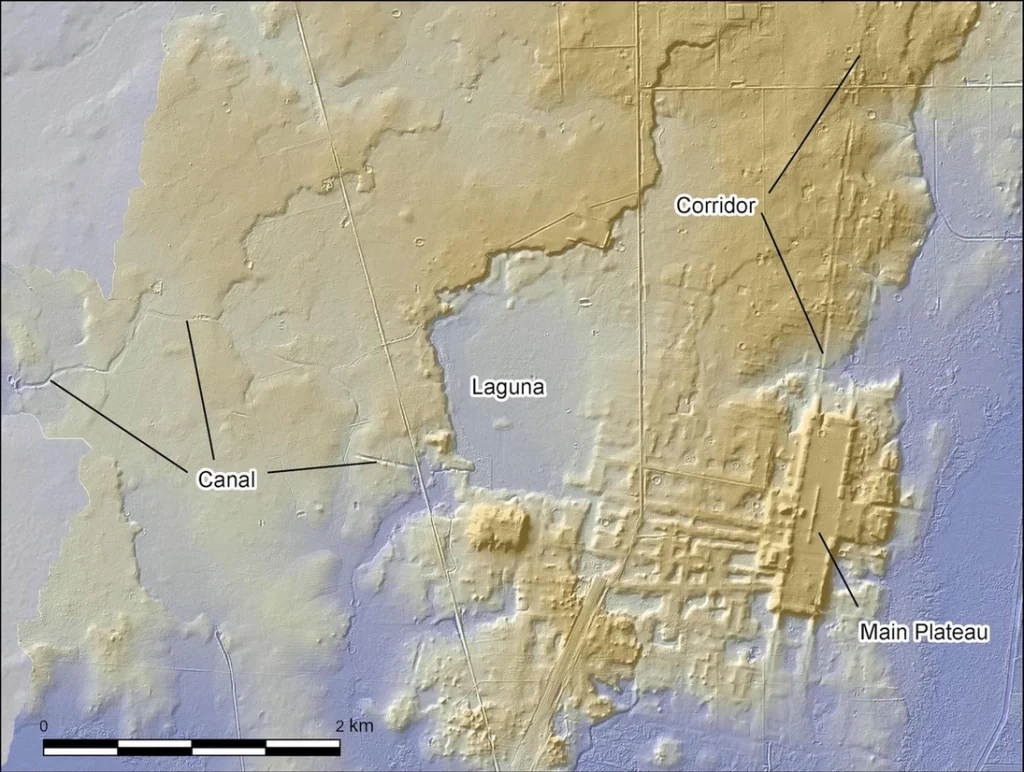
The site of Aguada Fénix lies on low ranchland near Mexico’s southeastern border with Guatemala. Using airborne lidar, or light detection and ranging, researchers mapped a huge plateau 1.4 km (0.9 miles) long and about 400 m (1 300 feet) wide. The platform rises between 9–15 m (30–50 feet), dwarfing later Maya temples.
Led by archaeologists Takeshi Inomata and Daniela Triadan from the University of Arizona, the team dated the monument to 1 050–700 B.C. Radiocarbon and ceramic analysis show that it predates cities like Tikal in Guatemala and Teotihuacan in central Mexico by nearly a millennium.
The discovery in 2020 redefined how archaeologists understand early Mesoamerican organization. It revealed that vast construction projects occurred long before hereditary kingship or formal states.
Since then, lidar mapping has identified nearly 500 smaller ceremonial sites across southeastern Mexico, suggesting a shared architectural tradition and a network of communities linked by ritual purpose.
A cosmic pattern carved into the landscape
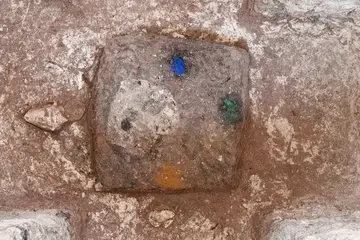
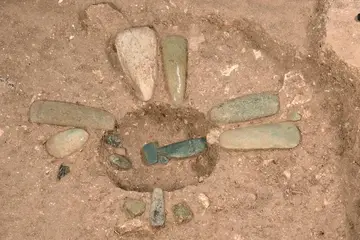
At the monument’s centre, excavations exposed a cross-shaped pit cut into limestone. Inside lay a cache of ritual objects: 24 unbaked-clay axes, jade ornaments and small piles of coloured soil. Each pigment was placed with directional intent, blue azurite to the north, green malachite to the east, yellow ochre mixed with goethite to the south, and faded red earth to the west.
“This is the first case we’ve found where pigments were placed for each direction,” said Inomata. “It materializes how early Mesoamericans conceived the structure of the universe.”
The cache was sealed between 900–845 B.C. Later visitors returned to bury jade carvings of a crocodile, a bird and a woman giving birth: symbols of fertility and creation. These finds confirm that Aguada Fénix functioned as a cosmogram, a material model of the universe representing the four cardinal directions.
The site’s main axis aligns with the sunrise on October 17–February 24 (a span of 130 days), representing half of the 260-day Mesoamerican ritual calendar. This shows that its builders connected astronomy to ritual geometry with remarkable precision.
Engineering a sacred environment
Lidar data revealed that the Aguada Fénix plateau was the center of a larger design measuring about 9 km (5.6 miles) north–south and 7.5 km (4.6 miles) east–west. Causeways, corridors and canals extended in straight lines from the plateau, following the same solar orientation.
A dam 120 m (394 feet) long and 30–55 m (98–180 feet) wide controlled water from Laguna Naranjito. From there, canals up to 35 m (115 feet) wide and 5 m (16 feet) deep ran as far as 9.6 km (6 miles). Excavations show the builders cut through clay, marl and hard limestone using stone tools.
The hydraulic system involved about 193 000 m3 (6.8 million ft3) of earth and stone and 255 000 person-days of labour. It was built not for irrigation but as a symbolic extension of the cosmic layout, with water representing life and renewal.
Although some canals remain unfinished, their scale and precision reveal sophisticated planning. The engineered landscape allowed processions and ritual movements aligned with the sun, turning the entire plain into a sacred stage.
Monumental cooperation without kings
No palaces or tombs exist at Aguada Fénix, and no carvings depict rulers or dynasties. The monument appears to have been built by cooperating communities under the guidance of astronomer-priests rather than kings.
“These leaders didn’t have power to force other people,” Inomata said. “Most came willingly because building a cosmogram was important to them.”
Verónica Vázquez López of UCL Archaeology described the project as “an extraordinary construction effort requiring collective collaboration.” She said its scale shows how belief systems tied together different groups long before political hierarchies existed.
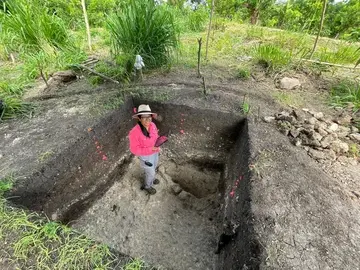
Xanti Ceballos Pesina, a doctoral student from the University of Arizona, said that seeing the monument mapped by lidar was astonishing. “In the Middle Preclassic Period, people with no centralized power came together to perform rituals and build this massive construction,” she said.
The main plateau alone contains about 3 630 000 m3 (128 million ft3) of earth, requiring around 10.8 million person-days of labour, an achievement equal to that of the largest later Maya centres.
Rethinking the origins of civilization
The findings challenge the idea that Mesoamerican civilization grew slowly from small villages to urban kingdoms. “What we are finding is that there was a ‘big bang’ of construction at the beginning of 1 000 B.C.,” Inomata said. “Huge planning and construction really happened at the very beginning.”
Archaeologists now view Aguada Fénix as evidence that monumental architecture can arise through shared ritual and astronomical knowledge rather than through coercive rule.
The builders were likely seasonal gatherers, meeting during the dry months for construction and ceremony, then returning to smaller settlements. This cycle maintained social ties without permanent urbanization.
Aguada Fénix was occupied for about 350 years before being abandoned, but its ideas endured. Colour symbolism, directional cosmology and ritual geometry became cornerstones of later Maya culture.
“The past shows it’s not like that,” Inomata said. “We don’t need deep inequality to accomplish great collective works.”

Legacy of the first cosmic city
Aguada Fénix represents the intersection of technology, belief and cooperation. Its builders linked astronomy and water engineering into a single vision of the world.
Pigments, shells and jade ornaments found in the cache mark the earliest directional colour system in Mesoamerica. The use of azurite and malachite suggests trade with distant copper regions of Mexico and Central America.
The unfinished canals show that grand projects could fail, but the attempt itself demonstrated a new level of collective imagination. Even without cities or rulers, these builders redesigned their world to reflect the universe they believed in.
Aguada Fénix stands today as proof that human societies can organize on massive scales through shared purpose and cosmic vision, not domination. It remains one of the earliest and most ambitious examples of monumental cooperation on Earth.
References:
1 U of A-led team discovers large ritual constructions by early Mesoamericans – The University of Arizona News – November 5, 2025
2 Enormous ritual construction by early Mesoamericans unearthed in Mexico – UCL – November 6, 2025

I’m a science journalist and researcher at The Watchers, contributing to the Epicenter edition, where I cover peer-reviewed scientific research and emerging discoveries across Earth and space sciences. With a background in astronomy and a passion for environmental science, I’ve worked in shark and coral conservation in Fiji, conducting reef and shark-behavior research, contributing to mangrove restoration, and earning PADI Open Water and Coral Reef Certifications. I bring a blend of scientific rigor and storytelling to illuminate the discoveries shaping our planet and beyond.

Commenting rules and guidelines
We value the thoughts and opinions of our readers and welcome healthy discussions on our website. In order to maintain a respectful and positive community, we ask that all commenters follow these rules.