
A simple forecast of Arctic sea-ice extent is putting complex models to the test
A forecasting method built only from the historical record of Arctic sea-ice extent has achieved September hindcast skill comparable with models used by the Sea Ice Prediction Network, giving researchers a simple test of whether more complex physics-based and AI systems are actually extracting additional predictive information. The Random Analogue Predictor (RAP), developed by Faiq Raees and Francesco Paparella, was evaluated at lead times of up to nine months and showed negligible bias with root-mean-square error no greater than 0.6 million km² (232 000 mi²).
Credit: Annie Spratt/Unsplash
Sea-ice extent measures the ocean region counted as ice-covered once ice concentration reaches a specified threshold; NSIDC uses 15%. It is different from the physical area occupied by ice because an entire satellite grid cell counts toward extent once it crosses that threshold. September extent is especially important because Arctic sea ice normally reaches its annual minimum near the end of the summer melt season.
The research addresses a basic problem in seasonal forecasting: some information about the future is already contained in the way Arctic sea ice evolved in the past. A sophisticated model that simulates the atmosphere, ocean and sea ice, or an AI system trained on many variables, should therefore demonstrate that its additional complexity produces predictive skill beyond what can already be extracted from the sea-ice record itself. Raees and Paparella propose RAP as that baseline.
That is the main significance of the study. RAP is not presented as a replacement for comprehensive forecast models. Instead, it creates a deliberately difficult minimum standard: if a much more elaborate forecasting system cannot consistently outperform a method that only recognizes recurring patterns in historical sea-ice extent, the extra information and computational complexity have not yet translated into greater forecast skill by that measure. NYU Abu Dhabi describes RAP as a transparent benchmark for physics-based and AI-driven models.
RAP works by looking backward before it looks forward. Rather than calculating how winds, ocean heat, ice motion and other physical processes will evolve, the algorithm searches the historical sea-ice record for past conditions resembling the current state and examines what happened afterward. Repeating that process produces an ensemble, a collection of possible future trajectories rather than a single deterministic path. The spread of those trajectories supplies an estimate of forecast uncertainty.
The researchers then use a statistical measure called band depth to identify a trajectory that is central within the ensemble. In physical terms, it serves a role similar to choosing a representative member from a bundle of possible forecast curves rather than assuming that one randomly selected trajectory is the forecast. The study compares that representative trajectory with observations and reports negligible overall bias and root-mean-square error no greater than 0.6 million km² (about 232 000 mi²). Root-mean-square error summarizes the typical size of forecast departures from observations, so lower values indicate closer agreement.
The strongest comparison concerned September-average sea-ice extent. The peer-reviewed paper reports that RAP hindcasts reached a level of skill comparable to models participating in the Sea Ice Prediction Network. A hindcast is a retrospective forecast test: the method predicts conditions for a period that has already occurred, allowing researchers to compare the forecast directly with observations. NYU Abu Dhabi said RAP’s September forecast error was comparable with that of 34 seasonal forecasting models.
The nine-month result needs a narrower interpretation than the headline phrase “predict nine months ahead” can imply. Nine months is the maximum lead time examined by the researchers, not evidence that every forecast made nine months in advance carries the same accuracy. RAP is probabilistic, and its ensemble spread is part of the result: a wider range of trajectories represents greater uncertainty about the future state.
The method also has a deliberate physical limitation. Because RAP uses only the historical sea-ice extent record, it does not simulate the atmospheric and oceanic processes that actually move, melt and form sea ice. Its skill comes from recognizing how similar ice states evolved previously. More complete models can incorporate information about atmospheric circulation, ocean conditions and sea-ice physics that RAP does not contain, which is precisely why the authors argue that those systems should be expected to outperform the benchmark.
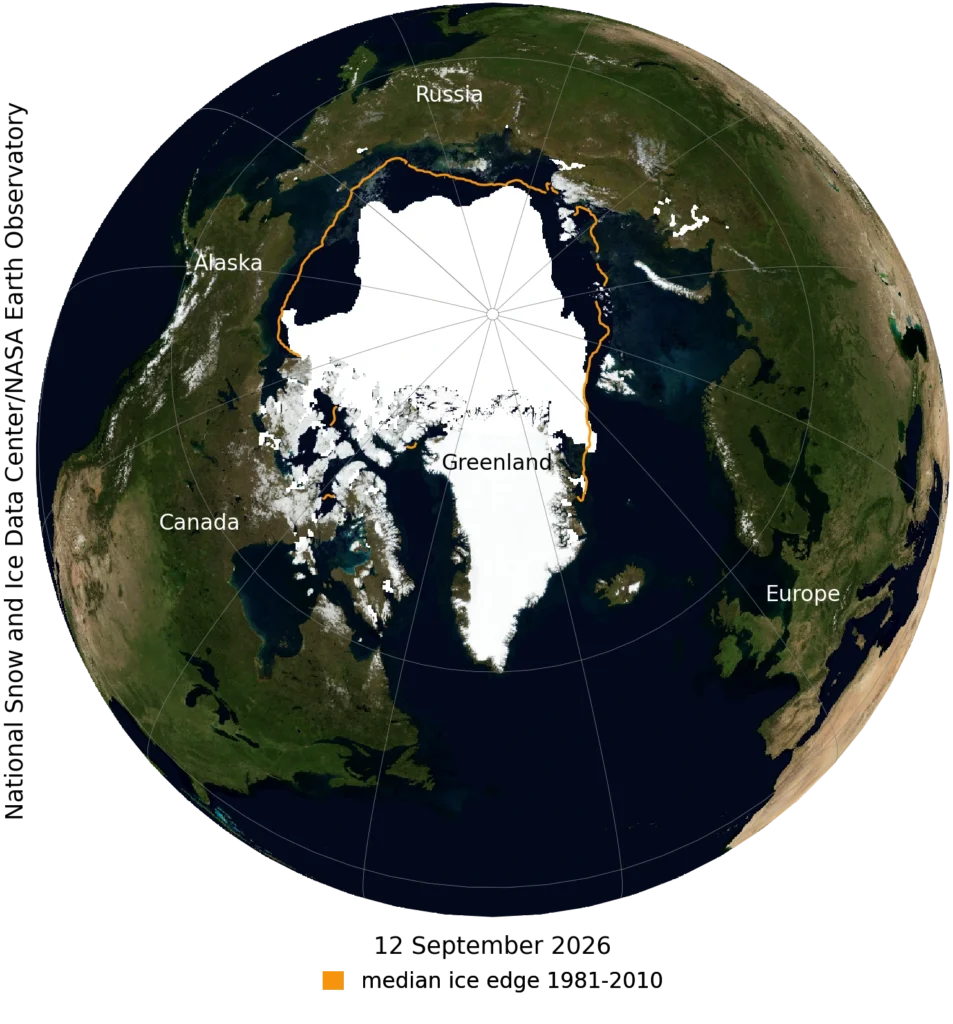
The forecasting target sits within a rapidly changing Arctic background. NSIDC measured September 2026 mean Arctic sea-ice extent at 4.81 million km² (1.86 million mi²), 1.6 million km² (618 000 mi²) below the 1981–2010 average. The 2026 seasonal minimum occurred on September 12 and tied 2008, 2010 and 2025 for the tenth-lowest minimum in the satellite record.
Those observations do not establish that RAP can predict every unusual Arctic season. They explain why a clear baseline for seasonal forecast skill has scientific value. A forecasting system can reproduce broad seasonal behavior while still missing short-lived weather-driven changes, unusual melt episodes, or other departures from patterns represented in its historical data.
RAP’s value is therefore diagnostic as much as predictive. It gives researchers a low-complexity reference against which additional physics, observations, and AI architecture can be tested. If a more complete model consistently beats RAP, researchers can examine what extra information produced the gain. If it does not, the additional complexity has not yet demonstrated added predictive skill against this benchmark.
References:
1 Raees, F., & Paparella, F. (2026). Random analog prediction provides a benchmark for seasonal Arctic sea ice extent forecasting. Scientific Reports. https://doi.org/10.1038/s41598-026-72959-0
2 New NYU Abu Dhabi algorithm could predict Arctic sea ice up to nine months ahead, offering new climate insights – New York University Abu Dhabi – October 8, 2026
3 “Stranger Things” in the 2026 Arctic – National Snow and Ice Data Center – October 7, 2026

I’m a science journalist and researcher at The Watchers, contributing to the Epicenter edition, where I cover peer-reviewed scientific research and emerging discoveries across Earth and space sciences. With a background in astronomy and a passion for environmental science, I’ve worked in shark and coral conservation in Fiji, conducting reef and shark-behavior research, contributing to mangrove restoration, and earning PADI Open Water and Coral Reef Certifications. I bring a blend of scientific rigor and storytelling to illuminate the discoveries shaping our planet and beyond.

I think sea ice volume can mean more than sea ice extent.
The Global Climate 2011-2020: Sea Ice
“There has also been a marked decrease in the extent of ice which lasted for more than one year.
In March 1985, old ice (four years or more) accounted for 33% of the total ice cover of the Arctic Ocean, but that figure had fallen below 10% by 2010, and in March 2020 it had dropped to 4.4%. Ice of this age is now mostly confined to a narrow strip extending from north of Greenland along the north-west edge of the Canadian archipelago.”
World Meteorology Organization WMO