
1906 San Francisco earthquake: Magnitude, damage, and key facts
A powerful earthquake struck northern California on April 18, 1906, devastating San Francisco and igniting fires that burned for three days. With an estimated magnitude of 7.9, it remains one of the most destructive seismic events in U.S. history. As the city marks the 119th anniversary today, the earthquake’s legacy continues to inform modern seismology, urban planning, and disaster preparedness.
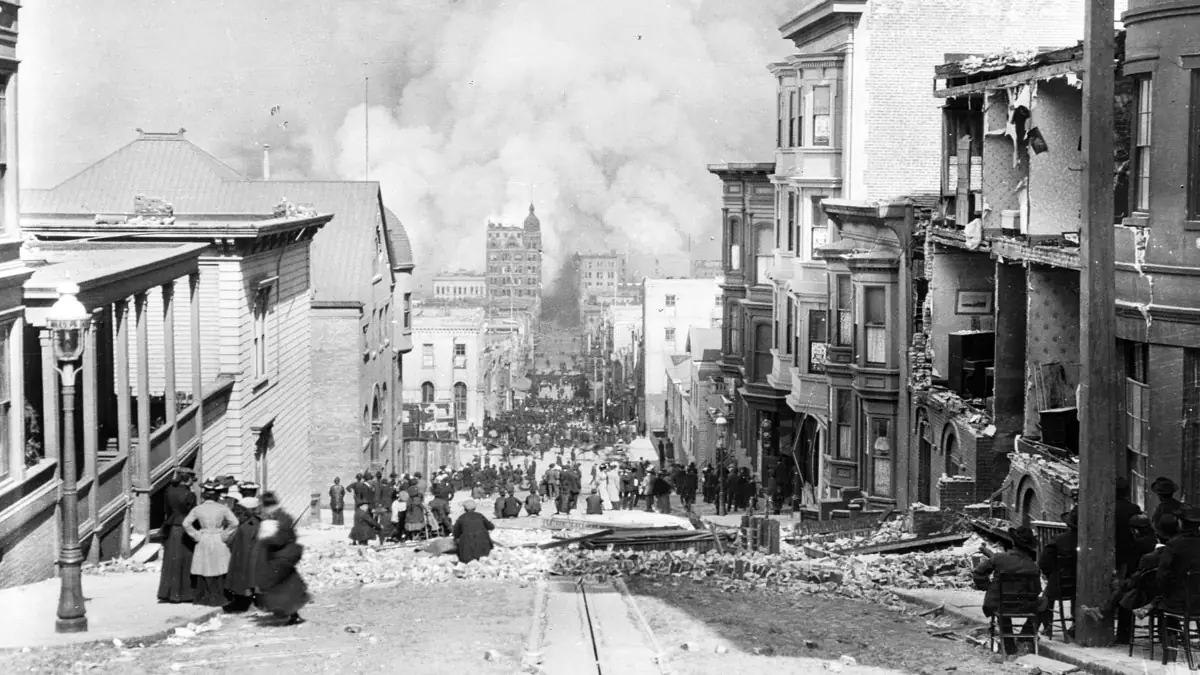
The most famous photo of the destruction of San Francisco by earthquake and fire on April 18, 1906. Credit: Arnold Genthe
Key facts at a glance:
- M7.9 earthquake struck San Francisco at 05:12 PST on April 18, 1906
- The rupture extended 477 km (296 miles) along the San Andreas Fault
- Fires following the quake destroyed 25 000 buildings across 490 blocks
- The estimated death toll ranges from 700 to over 3 000
- It remains the deadliest earthquake in U.S. history
- Annual commemorations take place at Lotta’s Fountain since 1915
The 1906 San Francisco earthquake is one of the most well-documented natural disasters in American history. It struck a rapidly growing city at the heart of the U.S. West Coast, causing widespread destruction, reshaping urban development, and spurring significant advancements in earthquake science. Its consequences were felt far beyond California, influencing seismic research and disaster response planning for generations.
The earthquake struck shortly after 05:00 PST (UTC-8) on April 18, 1906, violently shaking the San Francisco Bay Area and much of northern California. The main rupture extended approximately 477 km (296 miles) along the San Andreas Fault, from just northwest of San Juan Bautista to the tectonic boundary at Cape Mendocino. The event’s scale and geological complexity made it a key reference point for early seismological studies and led to major scientific breakthroughs in understanding fault mechanics.
This event holds the grim distinction of being the deadliest earthquake in U.S. history. To this day, it stands as the deadliest natural disaster in California, with the highest death toll in the state’s history.
1906 San Francisco earthquake magnitude
A minor foreshock was felt at 05:12 PST in the San Francisco Bay Area. Approximately 20 to 25 seconds later, the mainshock ruptured along the northern segment of the San Andreas Fault near San Francisco. The earthquake is estimated to have had a magnitude of M7.9 and a maximum Mercalli intensity of XI.
Ground shaking lasted between 45 and 60 seconds, with intervals of high-intensity motion. Seismic waves were recorded across a broad area, reaching as far as southern Oregon, southern California, and central Nevada.
Damage from the earthquake
The exact number of fatalities caused by the 1906 earthquake remains uncertain, with historical estimates ranging from 700 to over 3 000 deaths.
Out of an estimated population of 410 000, approximately 227 000 to 300 000 residents were displaced and left without homes.
An official report by the U.S. Army documented 498 deaths in San Francisco, 64 in Santa Rosa, and 102 in the vicinity of San Jose. A subsequent 1972 report by the National Oceanic and Atmospheric Administration (NOAA) suggested that an estimate between 700 and 800 deaths was reasonable.
However, later historical investigations uncovered significant underreporting. In 2005, the San Francisco Board of Supervisors passed a resolution officially recognizing that the earthquake had claimed more than 3 000 lives. The resolution was based on decades of archival research by city historian Gladys Hansen and supported by novelist James Dalessandro.
The subsequent fires
While the earthquake and its aftershocks caused significant damage, the fires that followed proved to be far more devastating.
Estimates suggest that fire was responsible for a clear majority of the total destruction. Over the course of three days, more than 30 separate fires swept through the city, consuming around 25 000 buildings across 490 blocks. The financial toll of the fires was enormous, reaching approximately USD 350 million at the time, which would be about USD 8.9 billion today.
The fires that broke out after the 1906 earthquake were mainly triggered by broken gas mains. One notorious fire, dubbed the “ham and eggs fire,” was sparked when a woman, unaware that the earthquake had damaged her chimney, accidentally started a blaze while attempting to cook breakfast. Ironically, some fires started when San Francisco firefighters attempted to use dynamite to create firebreaks without proper training, accidentally causing more damage.
Majority of the city’s devastation was linked to the fires rather than the earthquake itself, largely because many insurance policies covered fire damage but excluded losses caused by seismic activity. As a result, some property owners intentionally ignited their already-damaged buildings in order to qualify for insurance compensation.
Facts about the great San Francisco earthquake of 1906
| Date and time | April 18, 1906 at 05:12 PST (UTC-8) |
| Epicenter | Near San Francisco, California |
| Magnitude | M7.9 |
| Maximum intensity | XI (Extreme) on the Modified Mercalli scale |
| Rupture length | 477 km (296 miles) |
| Ground shaking duration | 45 to 60 seconds |
| Fatalities | Estimated 700 to over 3 000 |
| Displaced population | 227 000 to 300 000 |
| Buildings destroyed | Approximately 25 000 |
| City blocks burned | Approximately 490 |
| Financial damage (1906) | USD 350 million |
| Adjusted damage (2023) | About USD 8.9 billion |
| First annual commemoration | 1915 at Lotta’s Fountain |
At the time, geologists were baffled by the extensive horizontal movements and the length of the rupture. It wasn’t until the development of plate tectonic theory over 50 years later that the full implications of the fault’s activity were understood.
Insights gained from this earthquake, including ground displacement and crustal strain, led Harry Fielding Reid in 1910 to propose the elastic-rebound theory. This theory still stands as a foundational concept that continues to shape our understanding of earthquake mechanics today.
The Palace Hotel, a prominent San Francisco landmark, was destroyed in the fire along with other significant buildings like the Hall of Records and City Hall.
The original California Bear Flag from the 1846 Bear Flag Revolt, stored in a state building, was also destroyed.
International aid poured in after the disaster, with London contributing hundreds of thousands of dollars. Major donations included USD 100 000 each from Standard Oil, Andrew Carnegie, and the Canadian government, while the Bank of Canada in Ottawa contributed USD 25 000.
A large portion of San Francisco was reconstructed with improved resistance to both earthquakes and fires. As the ruins were cleared, new urban development plans began to take shape. The city showcased its transformation to a global audience during the 1915 Panama-Pacific International Exposition.
Since 1915, San Francisco has commemorated the 1906 earthquake with annual gatherings at Lotta’s Fountain, a site that served as a central meeting point for survivors and families in the immediate aftermath of the disaster.
In 2025, the city marked the 119th anniversary with an early-morning ceremony that included a moment of silence at 05:12, the time the earthquake struck. The tradition continued with the annual repainting of the golden fire hydrant in the Mission District. This hydrant was reportedly the only functioning water source used to save the south side of the Mission District during the fires that followed the earthquake.

My passions include trying my best to save a dying planet, be it through carpooling or by spreading awareness about it. Research comes naturally to me, complemented by a keen interest in writing and journalism. Guided by a curious mind and a drive to look beyond the surface, I strive to bring thoughtful attention and clarity to subjects across Earth, sciences, environment, and everything in between.

Commenting rules and guidelines
We value the thoughts and opinions of our readers and welcome healthy discussions on our website. In order to maintain a respectful and positive community, we ask that all commenters follow these rules.