• NASA’s Lucy spacecraft captures images of asteroid Donaldjohanson during flyby

    NASA’s Lucy spacecraft flew by asteroid Donaldjohanson on April 20, 2025, capturing images of its elongated, lumpy bowling pin shape. The flyby, conducted as a test for upcoming Jupiter Trojan asteroid missions, revealed the asteroid’s dimensions as approximately 8 km (5 miles) in length and 3.5 km (2 miles) in width.

  • Signs of life detected on exoplanet K2-18b

    Researchers using the James Webb Space Telescope have detected molecules in the atmosphere of exoplanet K2-18b that may indicate potential biological activity. The analysis revealed the presence of dimethyl sulfide and dimethyl disulfide—compounds that, on Earth, are primarily produced by biological processes.

  • Lyrid meteor shower to light up night sky in April 2025

    The Lyrid meteor shower, caused by debris from Comet Thatcher, will peak from April 21 to April 22, 2025, with an expected rate of 10–15 meteors per hour. It will be best visible in the Northern Hemisphere, and rare surges and fireballs may occur under favorable conditions,

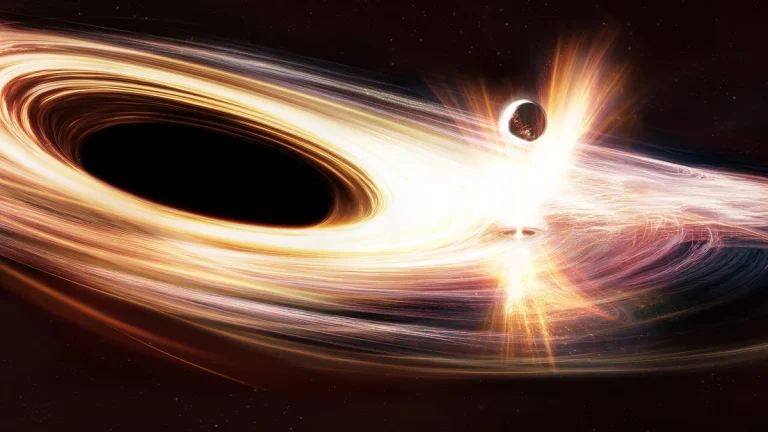
  • Supermassive black hole Ansky awakens with record-breaking X-ray flares

    Previously dormant supermassive black hole Ansky in galaxy SDSS1335+0728, approximately 300 million light-years away in Virgo, started emitting exceptional X-ray flares in late 2019. These quasiperiodic eruptions last 10 times longer, shine 10 times brighter, and release 100 times more energy than typical black hole bursts. ESA’s XMM-Newton and NASA telescopes have recorded 165 such events since February 2024.

  • Andromeda’s galactic imbalance stirs debate in cosmology

    A new study published in Nature found that Andromeda’s satellite galaxies are stacked on one side—an unusual imbalance that challenges the Lambda Cold Dark Matter (ΛCDM) cosmological model. The finding is stirring questions about the universe’s blueprint and suggests our cosmic models may be due for a rewrite.

  • Asteroid 2025 FV12 flew past Earth at 0.2 LD

    A newly discovered asteroid designated 2025 FV12 flew past Earth at a distance of 0.26 LD / 0.00079 AU (118 518 km / 73 644 miles) from the center of our planet at 01:31 UTC on March 28, 2025. This was the first of two asteroid flyby’s within 1 lunar distance today.