• Comet Tsuchinshan-ATLAS enters LASCO C3 field of view, first full-resolution science data from STEREO shows comet is very bright

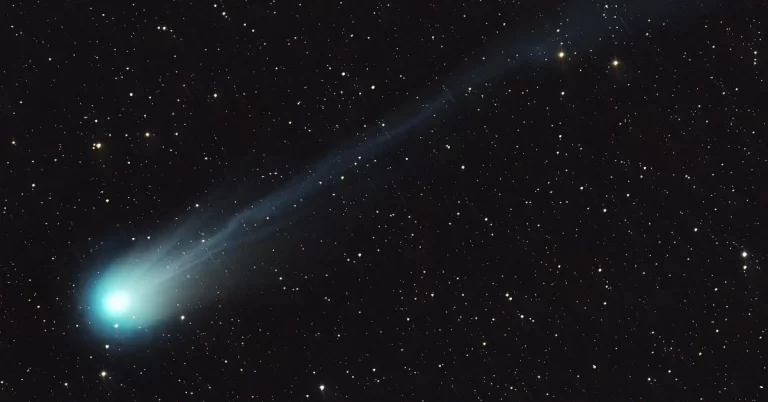
    Comet C/2023 A3 (Tsuchinshan–ATLAS), discovered in January 2023 by the Tsuchinshan Observatory and the ATLAS project, reemerged from behind the Sun in September and garnered attention from astronomers across the world due to its rapid brightening. On October 7, 2024, the comet entered the LASCO C3 field of view, beginning a series of rare observations accessible to more than just astronomers with specialized equipment.

  • New sungrazing comet A11bP71 could outshine Venus in October

    The ATLAS survey in Hawaii discovered a new sungrazing comet on September 27, 2024, which is part of the Kreutz sungrazing family and is expected to reach its perihelion on October 28, 2024. The comet is yet to be officially named and has been provisionally designated as A11bP71. A sungrazing comet from the Kreutz family…

  • 30 years since the historic collision of comet Shoemaker-Levy 9 with Jupiter

    Thirty years ago, Comet Shoemaker-Levy 9 collided with Jupiter, marking a historic moment in astronomy. This collision gave scientists a first-of-its-kind direct observation of an extraterrestrial collision within our Solar System, providing important information regarding Jupiter’s atmosphere and its role in protecting the inner planets from cosmic debris.

  • ‘Devil Comet’ 12P/Pons-Brooks reaches closest point to the Sun on April 21

    On April 21, 2024, Comet 12P/Pons-Brooks, commonly referred to as the ‘Devil Comet,’ will reach its perihelion, the closest point to the Sun, at a distance of 0.785 astronomical units (117 million km / 73 million miles). This celestial event will allow the comet to be visible just after sunset within the Taurus constellation, marking its peak visibility period.

  • DART impact altered Dimorphos’ orbit and shape, proving asteroid deflection technique viable

    On September 26, 2022, NASA’s Double Asteroid Redirection Test (DART) mission made history by intentionally colliding with the asteroid Dimorphos, significantly altering both its orbital period and physical shape. This is the first time humanity has purposefully altered the motion of a celestial object, as well as the first full-scale demonstration of asteroid deflection technology.

  • Study confirms no risk of asteroid Apophis being redirected toward Earth by other asteroids

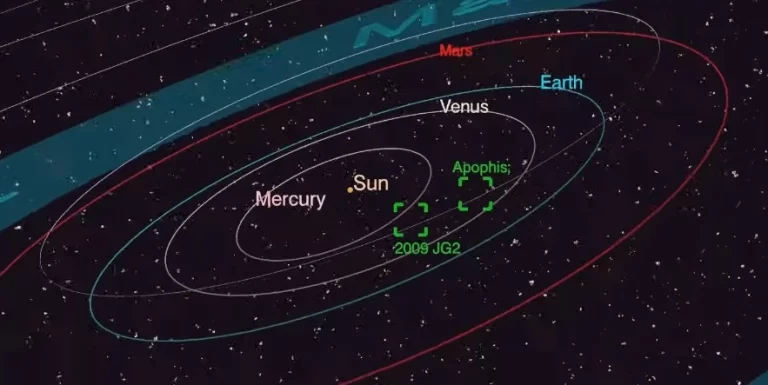
    A comprehensive study by astronomers from Western University calculated the paths of all known asteroids and found there is no risk of the notorious asteroid Apophis colliding with another space object and altering its course toward Earth, further dispelling fears of a potentially catastrophic impact in April 2029. Apophis is named for the demon serpent, who personified evil and chaos in ancient Egyptian mythology.

  • First detailed images of near-Earth asteroid 2008 OS7

    On February 2, NASA utilized the Deep Space Network’s Goldstone Solar System Radar to capture the first detailed images of asteroid 2008 OS7 during its close approach to Earth. The asteroid, measuring between 150 to 200 m (500 – 650 feet) wide, passed at a safe distance of approximately 2.9 million km (1.8 million miles), allowing scientists to refine its size, rotation, and orbital path, improving predictions of its future trajectories.

  • Asteroid Polyhymnia’s density beyond known elements

    A groundbreaking study by the University of Arizona reveals that asteroid Polyhymnia has a density exceeding that of any known elements on Earth. Led by Jan Rafelski, the research team used the Thomas-Fermi model to predict the existence of superheavy elements that could account for this extraordinary density. These findings not only challenge our understanding of the Periodic Table but also have significant implications for future asteroid mining endeavors.