• G2 geomagnetic storm and aurora forecast for December 3-4 following CME from X1.9 solar flare

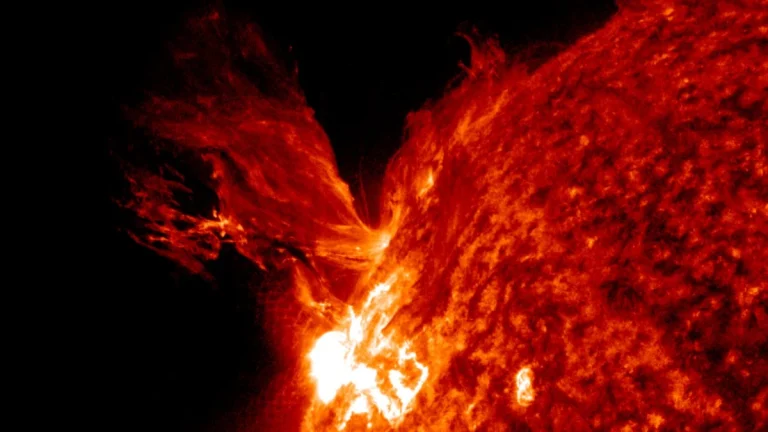
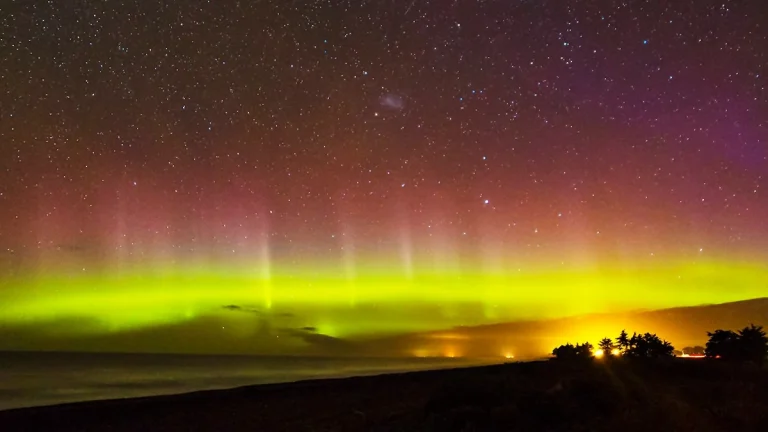
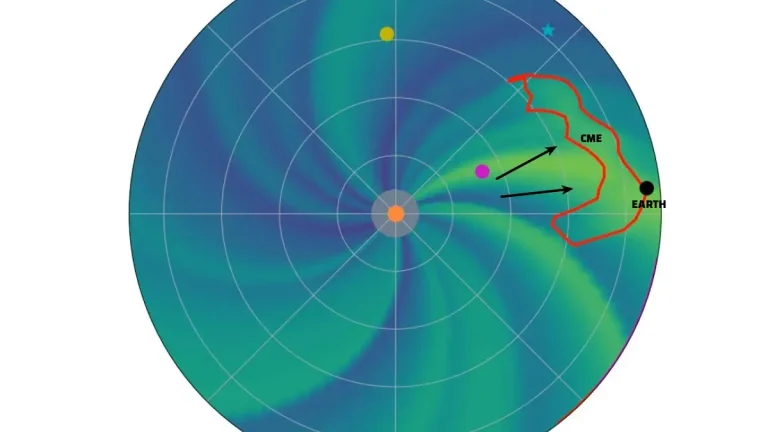
    NOAA’s Space Weather Prediction Center (SWPC) issued a G2 – Moderate geomagnetic storm watch for December 3 and 4, 2025, following a coronal mass ejection (CME) associated with the X1.9 solar flare from Active Region 4299 on December 1. The CME is expected to deliver a glancing blow to Earth’s magnetic field, coinciding with a co-rotating interaction region (CIR) and a sector boundary crossing, increasing the potential for moderate geomagnetic storming and visible auroras at mid-latitudes.

  • Two CMEs impact Earth, sparking G4 – Severe geomagnetic storming and aurora as far south as Mexico

    Coronal mass ejections produced by a long-duration X1.7 on November 9 and X1.2 on November 10 appear to have merged on their way to Earth and impacted our planet at 23:00 UTC on November 11, sparking G4 – Severe geomagnetic storming. Another CME, produced by a major X5.1 flare on November 11, is expected to impact Earth by the end of November 12, causing another round of severe geomagnetic storming. Aurora watchers have already reported impressive sightings as far south as Zacatecas, Mexico.

  • G4 – Severe or greater geomagnetic storm forecast, aurora likely as low as Alabama and California

    A major X5.1 solar flare erupted from Active Region 4274 at 10:04 UTC on November 11, 2025, producing a large Earth-directed coronal mass ejection (CME). NOAA SWPC issued a geomagnetic storm watch predicting G4 – Severe or greater conditions for November 12, G3 – Strong for November 13, and G1 – Minor for November 14. On November 12 and 13, aurora may be visible as far south as Alabama and northern California.

  • G3 – Strong geomagnetic storm on September 30

    Earth’s magnetic field reached G3 – Strong storm levels on September 30, driven by CME impacts and sustained southward IMF. The event was enhanced by seasonal Russell–McPherron geometry near equinox, increasing coupling efficiency. Storm strength has since eased to G2 and G1 as IMF weakened and Bz returned closer to neutral.

  • G3 – Strong geomagnetic storm sparks auroras down to Texas

    A geomagnetic storm that began late on September 14, 2025, intensified to G3 – Strong levels early on September 15, producing auroras visible as far south as Texas. The storm was driven by a negative polarity coronal hole high-speed stream (CH HSS) with possible influence from a coronal mass ejection (CME) launched on September 11.

  • G4 – Severe geomagnetic storm watch issued for June 2 following strong Earth-directed CME

    The U.S. Space Weather Prediction Center (SWPC) issued a G4 – Severe geomagnetic storm watch for June 2, 2025, following the eruption of a powerful, Earth-directed coronal mass ejection (CME) associated with a long-duration M8.1 solar flare from Active Region 4100. The CME is forecast to arrive at Earth late on June 1, with geomagnetic storm conditions expected to intensify through June 2.

  • Negative polarity CH HSS triggers G3 – Strong geomagnetic storm

    A G3 – Strong geomagnetic storm was observed at 02:16 UTC on May 29, 2025, triggered by the arrival of a negative polarity coronal hole high-speed stream at Earth. Coronal hole high-speed streams, and their associated transition zones called co-rotating interaction regions (CIRs), can create CME-like shock waves that are capable of producing strong geomagnetic disturbances and widespread auroras.