
G2 – Moderate geomagnetic storm watch issued for August 8, 2025
A G2 – Moderate geomagnetic storm watch is in effect for August 8, 2025, due to an incoming coronal mass ejection (CME) and co-rotating interaction region from a coronal hole in the Sun’s southern hemisphere.
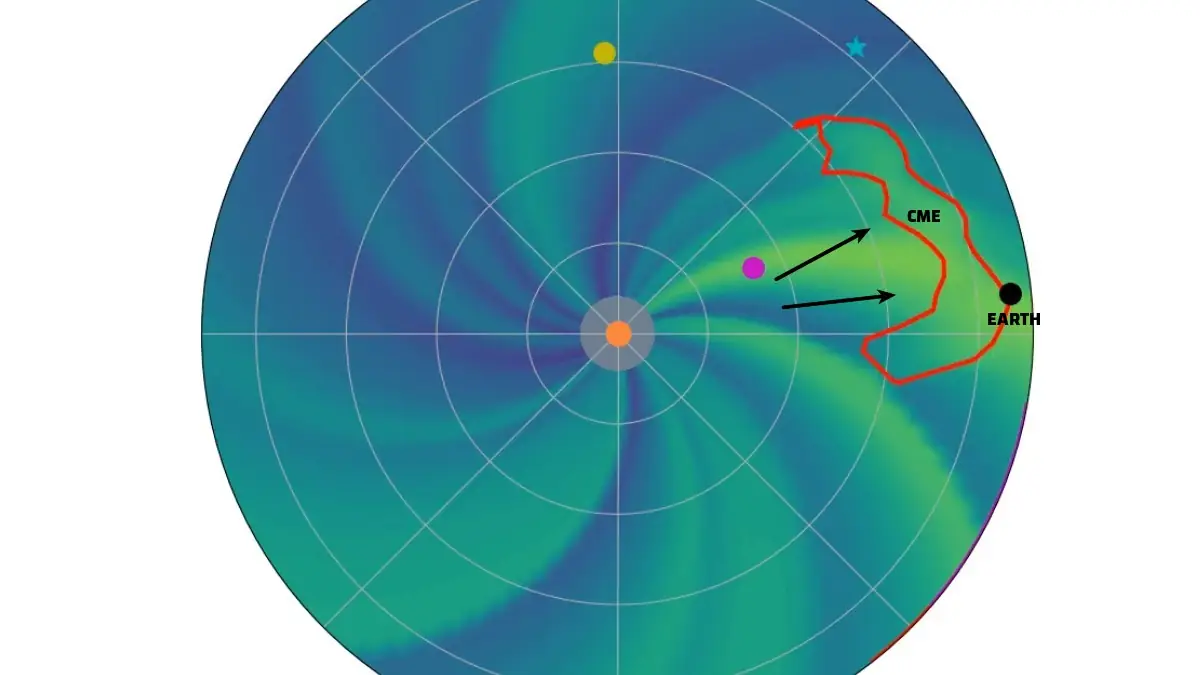
Impact forecast for CME produced by M4.4 solar flare on August 5, 2025. Credit: University of Reading/HUXt. Annotation by The Watchers
A G2 – Moderate geomagnetic storm watch has been issued by the National Oceanic and Atmospheric Administration’s (NOAA) Space Weather Prediction Center (SWPC) for August 8, 2025. The watch is followed by a G1 – Minor storm watch on August 9.
The alert is based on forecasts predicting the arrival of a coronal mass ejection (CME) associated with an M4.4 solar flare that erupted at 15:53 UTC on August 5.
The CME is expected to arrive during the first half of August 8, accompanied by a co-rotating interaction region (CIR) originating from a large southern hemisphere coronal hole. This combined solar wind structure is forecast to enhance interplanetary magnetic field strength, density, and speed, triggering geomagnetic storm conditions.


The area of expected impact is primarily poleward of 55° geomagnetic latitude. Anticipated effects include possible power grid fluctuations, particularly in high-latitude power systems where voltage alarms may be triggered. Satellite operations may be affected by orientation irregularities and increased drag on low Earth orbit satellites.
High frequency (HF) radio propagation may experience degradation at higher latitudes. Auroral activity could extend farther south than usual, potentially becoming visible as far south as New York, Wisconsin, and Washington state in the United States.
Solar activity is expected to continue at moderate levels with a high chance for M-class flares (55%), and a slight chance for X-class (10%) through August 9. Higher probabilities are being driven by the complexity and current activity of Region 4168.

Teo Blašković founded The Watchers in 2011 and edited it until 2026, covering seismic and volcanic activity, extreme weather, space weather and near-Earth objects. Articles on this page are his archive.
Earlier reporting
Nothing on Watchers was published in the last 24 hours. These are older articles.
- G1 geomagnetic storm watch remains in effect as NOAA forecasts Kp 4.67 late on November 17 and early on November 18
- On October 22, 2017, a single flash of lightning stretched 515 miles from eastern Texas to near Kansas City, a distance that takes eight hours to drive, and nobody realized how far it had gone until scientists went back through the satellite data years later Epicenter
- CPC posts a slight risk of heavy rain from the Gulf Coast to the Northeast urban corridor November 25-29, and a moderate risk of West Coast wind and Sierra snow on November 25
- Florida's east coast faces a moderate flash flood risk Wednesday through Friday, with 4 to 8 inches of rain forecast and the St. Johns River near Cocoa already in major flood at 17.13 feet
