
CME modeling suggests glancing blow to Earth from M4.4 flare produced by AR 4168
A moderately strong M4.4 solar flare erupted from Active Region 4168 at 15:53 UTC on August 5, 2025, producing a coronal mass ejection (CME). Initial modeling indicates most of the material was directed ahead of Earth’s orbit, with a glancing blow or shock arrival possible by late August 8.
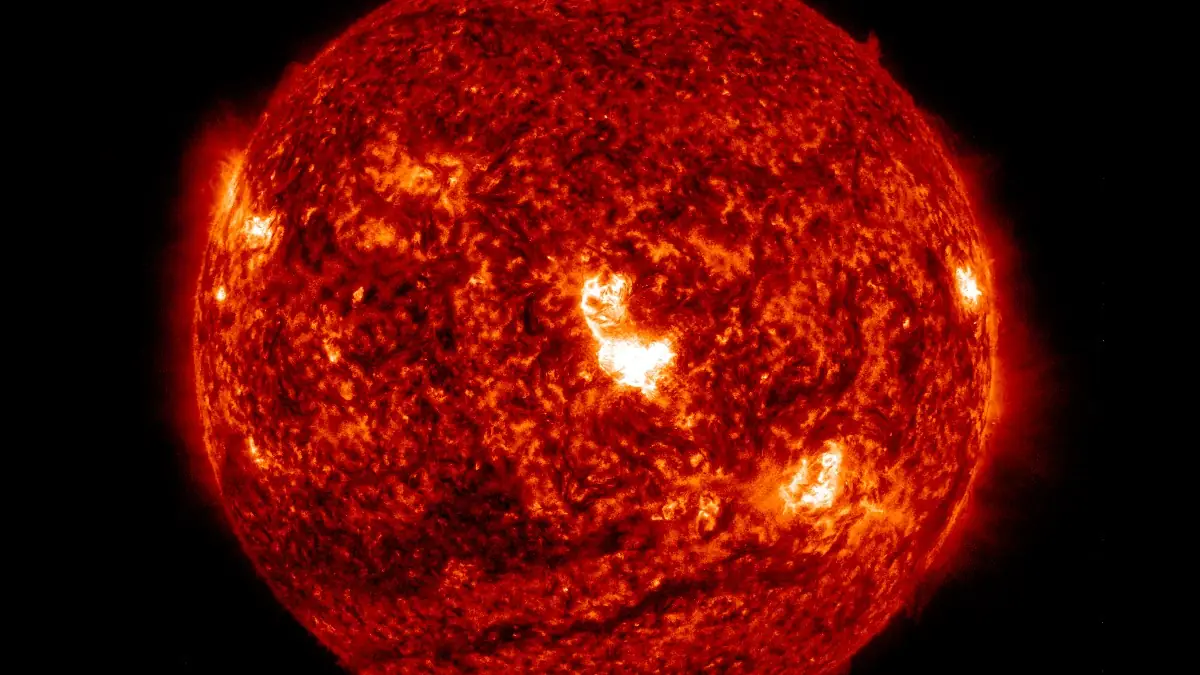
M4.4 solar flare produced on August 5, 2025. Credit: NASA/SDO AIA 304, The Watchers
The event was produced by geoeffective Active Region 4168 and was associated with a 200 pfu Tenflare, a Type II radio emission with estimated velocity of 865 km/s as well as Type IV radio emissions, suggesting a strong coronal mass ejection (CME) was produced.
Initial analysis of the coronagraph data indicated the possibility of more than one CME, as a western limb eruption followed in close succession.
Modeling suggests the bulk of the ejected material was directed ahead of Earth’s orbit. However, due to the proximity of the source region to the solar central meridian, a glancing blow or shock arrival at Earth remains possible.
SWPC forecasters anticipate potential impact by late August 8, although the scenario carries low confidence due to trajectory uncertainties.
In the ZEUS CME simulator we see the CME that is associated with the M4 class flare that originated AR4168 https://t.co/Od5aZXRVTA pic.twitter.com/V8PLyd0Eb5
— Industrial Engineer Irene Quiroz (@nenecallas) August 6, 2025
Eruption from Earth strike zone! We may get some impact on August 8. This was associated with an M4.4 flare in AR 14168, which seems to be still evolving. We see a more spectacular coronal wave than during yesterday's M2.0 flare. And major dimming (https://t.co/TJg8fqtNGa). pic.twitter.com/3AmNAct5cl
— Halo CME (@halocme) August 5, 2025

Solar activity is expected to remain moderate with a high chance for minor to moderate M-class flares and a slight chance for R3 – Strong through August 8. Region 4168 remains the primary driver of enhanced flare probabilities due to its magnetic complexity and recent activity.

Solar wind parameters over the past 24 hours reflected weakening coronal hole high speed stream (CH HSS) influence. Total magnetic field strength ranged from 4–7 nT with Bz mostly ±4 nT. Wind speeds decreased from near 440 km/s to 360–370 km/s while the phi angle was primarily negative throughout the period.
Solar wind parameters are expected to gradually return to nominal conditions through August 8. Enhanced conditions are likely to return late on August 8 as the southern hemisphere positive CH becomes geoeffective, coinciding with a potential shock arrival from the August 5 CME.
The geomagnetic field is at quiet levels, with activity expected to increase late on August 8 as the combined influence of the CH HSS and a glancing CME shock may produce G1 – Minor storm conditions.

I'm a dedicated researcher, journalist, and editor at The Watchers. With over 20 years of experience in the media industry, I specialize in hard science news, focusing on extreme weather, seismic and volcanic activity, space weather, and astronomy, including near-Earth objects and planetary defense strategies. You can reach me at teo /at/ watchers.news.

Commenting rules and guidelines
We value the thoughts and opinions of our readers and welcome healthy discussions on our website. In order to maintain a respectful and positive community, we ask that all commenters follow these rules.