
Texas grid sank to 59.304 Hz in the 2021 freeze, 4 minutes 37 seconds from relays tripping 17,000 MW; state confirmed 246 deaths
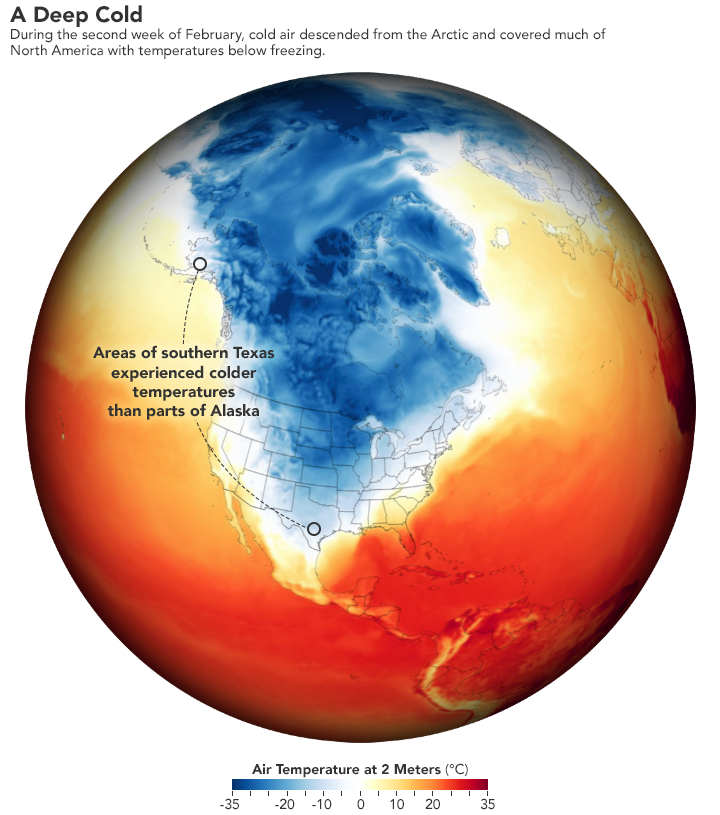
Texas’ main power grid spent 4 minutes 23 seconds below a 59.4 Hz protection threshold early on February 15, 2021, leaving 4 minutes 37 seconds before relays on approximately 17 GW of generation could begin tripping. Federal investigators said the resulting losses could have caused a total blackout across the ERCOT region; operators stopped the cascade by disconnecting thousands of megawatts of customer demand.
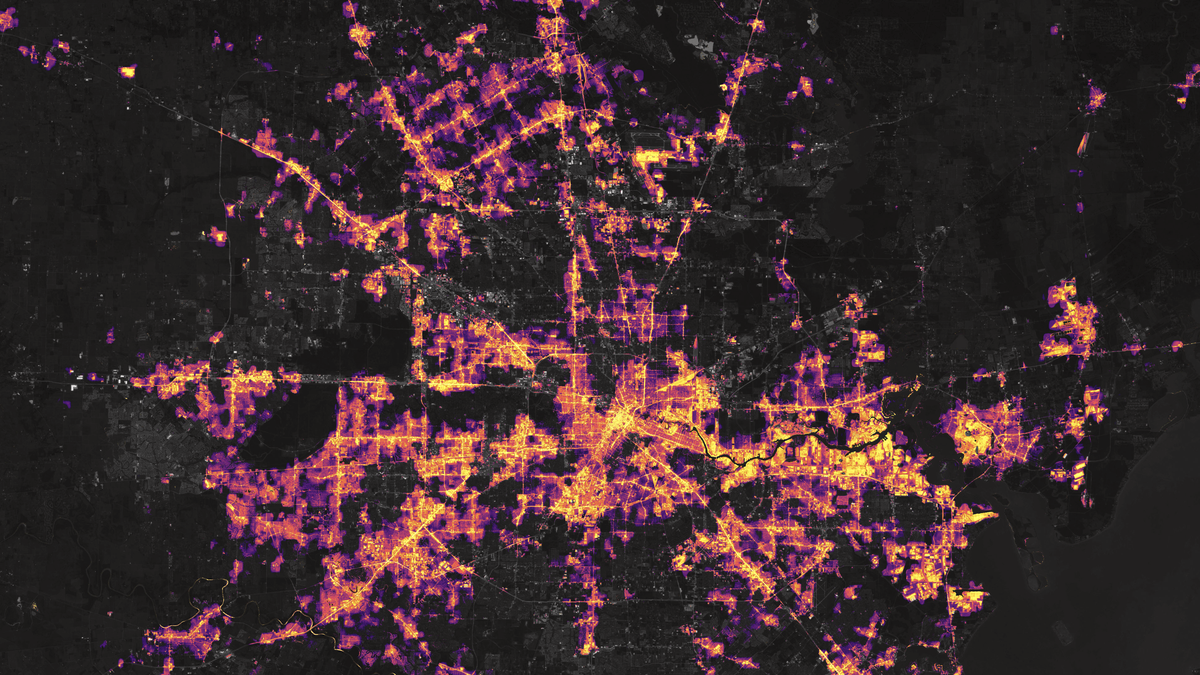
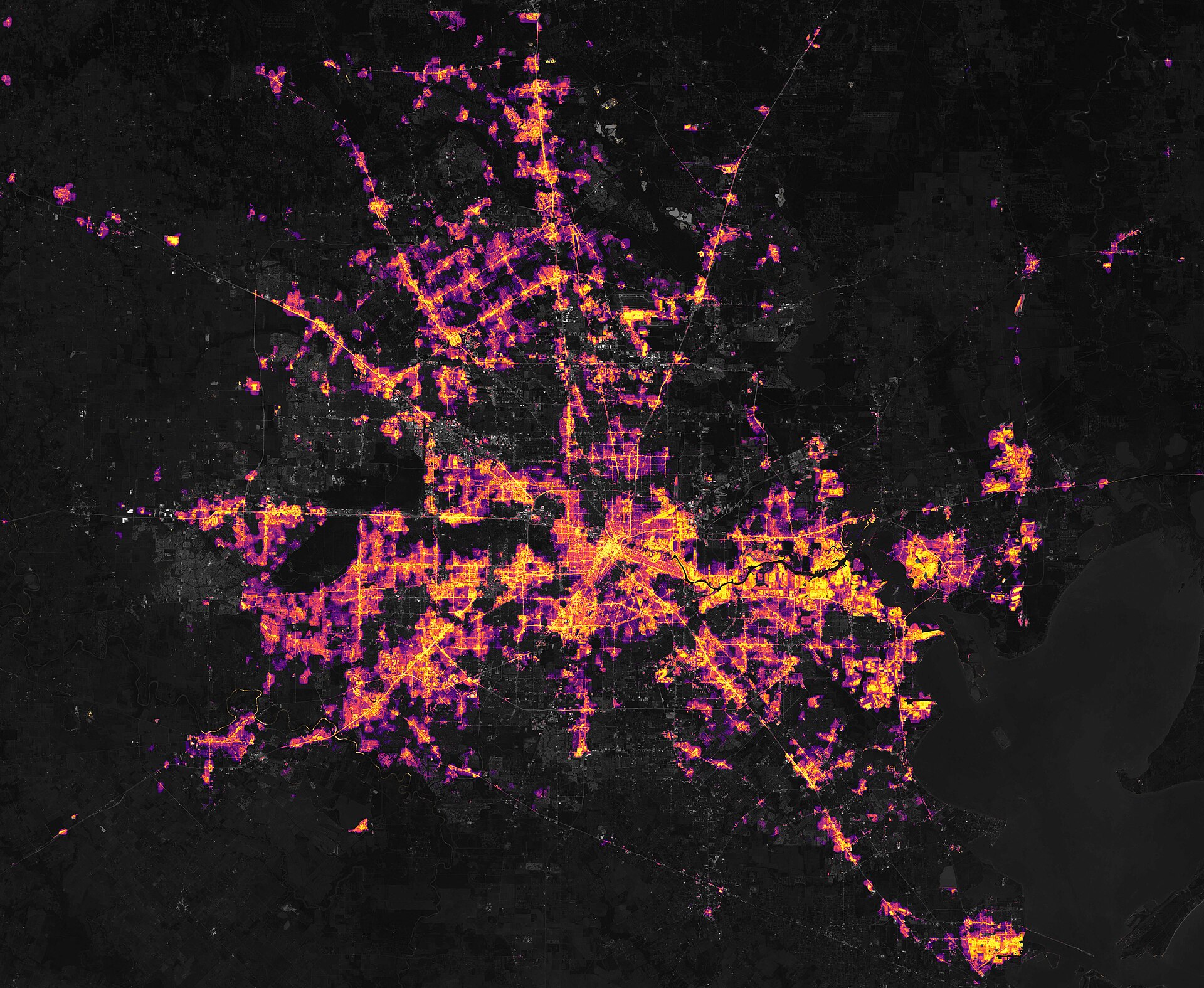
Night lights over Houston on 16 February 2021, during the blackouts. Credit: NASA Earth Observatory (public domain), via Wikimedia Commons.
At 07:54 UTC (01:54 CST), the grid frequency bottomed at 59.304 Hz. Ordered power cuts then began lifting it, and the system moved back above 60.0 Hz at 08:02 UTC (02:02 CST). A federal review later called the period after midnight “the most dangerous two hours of ERCOT’s existence.”
The widely repeated 4-minute-37-second figure came from a February 24 timeline presented to the Electric Reliability Council of Texas board and reported by KUT and Texas Standard. The final federal investigation confirmed the underlying sequence, while making clear that the number described time remaining on a relay setting rather than a guaranteed countdown to instant statewide darkness.
What the 4 minutes 37 seconds meant
An alternating-current grid has to keep electricity supply and demand in balance from moment to moment. In the ERCOT region, that balance is reflected in a system frequency centered on 60 Hz. When generation falls short of demand, frequency falls. If it falls far enough, protective relays disconnect equipment to prevent damage.
At 07:51 UTC (01:51 CST), ERCOT frequency dropped below the 59.4 Hz trip level, starting a nine-minute delay on underfrequency relays protecting about 17 000 MW of generation. The grid remained below the threshold for 4 minutes 23 seconds. Subtracting that interval from the nine-minute delay left 4 minutes 37 seconds before those relays could operate.
Expiration of the timer would not, by itself, have guaranteed a complete blackout. The danger was that losing another 17 000 MW almost simultaneously could have driven frequency lower, tripped still more equipment and produced an uncontrolled cascade across the ERCOT footprint, which served about 90% of Texas’ electric load.
The grid’s most dangerous 15 minutes
ERCOT entered its first emergency level at 06:15 UTC (00:15 CST), after reserves fell below 2 300 MW. It advanced to Energy Emergency Alert 2 at 07:07 UTC and to the highest level, EEA 3, at 07:20 UTC, when it ordered the first 1 000 MW of firm customer load disconnected.
| UTC | CST | Grid condition or action |
| 07:20 | 01:20 | EEA 3 declared; first 1 000 MW of firm load shed |
| 07:45 | 01:45 | A further 1 000 MW ordered off, bringing the total to 2 000 MW |
| 07:51 | 01:51 | Frequency drops below 59.4 Hz; nine-minute relay timer begins |
| 07:54 | 01:54 | Frequency reaches the event minimum of 59.304 Hz |
| 07:55 | 01:55 | Frequency rises above 59.4 Hz after 4 minutes 23 seconds below it |
| 08:02 | 02:02 | Frequency rises above 60.0 Hz |
Timeline: FERC, NERC, and regional entity staff final report. All times are February 15, 2021
The danger did not end when frequency crossed back above 59.4 Hz. Seven more generators tripped or reduced output between 07:57 and 08:01 UTC, removing 1 165 MW. ERCOT offset those losses with another 2 000 MW of load shedding at 08:00 UTC, bringing the ordered total to 10 500 MW. The system was considered stable at 08:30 UTC (02:30 CST), with 9 000 MW of customer load still disconnected.
Later on February 15, ERCOT’s ordered firm load shed reached 20 000 MW, the largest manually controlled load-shedding event in US history. What were often called rolling outages could not always be rotated because the shortage was so large and many circuits served hospitals, water systems, and other critical loads.
The freeze reached every major power source
The cold did not produce a single-fuel failure. Natural gas, coal, nuclear, wind, and solar resources all experienced outages or reduced output. 1 045 bulk-power generating units recorded 4 124 outages, derates or failures across Texas and the south central United States, during the wider February 8-20 event.
Freezing problems accounted for 44.2% of those events and fuel problems for another 31.4%. Natural gas units represented 58% of the affected generators, wind 27%, coal 6%, solar 2%, and other types 7%; four nuclear units made up less than 1%. Those percentages count affected units rather than lost megawatts, but they show why blaming the crisis on wind alone is not supported by the record.
ERCOT’s later analysis likewise showed natural gas as the largest block of unavailable generation through much of the emergency. A peer-reviewed retrospective estimated that gas generation ran more than 18 000 MW below expectations and accounted for nearly two-thirds of the total supply deficit, while wind, coal and nuclear generation also underperformed.
The electricity and gas systems also failed together. Frozen wellheads, processing equipment, and pipelines reduced gas supply and pressure. At the same time, power cuts disabled some electrically operated gas facilities, which further reduced fuel available to power stations. ERCOT could import only slightly more than 1 000 MW over its limited direct-current ties, far short of the loss developing inside the region.
A separate nuclear trip came later. South Texas Project Unit 1 automatically shut down at 11:26 UTC (05:26 CST), more than three hours after frequency had recovered above 60 Hz. The Nuclear Regulatory Commission’s initial notification recorded low steam-generator levels after the loss of two feedwater pumps and listed the cause as unknown; an owner filing later attributed the loss of feedwater to an extreme-cold failure of a pressure-sensing line. Unit 2 remained at full power. The Unit 1 trip therefore illustrates the depth of the freeze, but it was not part of the 4-minute-37-second interval.
What a total blackout could have meant
A total ERCOT blackout would have required a black start: rebuilding the grid in sections using generating units capable of starting without outside electricity, energizing transmission paths and then restarting and synchronizing larger plants. Most large generators cannot simply switch themselves back on after the surrounding grid has gone dark.
KUT and Texas Standard reported that recovery could have taken weeks or longer. ERCOT chief executive Bill Magness did not give the board a fixed timetable. “If we have a blackout of the system, the system is out for an indeterminate amount of time,” he said. The actual duration would have depended on which plants, transmission paths and black-start resources survived the cascade, so a precise claim of weeks or months cannot be established from the available record.
The human toll and the response
More than 4.5 million electricity customers lost power, some for as long as four days, while below-freezing conditions persisted. The Texas Department of State Health Services ultimately confirmed 246 storm-related deaths across 77 counties. Extreme cold exposure accounted for 161 deaths, including 158 from hypothermia; other deaths involved disrupted medical care, crashes, carbon monoxide poisoning, fires and falls.
Texas responded with Senate Bill 3, which required weatherization for parts of the electricity and natural-gas supply chain and created new inspection, mapping and emergency-planning duties. Public Utility Commission rule 25.55 now requires annual declarations of weather preparedness and ERCOT inspections of generating and transmission facilities.
Federal cold-weather reliability standards have also continued to evolve. FERC approved standard EOP-012-3 in September 2025 with an October 1, 2025 effective date, expanding generator cold-weather preparedness requirements. The reforms address weaknesses exposed in 2021, but the 4-minute-37-second episode remains a record of how quickly a supply shortfall can become a grid-wide stability emergency.
References:
1The February 2021 Cold Weather Outages in Texas and the South Central United States – Federal Energy Regulatory Commission, North American Electric Reliability Corporation and regional entities – November 2021
2 Cascading risks: Understanding the 2021 winter blackout in Texas – Busby, J. W., et al. – Energy Research & Social Science, 77, 102106 – 2021 – https://doi.org/10.1016/j.erss.2021.102106
3 February 2021 Winter Storm-Related Deaths – Texas – Texas Department of State Health Services – December 31, 2021
4 Senate Bill 3, 87th Regular Session: bill summary – Texas Legislature
5 Extreme Winter Weather Causes U.S. Blackouts – NASA Earth Observatory – February 22, 2021
6 Texas’ Power Grid Was 4 Minutes And 37 Seconds Away From Collapsing. Here’s How It Happened – Texas Standard / KUT – March 1, 2021

Rishav Kothari is Editor-in-Chief of The Watchers, where he runs the newsroom and covers earthquakes, volcanoes, severe weather and space weather.
