
Five stations break daily rainfall records following Typhoon Dolphin’s double landfall, China
Five stations break station-history daily rainfall records in in Zhejiang and Shanghai, following Typhoon Dolphin’s double landfall on August 9, 2026. Localized rainfall totals in parts of Taizhou exceeded 700 mm (28 inches) between August 8 and early August 10. Meanwhile, The Ministry of Emergency Management activated a Level IV national emergency response for geological disasters in Hebei, Henan and Hubei on August 10.
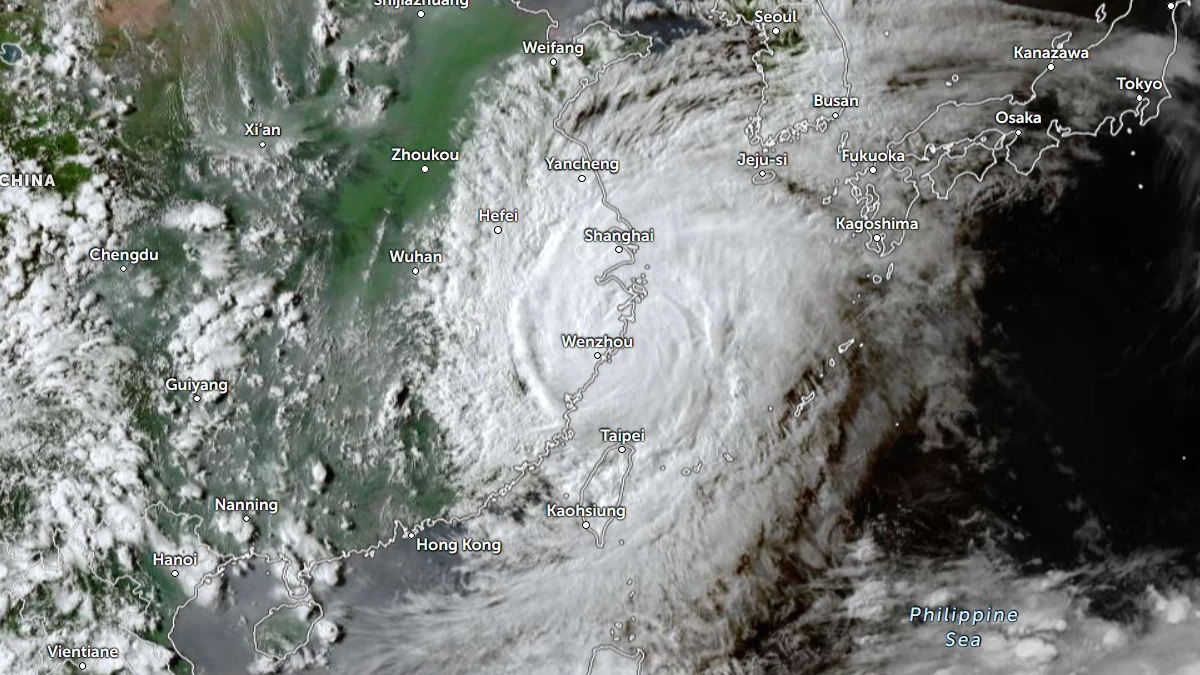
Satellite image of Typhoon Dolphin at 09:30 UTC on August 9, 2026. Credit: JMA/Himawari-9, Zoom Earth. The Watchers
Rainfall associated with Typhoon Dolphin broke all-time daily rainfall records at five national meteorological observation stations in Zhejiang and Shanghai after the cyclone made two landfalls in Zhejiang on August 9, according to the National Meteorological Center (NMC).
Localized rainfall totals of over 700 mm (28 inches) were reported in Taizhou between August 8 and the morning of August 10.
NMC reported heavy to very heavy rainfall across Zhejiang, Shanghai, southern Anhui and southern Jiangsu during the initial post-landfall period, with extremely heavy rainfall in parts of eastern Zhejiang and central Shanghai.

The cyclone continued to weaken as it moved inland. At 18:00 LT (10:00 UTC) on August 10, Dolphin was located over Dexing City, Jiangxi Province, NMC reported.
The system remained a tropical storm with 10-minute sustained winds of approximately 70 km/h (45 mph), and an estimated minimum central pressure of 990 hPa.
Dolphin was moving west-northwest at about 15 km/h (9 mph), with little immediate change in intensity. Maximum winds at that stage were less than half the 150 km/h (95 mph) winds, measured at the cyclone’s first Zhejiang landfall.

NMC forecast widespread rainfall to continue as Dolphin moved inland, affecting Zhejiang, Shanghai, Jiangsu, Anhui, Hubei, Henan, Hebei and surrounding areas.
The agency warned of high risk for mountain floods, geological disasters and flooding on small and medium sized rivers in parts of Zhejiang, Anhui, Hubei and Henan.

The Ministry of Emergency Management activated a national Level IV geological-disaster emergency response for Hebei, Henan and Hubei on August 10 after a joint assessment with the Ministry of Natural Resources identified elevated geological-hazard risk in southern Hebei, parts of northern and southern Henan and western Hubei.
Dolphin’s inland rainfall followed two coastal landfalls in Zhejiang on August 9. NMC said the cyclone first made landfall at Kanmen Subdistrict in Yuhuan City, Taizhou, at about 17:30 LT (09:30 UTC) with 10-minute sustained winds of approximately 150 km/h (95 mph), at strong-typhoon intensity.
It crossed Yueqing Bay and made a second landfall at Wengyang Subdistrict in Yueqing City at about 18:40 LT (10:40 UTC), with sustained winds of approximately 135 km/h (85 mph).
References:
1 Typhoon Dolphin makes two landfalls in Zhejiang; heavy rainfall affects Zhejiang, Shanghai, Jiangsu, Anhui, Hubei and Henan – NMC – August 10, 2026
2 Typhoon quick bulletin, No. 1091 of 2026 – NMC – August 10, 2026
3 Level IV national geological-disaster emergency response activated for Hebei, Henan and Hubei – Ministry of Emergency Management – August 10, 2026

Rishav Kothari is Editor-in-Chief of The Watchers, where he runs the newsroom and covers earthquakes, volcanoes, severe weather and space weather.
