
Intense Mount Etna eruption sends ash south, Catania Airport suspends arrivals, Italy
Mount Etna continued intense explosive and effusive activity on August 10, 2026, with abundant ash from Voragine and multiple active lava flows. Catania Airport suspended arrivals until 17:00 LT (15:00 UTC) as volcanic ash affected operations, while Toulouse VAAC maintained Etna’s Aviation Color Code at Red.

Eruption at Etna volcano, Italy on July 31, 2026. Credit: INGV/Boris Behncke
The National Institute of Geophysics and Volcanology (INGV), Etna Observatory, reported at 10:16 LT (08:16 UTC) on August 10 that surveillance cameras showed intense and continuous explosive activity at Voragine crater. Volcanic bombs were falling in the summit area, while abundant ash was dispersing toward the south-southwest.
Two active vents at approximately 2 750 m (9 020 feet) and 2 360 m (7 740 feet) elevation were feeding several lava flows that formed complex lava fields. The most advanced active fronts are near 1 500 m (4 920 feet) elevation at the base of the northern wall of Valle del Bove, in the Monte Rinatu area, INGV specialists said.
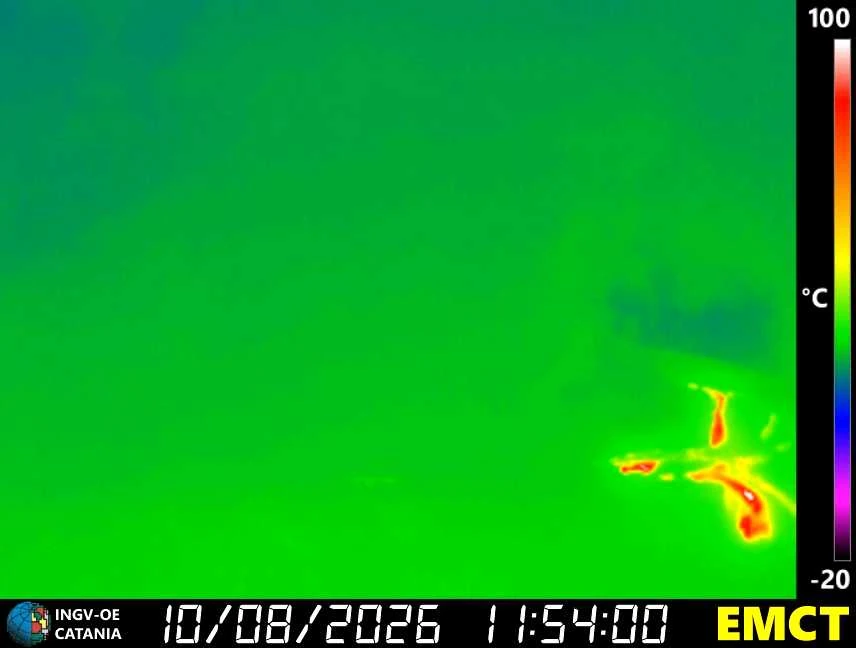
Due to Etna’s continued eruptive activity and volcanic ash present in the area, Società Aeroporto Catania S.p.A. (SAC) suspended arriving flights at Catania Airport until 17:00 LT (15:00 UTC).
“Due to Etna’s eruptive activity and the simultaneous emission of volcanic ash into the atmosphere, the closure of the airspace corresponding to the cloud in the southwest (Sector C1) has been ordered,” airport officials said. “Arrivals are suspended until 5:00 PM.”
“In relation to the situation, with a strong operational impact, we invite passengers not to go to the airport without first checking the status of their flight directly with the airline. The situation is being constantly monitored, and further updates will be provided as the volcanic activity and weather conditions evolve.”
Etna Observatory raised the Aviation Color Code from Orange to Red at 16:19 LT (14:19 UTC) on August 9. The Volcano Observatory Notice for Aviation (VONA) reported strong explosive activity at the summit craters, lava flows in Valle del Leone and Valle del Bove, and ash moving toward the south and southeast.
Toulouse Volcanic Ash Advisory Center (VAAC) retains the Red Aviation Color Code in advisory ETNA.63 issued at 12:00 LT (10:00 UTC) on August 10. The advisory noted observed volcanic ash from the surface to about 4.6 km (15 000 feet), moving south at about 20 km/h (10 mph). The center described the eruption as ongoing and reported an SO2 cloud drifting southward near the Libyan coast.
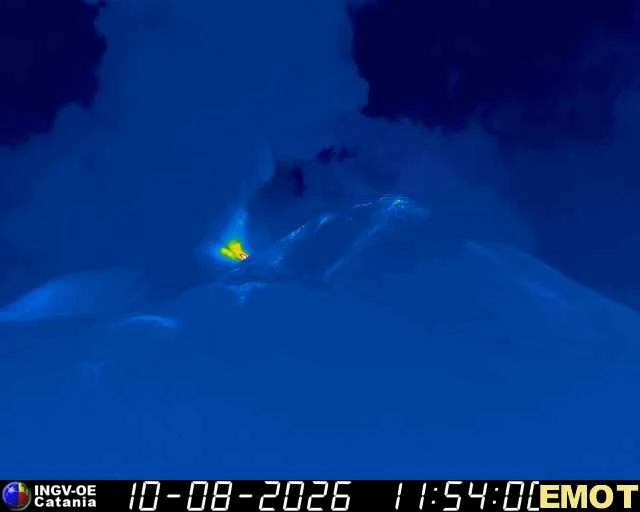
Volcanic tremor remained at elevated amplitude following the previous update, although its average amplitude stayed in the lower part of the high range.
The centroid of the tremor sources temporarily shifted from about 20:15 LT (18:15 UTC) on August 9 to an area between Voragine and Northeast craters at approximately 2 400–2 700 m (7 900–8 900 feet) elevation, before returning to the Voragine area from 08:30 LT (06:30 UTC) on August 10 at roughly 3 000 m (9 840 feet) elevation.
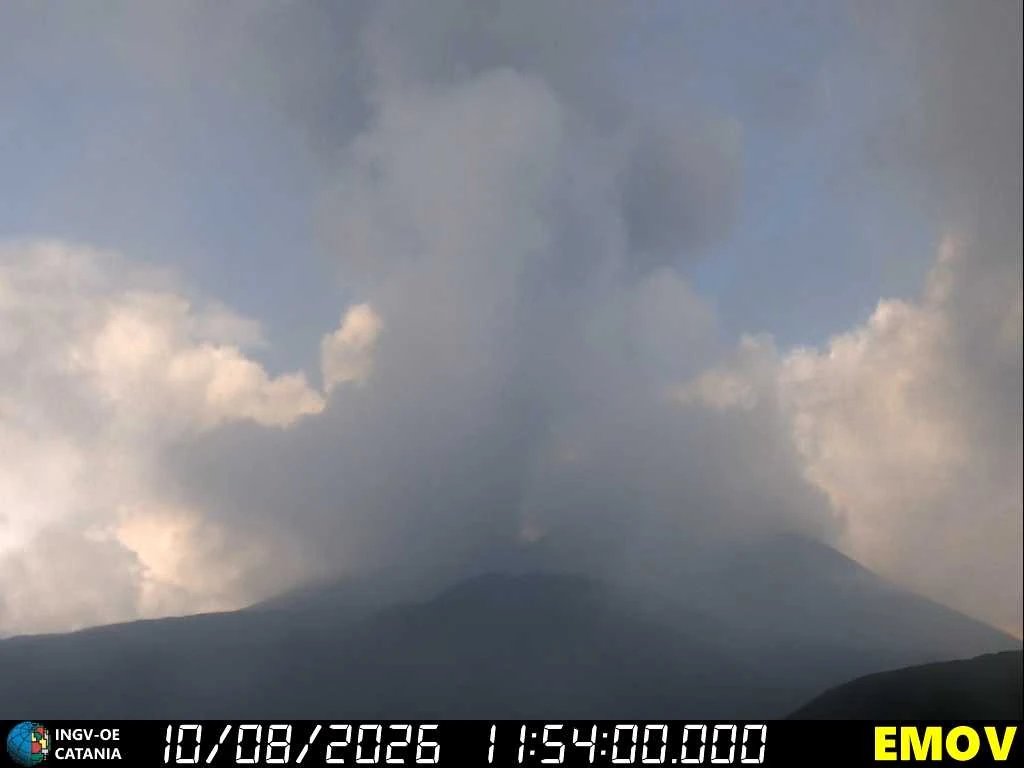
Infrasound activity reached a high level late on August 9 before remaining at medium-high levels during the early hours of August 10. INGV located the infrasonic events in the Voragine crater area, with medium amplitudes and, especially during the latest hours covered by the bulletin, high amplitudes.
The GNSS monitoring network recorded no significant variations. The trend previously observed by summit tiltmeters was decreasing slightly, with a maximum recorded variation of about 8 microradians at the Cratere del Piano station.
References:
1 Comunicado Etna – INGV – August 10, 2026
2 Volcano Observatory Notice for Aviation (VONA) – INGV-OE – 14:19 UTC on August 9, 2026

Teo Blašković founded The Watchers in 2011 and edited it until 2026, covering seismic and volcanic activity, extreme weather, space weather and near-Earth objects. Articles on this page are his archive.
