
Cutting-edge techniques enhance search for lunar water ice
Scientists are deploying ShadowCam’s high-sensitivity imaging and cosmic ray radar simulations to locate and quantify lunar water ice, a critical resource for future lunar bases that could provide drinking water or be processed into rocket fuel components.
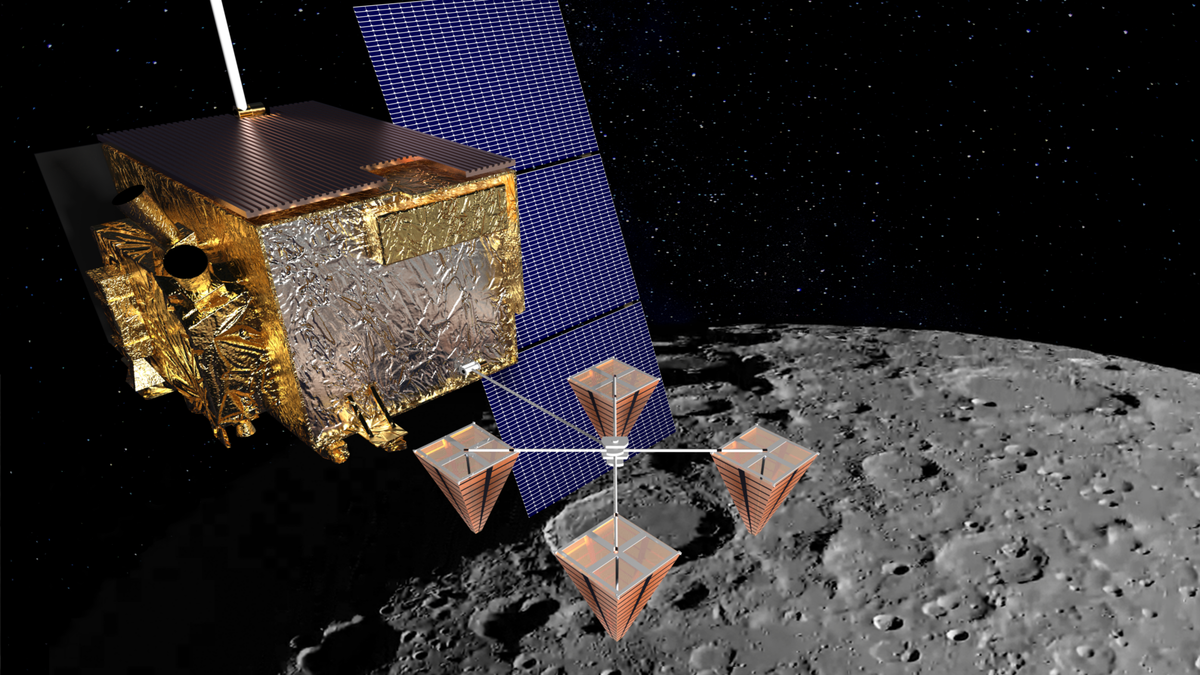
An artist rendering of what a future cosmic ray radar instrument could look like, attached to a satellite orbiting the Moon. Image credit: Christian Miki, Department of Physics, UH Manoa.
A research team led by Jordan Ando at the University of Hawai‘i at Mānoa is using ShadowCam, a visible-light camera aboard the Korea Lunar Pathfinder Orbiter, to investigate water ice in the Moon’s permanently shadowed regions (PSRs).
These regions, located at the lunar poles, remain in constant darkness with temperatures below -173 °C (-279 °F), creating stable cold traps for ice over 3.4 billion years.
ShadowCam, 200 times more sensitive than previous lunar cameras, captures images at 1.7 meters per pixel, targeting brightness increases that could indicate ice, which reflects more light than the surrounding regolith.
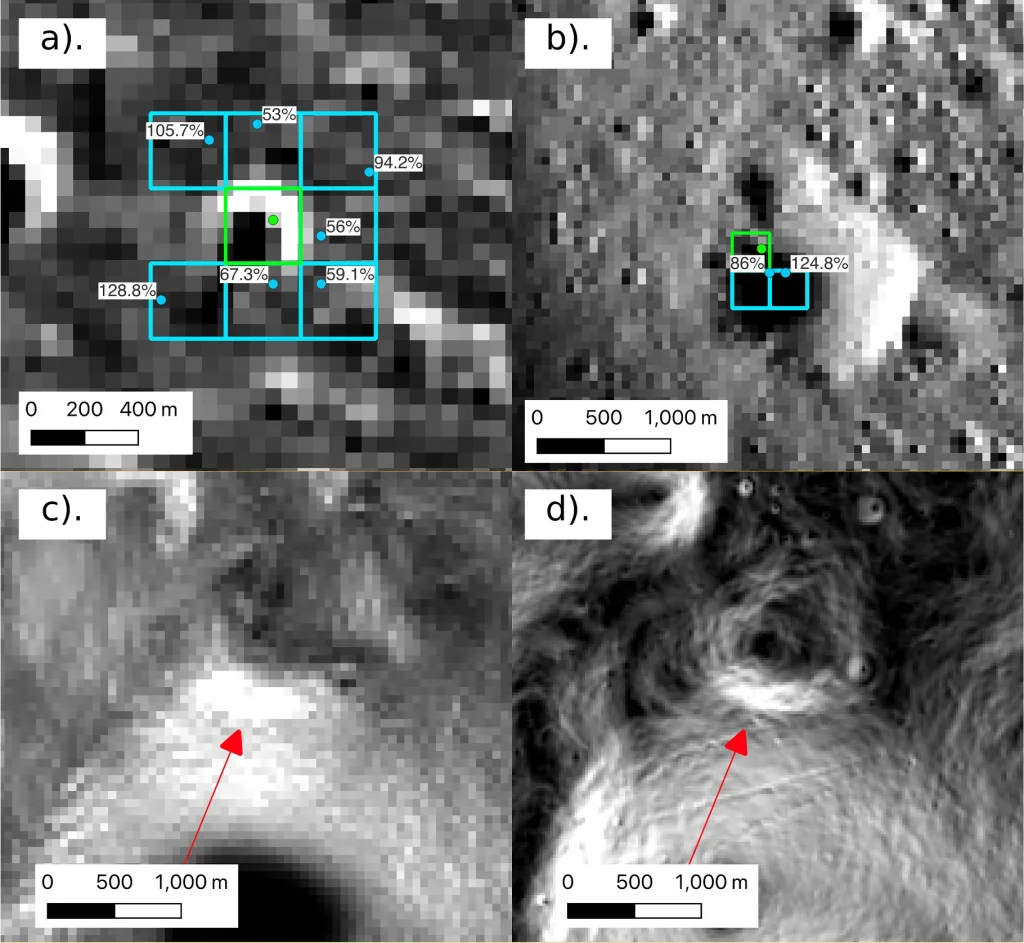
The study analyzed ShadowCam images collected from January 2023 to December 2024, constructing maximum radiance mosaics downsampled to 60 meters per pixel to map PSR brightness. These mosaics select the brightest pixel value at each location over time, reducing the impact of scattered sunlight from crater walls.
While individual sites identified by the Moon Mineralogy Mapper (M3) for potential ice showed no distinct radiance contrasts, PSRs in the north pole with M3 ice detections were 4.4 times brighter on average than those without.

ShadowCam’s visible-wavelength data (400–760 nm) was cross-referenced with M3’s infrared spectroscopy, which detects ice through absorption bands at 1.5 and 2.0 μm.
The absence of clear brightness at M3 detection sites supports prior estimates from M3 and the LCROSS mission, suggesting ice concentrations of 5–30% by weight, below the 20–30% threshold needed for a 15% brightness contrast in ShadowCam images. Analytical methods included comparing radiance distributions, examining neighboring pixels, and using bootstrapping with 2 000 iterations to assess statistical significance, revealing no notable brightness deviations at individual sites.
To explore regional ice distribution, researchers created a kernel density heatmap with a 2 km (1.2 miles) radius Epanechnikov kernel based on M3 detection locations.
This defined high-ice-probability regions (50% contour) and low-ice-probability regions (outside 5% contour), but no consistent brightness differences were found, suggesting ice is diffuse and mixed with regolith.
In contrast, PSRs at the north pole showed elevated brightness compared to the south pole, hinting at regional variations in ice presence or environmental factors.
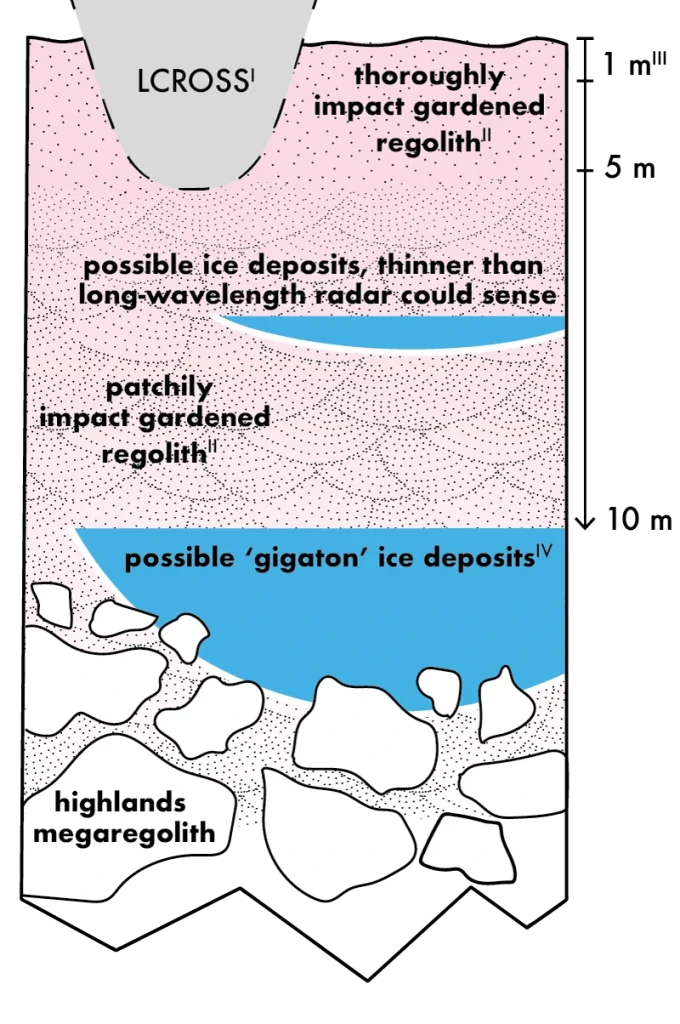
A parallel study, led by Emily S. Costello, investigated buried ice using cosmic ray radar, a novel technique that leverages ultra-high-energy cosmic rays penetrating the lunar surface. These rays generate radar waves that reflect off subsurface ice or rock layers, with simulations indicating potential detection of ice at a depth of 5–10 m (16–32 feet). The team used advanced computer models to study radar wave propagation through lunar soil, aiming to develop a dedicated radar instrument for lunar orbit, with testing planned by early 2026.
Detecting lunar ice faces multiple challenges, including low ice concentrations, complex PSR illumination from scattered sunlight, and spatial misalignment between M3’s 280-meter resolution and ShadowCam’s finer scale.
Registration errors were mitigated by expanding M3 detection areas to 1 000 m (3 280 feet), but signals may still be diluted. Unlike Mercury or Ceres, where large, pure ice deposits are visible due to minimal impact gardening, lunar ice is likely interspersed with regolith, complicating surface detection.
Future research may exploit ShadowCam’s native 1.7-meter resolution to identify small, concentrated ice patches or analyze brightness variations with sunlight phase angles, as ice exhibits stronger forward-scattering than regolith.
Integrating ShadowCam with M3’s infrared data, LAMP’s ultraviolet observations, radar, and neutron spectroscopy could enhance ice detection accuracy.
References:
1 Radiance Contrasts at Possible Lunar Water Ice Exposures Seen by ShadowCam – Jordan Ando et al. – The Planetary Science Journal – March 19, 2025 – https://doi.org/10.3847/PSJ/adb8d1 – OPEN ACCESS
2 Innovative approaches advance search for ice on the Moon – SOEST – April 22, 2025

I’m a science journalist and researcher at The Watchers, contributing to the Epicenter edition, where I cover peer-reviewed scientific research and emerging discoveries across Earth and space sciences. With a background in astronomy and a passion for environmental science, I’ve worked in shark and coral conservation in Fiji, conducting reef and shark-behavior research, contributing to mangrove restoration, and earning PADI Open Water and Coral Reef Certifications. I bring a blend of scientific rigor and storytelling to illuminate the discoveries shaping our planet and beyond.

Commenting rules and guidelines
We value the thoughts and opinions of our readers and welcome healthy discussions on our website. In order to maintain a respectful and positive community, we ask that all commenters follow these rules.