
Major X1.2 solar flare erupts from AR 3738
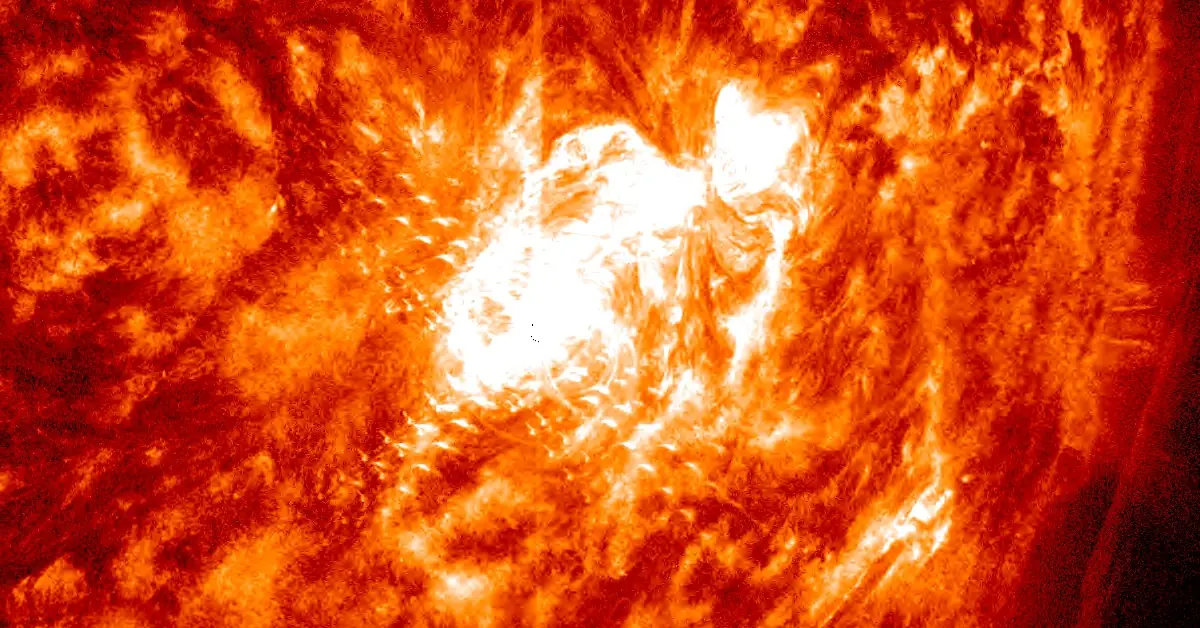
Featured image: X1.2 solar flare on July 14, 2024. Credit: NASA SDO/AIA 304, Helioviewer, The Watchers.
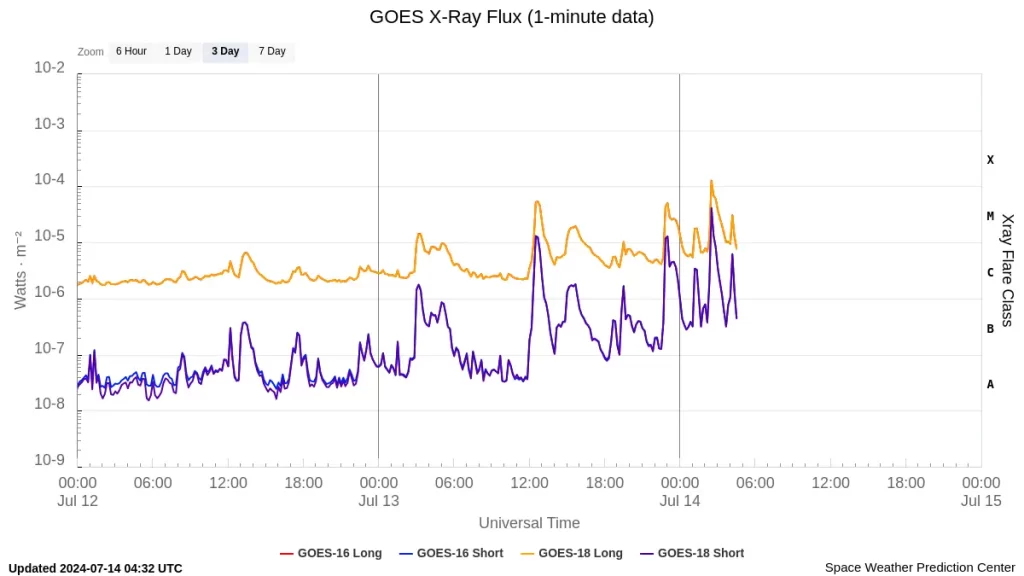
A major solar flare measuring X1.2 erupted from Active Region 3738 at 02:34 UTC on July 14, 2024. The event started at 02:23 and ended at 02:48 UTC.
A 10cm Radio Burst (tenflare), lasting 4 minutes and with a peak flux of 380 sfu, was associated with this event. This indicates that the electromagnetic burst associated with a solar flare at the 10cm wavelength was double or greater than the initial 10cm radio background. It can be indicative of significant radio noise in association with a solar flare. This noise is generally short-lived but can cause interference for sensitive receivers including radar, GPS, and satellite communications.
Type II and IV radio bursts, strong indicators of CME, were not detected during this event.
Radio signatures were forecast to be most degraded over East Asia, Australia, and the Pacific Ocean at the time of the flare.
This is the 54th solar flare of Solar Cycle 25. The last one was X1.4 on June 1.


The location of this region does not favor Earth-directed CMEs, but it has a ‘beta-gamma-delta’ magnetic configuration and is capable of producing more strong to major eruptions on the Sun.
At 12:42 UTC on July 13, it produced an M5.3 solar flare, associated with a Type II radio emission (estimated veolocity 297 km/s), however, no discernable CMEs were observed in subsequent coronagraph imagery. At 23:01 UTC on July 13, Region 3738 also produced an impulsive M5.0.
The geomagnetic field is quiet at the time, but could reach unsettled to active levels, with the potential for periods of G1 – Minor storming today, due to positive polarity coronal hole high speed stream (CH HSS) influences.

Teo Blašković founded The Watchers in 2011 and edited it until 2026, covering seismic and volcanic activity, extreme weather, space weather and near-Earth objects. Articles on this page are his archive.
